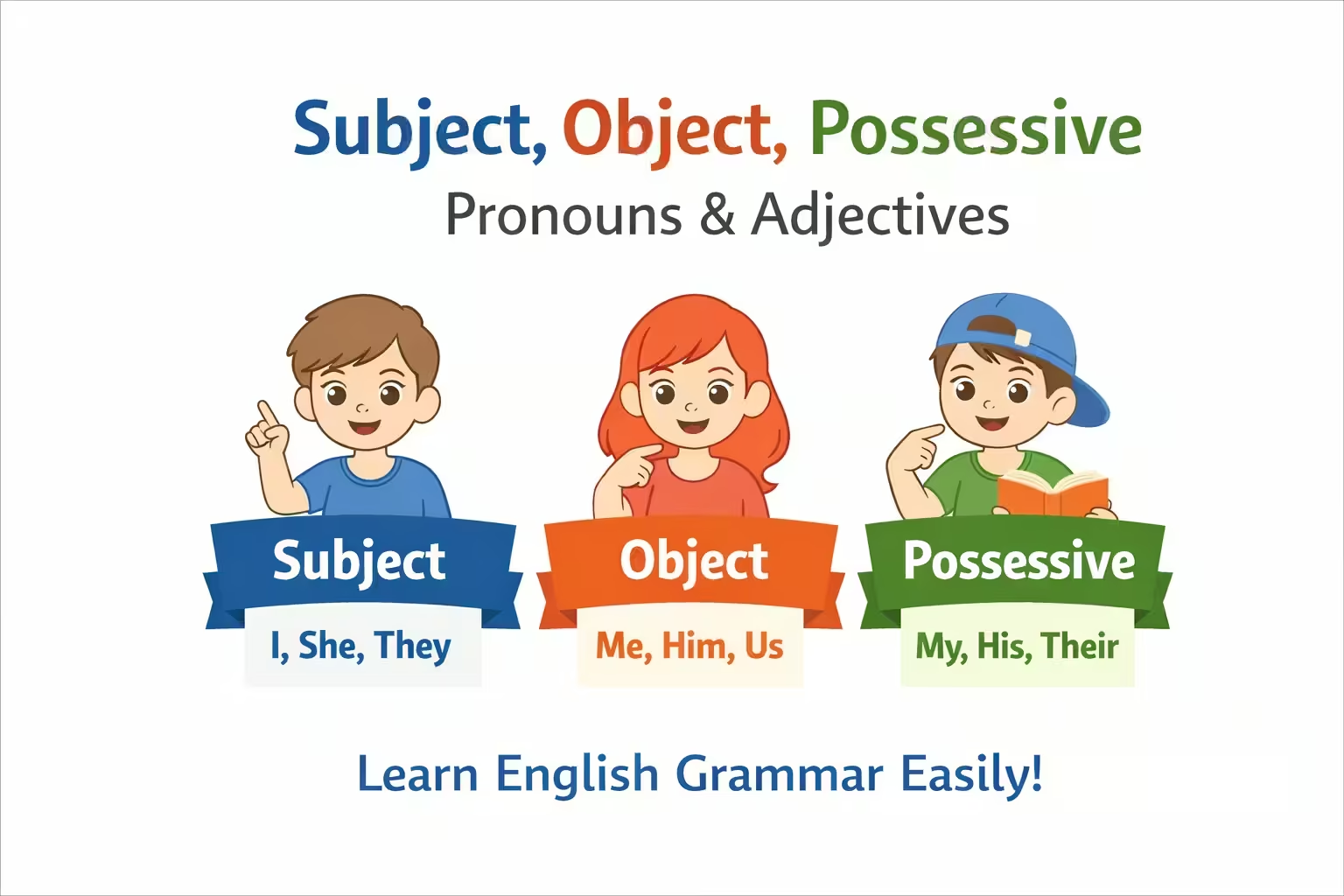
Introduction: Why Pronouns and Possessives Trip Up So Many Learners
Have you ever said “Me and my friend went to the market” — and then wondered if that was correct? Or maybe you wrote “Her book is better than my” and felt something was off but couldn’t explain why?
You are not alone. Subject, object, possessive pronouns and adjectives are among the most commonly misused parts of English grammar — for native speakers and ESL learners alike. When you don’t understand these three types clearly, your sentences can sound awkward, confusing, or just plain wrong.
The good news? Once you learn the difference between them, everything clicks. I will help you understand subject pronouns, object pronouns, and possessive pronouns and adjectives in plain, simple English — with examples, common mistakes, practice exercises, and tips you can use right away.
Let’s get started.
Find more grammar posts in English Grammar category.
What Are Pronouns? A Quick Refresher
Before we dive into the three types, let’s make sure we’re on the same page about what a pronoun is.
A pronoun is a word that replaces a noun (a person, place, or thing) to avoid repetition.
Instead of saying:
“Maria called Maria’s mother because Maria was late.”
We say:
“Maria called her mother because she was late.”
The words her and she are pronouns. They replace the name “Maria” and make the sentence sound natural.
Now, there are three main types of pronouns you need to know: subject pronouns, object pronouns, and possessive pronouns. There is also a related form called a possessive adjective, which works slightly differently. We’ll cover all four clearly.
Subject Pronouns: Who Is Doing the Action?
A subject pronoun tells us who is performing the action in a sentence. It is the “doer.”
The Subject Pronouns in English
| Subject Pronoun | Example |
|---|---|
| I | I am learning English. |
| You | You speak very well. |
| He | He works at a hospital. |
| She | She loves reading. |
| It | It is raining outside. |
| We | We are going to the store. |
| They | They finished the project. |
How to Identify a Subject Pronoun
Ask yourself: Who is doing the action? That word is your subject pronoun.
- “She cooks dinner every evening.” → Who cooks? She. → Subject pronoun.
- “They won the match.” → Who won? They. → Subject pronoun.
- “I forgot my umbrella.” → Who forgot? I. → Subject pronoun.
A Common Classroom Mistake
One of the most common errors I see in my classes — both in-person and online — is this:
❌ “Me and John went to the office.” ✅ “John and I went to the office.”
Why? Because me is an object pronoun (we’ll get to that in a moment). The subject of the sentence is the one doing the going, so we need I, not me.
A quick trick: remove the other person’s name and say the sentence with just the pronoun.
- “Me went to the office.” — That sounds wrong, right?
- “I went to the office.” — That sounds correct.
Use the same test every time, and you’ll rarely make this mistake again.
Object Pronouns: Who Receives the Action?
An object pronoun tells us who or what is receiving the action in a sentence. The subject does something to or for the object.
The Object Pronouns in English
| Object Pronoun | Example |
|---|---|
| Me | She called me last night. |
| You | I will help you tomorrow. |
| Him | We saw him at the market. |
| Her | He thanked her for the gift. |
| It | The dog chased it across the yard. |
| Us | The teacher praised us. |
| Them | I don’t know them very well. |
How to Identify an Object Pronoun
Ask: Who or what is receiving the action? That is your object pronoun.
- “The manager hired him.” → Who was hired? Him. → Object pronoun.
- “Can you please help us?” → Who needs help? Us. → Object pronoun.
- “I sent her a message.” → Who received the message? Her. → Object pronoun.
Object Pronouns After Prepositions
Object pronouns also appear after prepositions like with, for, to, from, about, between.
- “This is a secret between you and me.” ✅
- ❌ “This is a secret between you and I.” — This is a very common error, even among native English speakers!
The word between is a preposition, so it must be followed by an object pronoun. Me, not I.
Real Classroom Moment
In one of my online classes, a student wrote: “The teacher gave the award to he.” Another student quickly said, “That doesn’t sound right, but I don’t know why.”
Here’s the explanation I gave them:
He is a subject pronoun. After a preposition like to, you need an object pronoun. So the correct sentence is: “The teacher gave the award to him.”
Once students understand this rule, they don’t forget it.
Explore more interesting topics here:
- Negative Adjectives in English Grammar (With Meanings and Examples)
- English Grammar: Transitive and Intransitive Verbs Explained
- The Ultimate Guide to English Grammar for Learners
- Parts of Speech: The Building Blocks of English Grammar
- ChatGPT vs Grammarly: Which Is Better for English Writing?
Possessive Adjectives: Showing Ownership Before a Noun
Now we arrive at possessives — and this is where many learners get confused because there are two forms: possessive adjectives and possessive pronouns.
Let’s start with possessive adjectives, because they’re simpler.
A possessive adjective comes before a noun and shows who something belongs to.
The Possessive Adjectives in English
| Possessive Adjective | Example |
|---|---|
| My | This is my car. |
| Your | Is this your phone? |
| His | He forgot his keys. |
| Her | She loves her job. |
| Its | The cat licked its paw. |
| Our | We cleaned our room. |
| Their | They finished their homework. |
Key Point: Possessive Adjectives Always Come Before a Noun
Notice that every example above has a noun right after the possessive adjective: my car, your phone, his keys, her job. The adjective describes who owns that noun.
- “My sister is a doctor.” → My describes whose sister.
- “They lost their tickets.” → Their describes whose tickets.
- “The bird built its nest.” → Its describes whose nest.
Don’t Confuse “Its” and “It’s”
This is one of the most frequently made errors in written English:
- Its (possessive adjective) = belonging to it → “The company improved its profits.”
- It’s (contraction of “it is”) → “It’s a beautiful day.”
If you’re not sure which one to use, try replacing the word with “it is.” If the sentence still makes sense, use it’s. If it doesn’t, use its.
Possessive Pronouns: Showing Ownership Without a Noun
A possessive pronoun replaces a noun entirely. Unlike possessive adjectives, possessive pronouns stand alone — there is no noun after them.
The Possessive Pronouns in English
| Possessive Pronoun | Example |
|---|---|
| Mine | That car is mine. |
| Yours | Is this bag yours? |
| His | The blue jacket is his. |
| Hers | The red one is hers. |
| Ours | This table is ours. |
| Theirs | The corner office is theirs. |
Note: There is no possessive pronoun form for “it.”
Possessive Adjective vs. Possessive Pronoun: Side by Side
This comparison is one of the most useful things I teach in class:
| Possessive Adjective (before a noun) | Possessive Pronoun (stands alone) |
|---|---|
| This is my book. | This book is mine. |
| Is that your pen? | Is that pen yours? |
| He took his bag. | That bag is his. |
| She read her report. | The report is hers. |
| We finished our project. | The project is ours. |
| They parked their car. | That car is theirs. |
In both cases, the meaning is the same — something belongs to someone. The difference is structure. When you use a possessive adjective, you keep the noun. When you use a possessive pronoun, the noun disappears because it’s already understood.
Common Mistakes with Pronouns and Possessives
After teaching English for over ten years, I’ve seen the same errors come up again and again. Here are the most common ones — and how to fix them.
Mistake 1: Using “me” instead of “I” as the subject
❌ “Me and Sara are best friends.” ✅ “Sara and I are best friends.”
Fix: Remove the other person. “Me am a best friend” → wrong. “I am a best friend” → correct.
Mistake 2: Using “I” instead of “me” after a preposition
❌ “She sent a letter to Tom and I.” ✅ “She sent a letter to Tom and me.”
Fix: After to, for, with, between and other prepositions, always use an object pronoun.
Mistake 3: Confusing “his” (possessive adjective) with “him” (object pronoun)
❌ “Give it to him bag.” ✅ “Give it to him.” OR “Give him his bag.”
Mistake 4: Using “their” instead of “theirs”
❌ “That house is their.” ✅ “That house is theirs.”
Fix: When the noun is not present, use the possessive pronoun (theirs, not their).
Mistake 5: Writing “your” when you mean “you’re”
❌ “Your going to love this!” ✅ “You’re going to love this!”
Fix: Your is a possessive adjective. You’re is a contraction of “you are.”
Practice Exercises
Try these exercises to test what you’ve learned. The answers are below.
Exercise 1: Fill in the blank with the correct subject or object pronoun.
- _____ is my brother. (He / Him)
- Can you help _____? (I / me)
- _____ and I went to the cinema. (Her / She)
- The teacher gave _____ extra time. (we / us)
- _____ finished the report yesterday. (They / Them)
Exercise 2: Fill in the blank with a possessive adjective or possessive pronoun.
- I left _____ phone at home. (my / mine)
- That blue umbrella is _____. (her / hers)
- Is this _____ jacket? (your / yours)
- The dog hurt _____ leg. (its / it’s)
- We painted _____ house last summer. (our / ours)
Answers
Exercise 1: 1. He 2. me 3. She 4. us 5. They
Exercise 2: 1. my 2. hers 3. your 4. its 5. our
Practical Tips for Spoken English and Fluency
Understanding grammar rules is important, but using them naturally in conversation is a different skill. Here are some tips from my years of teaching spoken English:
Tip 1: Practice out loud. Say example sentences aloud every day. Your brain and mouth need to work together. The more you speak, the more natural pronouns will feel.
Tip 2: Record yourself. Use your phone to record short sentences or mini conversations. Listen back and notice if you’re using the right pronouns.
Tip 3: Use substitution drills. Take a simple sentence and swap out the nouns for pronouns. For example: “Maria called John” → “She called him.” This builds speed and confidence.
Tip 4: Read English out loud. Pick a paragraph from any English article or book. Read it out loud and notice every pronoun. Ask yourself: is this a subject, object, or possessive?
Tip 5: Don’t fear mistakes. In my classroom, I always say: mistakes are not failures — they’re feedback. Every error is a chance to learn. Keep practicing and correct yourself gently.
Quick Reference Chart: All Four Forms Together
| Person | Subject | Object | Possessive Adjective | Possessive Pronoun |
|---|---|---|---|---|
| 1st singular | I | me | my | mine |
| 2nd | you | you | your | yours |
| 3rd singular (m) | he | him | his | his |
| 3rd singular (f) | she | her | her | hers |
| 3rd singular (n) | it | it | its | — |
| 1st plural | we | us | our | ours |
| 3rd plural | they | them | their | theirs |
Save this chart. Refer to it whenever you’re unsure. Over time, you won’t need it at all — these forms will become second nature.
Conclusion: Mastering Subject, Object, and Possessive Pronouns and Adjectives
Learning to use subject, object, and possessive pronouns and adjectives correctly is one of the best investments you can make in your English skills. These small words appear in every single sentence you speak or write — and getting them right makes a big difference to how clear and professional you sound.
To quickly summarize what we’ve covered:
- Subject pronouns (I, you, he, she, it, we, they) show who is doing the action.
- Object pronouns (me, you, him, her, it, us, them) show who receives the action.
- Possessive adjectives (my, your, his, her, its, our, their) come before nouns and show ownership.
- Possessive pronouns (mine, yours, his, hers, ours, theirs) stand alone and replace the noun entirely.
Remember: progress takes time and consistent practice. Don’t try to memorize everything in one day. Review the chart, do the exercises, speak out loud, and most importantly — keep going. Every lesson builds on the last.
You’ve got this.
Frequently Asked Questions (FAQs)
Q1: What is the difference between a possessive adjective and a possessive pronoun?
A possessive adjective comes before a noun (e.g., “my book”), while a possessive pronoun stands alone in place of the noun (e.g., “the book is mine”). The key test: if there’s a noun right after it, it’s an adjective. If it stands alone, it’s a pronoun.
Q2: Why do people say “between you and I” when it should be “between you and me”?
This is a case of overcorrection. Many people are taught that “you and I” is more formal than “you and me,” and they apply this rule too broadly. However, after a preposition like between, you always need an object pronoun — so “between you and me” is correct.
Q3: Is “their” ever correct when referring to one person?
Yes! In modern English, “they/them/their” is increasingly used as a singular pronoun when referring to a person whose gender is unknown or nonbinary. For example: “Someone left their bag in the classroom.” This is widely accepted in both spoken and written English today.
Q4: How can ESL learners practice subject and object pronouns quickly?
One of the fastest methods is the substitution drill: take any sentence and replace the nouns with pronouns. For example, “The manager told the employee to submit the report” becomes “She told him to submit it.” Do five sentences a day, and you’ll be fluent with pronouns within weeks.
Q5: What is the most common pronoun mistake in formal writing?
The most frequent error in formal writing is using “I” where “me” is required — especially in phrases like “for you and I” or “between Sarah and I.” Always remember: after prepositions, use object pronouns (me, him, her, us, them).
📚 Continue Learning English
Choose your next lesson and keep improving your English skills with our free English learning resources.
