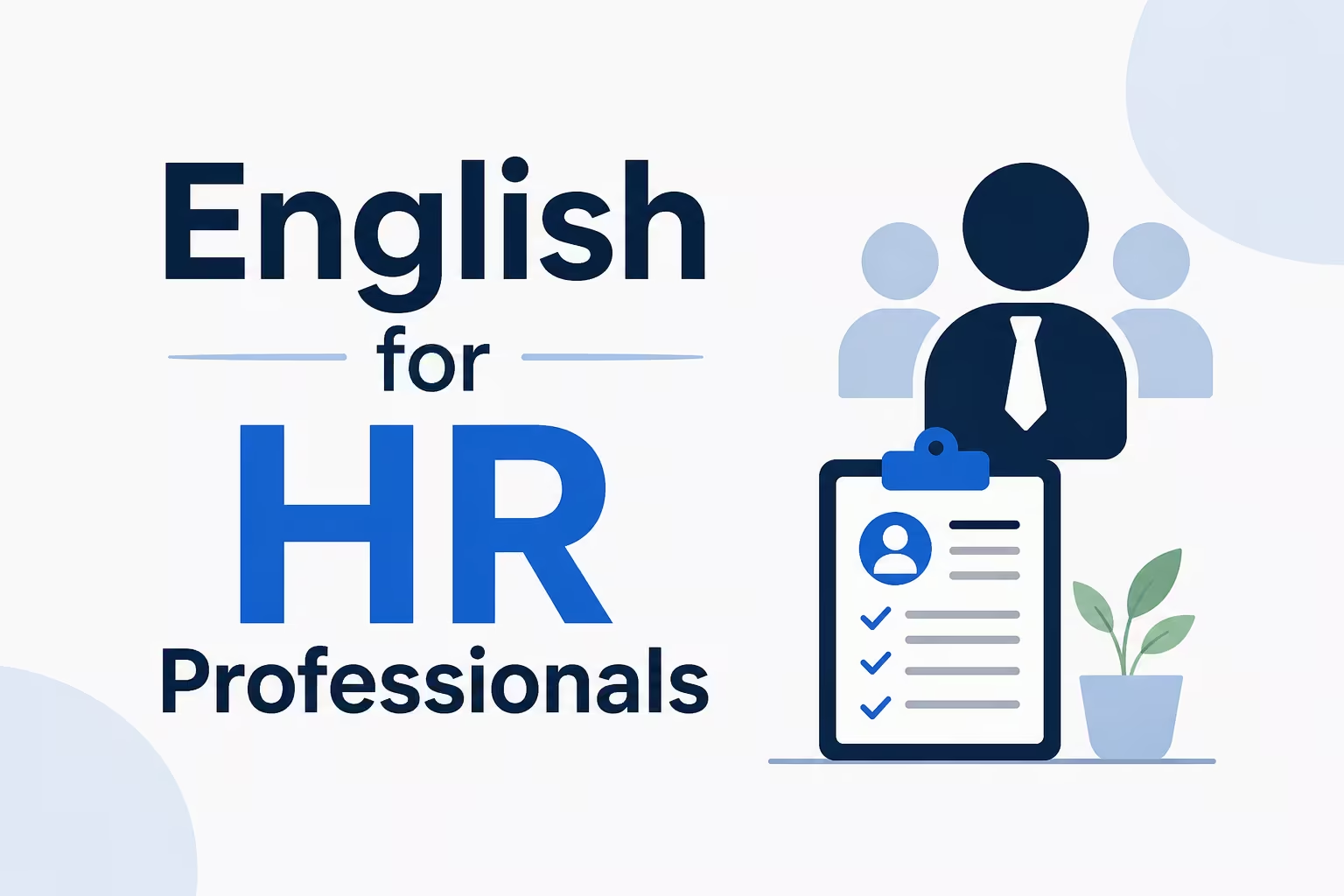
Introduction: Why HR English Can Make or Break Your Career
Imagine walking into a job interview feeling confident. You know your skills. You have the experience. But when the HR manager asks a question, you freeze. You understand the words — but you are not sure how to answer professionally.
This happens to many ESL learners and non-native English speakers every day.
English for HR professionals is not just about grammar. It is about knowing the right words, the right tone, and the right phrases for real workplace situations. Whether you are an HR manager, a job seeker, or someone who works with people every day — this guide is for you.
By the end of this post, you will know how to speak, write, and communicate like a confident HR professional in English.
What Is English for HR Professionals?
English for HR professionals refers to the specific vocabulary, phrases, and communication skills used in human resources settings.
HR stands for Human Resources. HR professionals handle people at work. They hire new employees, write job descriptions, conduct interviews, manage conflicts, and communicate company policies.
Because HR involves so much communication, strong English skills are essential.
English for HR includes:
- Job posting language — how to write clear and attractive job ads
- Interview English — how to ask and answer interview questions
- Email writing — how to write professional HR emails
- Policy language — how to explain company rules clearly
- Performance review language — how to give and receive feedback professionally
- Conflict resolution phrases — how to handle workplace problems diplomatically
This type of English is also called “Business English” or “Workplace English.” But HR English is more specific. It focuses on people, communication, and professional relationships.
Why English for HR Professionals Is Important
HR is the bridge between a company and its employees. If communication breaks down, everything suffers.
Here is why strong HR English skills matter:
1. Clearer Hiring Processes
When HR professionals write clear job descriptions, they attract the right candidates. Vague language causes confusion and wastes time.
2. Better Interviews
Knowing the right questions to ask — and the right way to answer them — makes interviews more effective and fair.
3. Stronger Employee Relationships
Good English helps HR managers explain policies, handle complaints, and support employees — without misunderstandings.
4. Professional Image
Companies with HR teams that communicate well appear more trustworthy and organized. This builds the company’s reputation.
5. Global Workplaces
Today, many companies are international. HR professionals who speak clear English can work with people from all over the world.
Key Vocabulary for HR Professionals
Learning the right vocabulary is the first step. Here are the most important HR English words and phrases you need to know.
Recruitment and Hiring Vocabulary
- Job opening / vacancy — a position that needs to be filled
- Applicant / candidate — a person who applies for a job
- Resume / CV — a document listing your work experience and education
- Cover letter — a letter explaining why you want a job
- Shortlist — a small group of top candidates selected for interviews
- Job offer — an official invitation to work for a company
- Onboarding — the process of welcoming and training a new employee
Example sentence:
“We have shortlisted five candidates for the final round of interviews.”
Interview Vocabulary
- Competency-based questions — questions that ask about past experience
- Panel interview — an interview with more than one interviewer
- Follow-up — contacting someone after the interview
- Reference — a person who can speak about your work skills
Example sentence:
“Can you give me an example of a time you resolved a conflict at work? This is a typical competency-based interview question.”
Employee Relations Vocabulary
- Grievance — a formal complaint from an employee
- Performance review — a regular evaluation of an employee’s work
- Appraisal — another word for performance review
- Probation period — a trial period for new employees
- Termination — ending someone’s employment
- Resignation — when an employee decides to leave a job
Example sentence:
“Your probation period will last three months. After that, we will conduct a full performance review.”
Essential HR Phrases and Sentences
Vocabulary alone is not enough. You also need to know how to use these words in real sentences.
Phrases for Job Interviews
For HR managers asking questions:
- “Could you walk me through your work experience?”
- “What are your strengths and areas for improvement?”
- “Why do you want to work with us?”
- “Can you describe a challenging situation and how you handled it?”
For candidates answering questions:
- “In my previous role, I was responsible for…”
- “One of my key strengths is…”
- “I am looking for an opportunity where I can…”
- “I handled that situation by first…”
Phrases for HR Emails
Opening an email:
- “I am writing to inform you about…”
- “Please find attached the information you requested.”
- “Further to our conversation…”
Confirming interviews:
- “We would like to invite you for an interview on [date].”
- “Please confirm your availability at your earliest convenience.”
Rejecting candidates politely:
- “Thank you for your interest in this position.”
- “After careful consideration, we have decided to move forward with another candidate.”
- “We will keep your profile on file for future opportunities.”
Welcoming new employees:
- “We are delighted to have you join the team.”
- “Please do not hesitate to reach out if you have any questions.”
Writing Job Descriptions in English
A good job description attracts the right people. A bad one wastes everyone’s time. Here is how to write one clearly.
Structure of a Good Job Description
- Job Title — clear and simple
- Company Overview — one or two sentences about your company
- Role Summary — what the job involves
- Key Responsibilities — listed with bullet points
- Required Qualifications — must-have skills
- Preferred Qualifications — nice-to-have skills
- What We Offer — salary, benefits, work environment
Tips for Clear Job Description Writing
- Use simple, direct language
- Avoid jargon and overly technical words
- Use action verbs like “manage,” “coordinate,” “develop,” “support”
- Keep sentences short and focused
- Be specific — avoid phrases like “good communication skills” without context
Example of a weak sentence:
“The candidate must possess excellent interpersonal communication competencies.”
Better version:
“You will communicate clearly with team members and clients every day.”
Common Mistakes HR Professionals Make in English
Even experienced professionals make these mistakes. Knowing them helps you avoid them.
Mistake 1: Using Too Much Jargon
HR language can become too formal or full of buzzwords. Words like “synergy,” “leverage,” and “holistic approach” confuse people.
Fix: Use plain English whenever possible.
Mistake 2: Vague Feedback
Saying “your performance needs improvement” is not helpful. Employees need specific examples.
Fix: “In the last quarter, three project deadlines were missed. Let us talk about how to improve time management.”
Mistake 3: Passive Language in Rejection Emails
“You have not been selected” sounds cold. It does not acknowledge the candidate’s effort.
Fix: “We truly appreciated your time and the effort you put into this process.”
Mistake 4: Skipping Confirmation Details
Many HR emails forget to include the date, time, location, or name of the interviewer.
Fix: Always include the full details — date, time, location, contact person, and any documents the candidate should bring.
Mistake 5: Not Proofreading
Spelling mistakes in official HR documents make a company look unprofessional.
Fix: Always proofread emails and documents before sending. Use tools like Grammarly if needed.
Step-by-Step Tips to Improve Your HR English
Follow these practical steps to build your confidence and skill.
Step 1: Learn 10 New HR Words Every Week
Start with the vocabulary list in this article. Add new words each week. Write them in sentences to remember them better.
Step 2: Read Real HR Documents
Find real job descriptions, HR policy templates, and employee handbooks online. Notice how they are written. Pay attention to vocabulary and structure.
Step 3: Practice Writing HR Emails
Write a practice email every day. Try different types — a job offer, an interview invitation, a rejection letter. Then check your writing or ask someone to review it.
Step 4: Watch HR Videos in English
YouTube has many HR training videos in English. Watching these helps you hear how HR professionals speak naturally.
Step 5: Role-Play Interview Conversations
Practice with a friend or language partner. One person plays the HR manager. The other plays the candidate. This builds real speaking confidence.
Step 6: Use Templates
Start with templates for emails and documents. Over time, you will learn to customize them and write from scratch.
Step 7: Focus on Listening
Understanding is just as important as speaking. Listen carefully in meetings. Take notes. Ask for clarification if you miss something — “Could you please repeat that?” is always acceptable.
Real-Life HR Situations in English
Let us look at real situations you might face and how to handle them in English.
Situation 1: Conducting a Job Interview
HR Manager: “Welcome, Priya. Thank you for coming in today. Could you start by telling me a little about yourself?”
Candidate: “Of course. I have five years of experience in customer service, and I am now looking to transition into a more people-focused role in HR.”
HR Manager: “That sounds great. Can you tell me about a time you handled a difficult situation at work?”
Candidate: “Certainly. In my last role, a team member and a client had a misunderstanding. I arranged a meeting, listened to both sides, and helped them find a resolution that worked for everyone.”
Situation 2: Explaining a Company Policy
“Good morning everyone. I would like to explain our new remote work policy. Starting next month, all employees may work from home up to two days per week. Requests must be submitted to your manager every Friday for the following week. Please check the employee handbook for full details.”
Situation 3: Giving a Performance Review
“Thank you for meeting with me today. Overall, your performance this quarter has been strong. You consistently meet deadlines and communicate well with the team. One area we would like to see improvement in is report accuracy. Let us set a goal together for the next quarter.”
Expert Tips for HR English Success
These expert-level tips will help you go beyond basics and truly stand out.
- Mirror professional language: Read HR blogs, LinkedIn posts, and business news. Notice the phrases professionals use and try them in your own writing.
- Be culturally aware: HR English varies slightly between countries. UK English uses “CV” while American English uses “resume.” Be aware of these differences.
- Avoid discriminatory language: Good HR English is inclusive. Do not use language that could be offensive or biased. Use gender-neutral terms like “they” instead of assuming gender.
- Develop your active listening skills: In HR, listening is as important as speaking. Show you are listening by nodding, taking notes, and summarizing what you have heard.
- Ask for feedback: Request feedback on your written English from native speakers or colleagues. Improvement comes faster with honest feedback.
Frequently Asked Questions About English for HR Professionals
1. What is English for HR professionals?
It is the specific vocabulary, phrases, and communication skills used in human resources roles, including interviewing, writing job descriptions, and managing employee relations.
2. Do I need perfect English to work in HR?
No. You need clear, professional, and confident English — not perfect grammar. Focus on communication, not perfection.
3. What are the most important HR English skills?
The most important skills are writing professional emails, conducting interviews, explaining policies clearly, and giving constructive feedback.
4. How can I learn HR vocabulary quickly?
Read real job postings, HR policy documents, and business English textbooks. Practice using new words in sentences every day.
5. What are common HR interview questions in English?
Common questions include: “Tell me about yourself,” “What are your strengths?” “Describe a challenging situation,” and “Why do you want this job?”
6. How do I write a professional HR email in English?
Start with a clear subject line. Use a polite greeting. State your purpose early. Keep sentences short. End with a professional closing.
7. What is onboarding in HR English?
Onboarding is the process of welcoming, training, and integrating a new employee into the company.
8. How do I reject a candidate politely in English?
Thank them for their time, let them know the decision, and encourage them to apply again in the future. Keep the message warm and professional.
9. What does “shortlisting” mean in HR?
Shortlisting means selecting the top candidates from all applicants to invite for an interview.
10. What is a performance appraisal?
A performance appraisal is a formal review of an employee’s work over a set period. It usually includes feedback, goals, and sometimes salary decisions.
11. How do I improve my English for job interviews?
Practice common interview questions out loud. Record yourself and listen back. Ask a friend or teacher to role-play interviews with you.
12. What does “grievance” mean in HR?
A grievance is a formal complaint made by an employee about a workplace issue such as unfair treatment or policy violations.
13. Is HR English different from general business English?
Yes. HR English focuses specifically on people, recruitment, employee relations, and workplace communication. It has its own vocabulary and context.
14. Can ESL learners work in HR roles?
Absolutely. Many ESL speakers work successfully in HR. Strong communication, empathy, and a willingness to keep learning are more important than a perfect accent.
15. Where can I practice HR English online?
You can practice through LinkedIn Learning, business English YouTube channels, HR podcasts, and online courses focused on workplace communication.
Summary and Key Takeaways
Here is a quick review of everything you have learned:
- English for HR professionals covers recruitment, interviewing, emailing, policy communication, and performance reviews.
- Learning key HR vocabulary is the foundation — words like vacancy, onboarding, appraisal, and grievance are used every day.
- Professional email writing is one of the most important HR skills. Keep emails clear, polite, and detailed.
- Job descriptions should use simple language, action verbs, and bullet points.
- Avoid common mistakes like vague feedback, jargon overload, and missing details in emails.
- Practice daily — through role-play, reading, and writing — to build confidence fast.
- Real HR communication is warm, clear, and respectful. Always put people first.
Conclusion: Start Speaking HR English with Confidence Today
English for HR professionals does not have to be complicated. With the right vocabulary, the right phrases, and daily practice, you can communicate confidently in any HR situation.
Whether you are preparing for a job interview, writing your first HR email, or training to work in human resources — the skills in this guide will help you get there.
Start small. Learn five new words this week. Write one practice email tomorrow. Role-play one interview conversation this weekend.
Every step forward builds your confidence. And confidence is what makes a great HR professional.
Ready to take the next step? Explore more guides on business English, workplace communication, and career development to sharpen your skills and grow your professional English even further.
Recommended posts:
- English for School Students: The Complete Guide to Learn, Improve, and Succeed
- English for Content Creators: The Complete Guide to Writing, Speaking, and Growing Online
- English for LinkedIn Networking: The Complete Guide for ESL Learners and Job Seekers
- English for Getting a Job: The Complete Guide for ESL Learners and Job Seekers
- English for Online Teaching: The Complete Guide for Beginners and Professionals
- English for Online Jobs: The Complete Guide for ESL Learners and Job Seekers
📚 Continue Learning English
Choose your next lesson and keep improving your English skills with our free English learning resources.