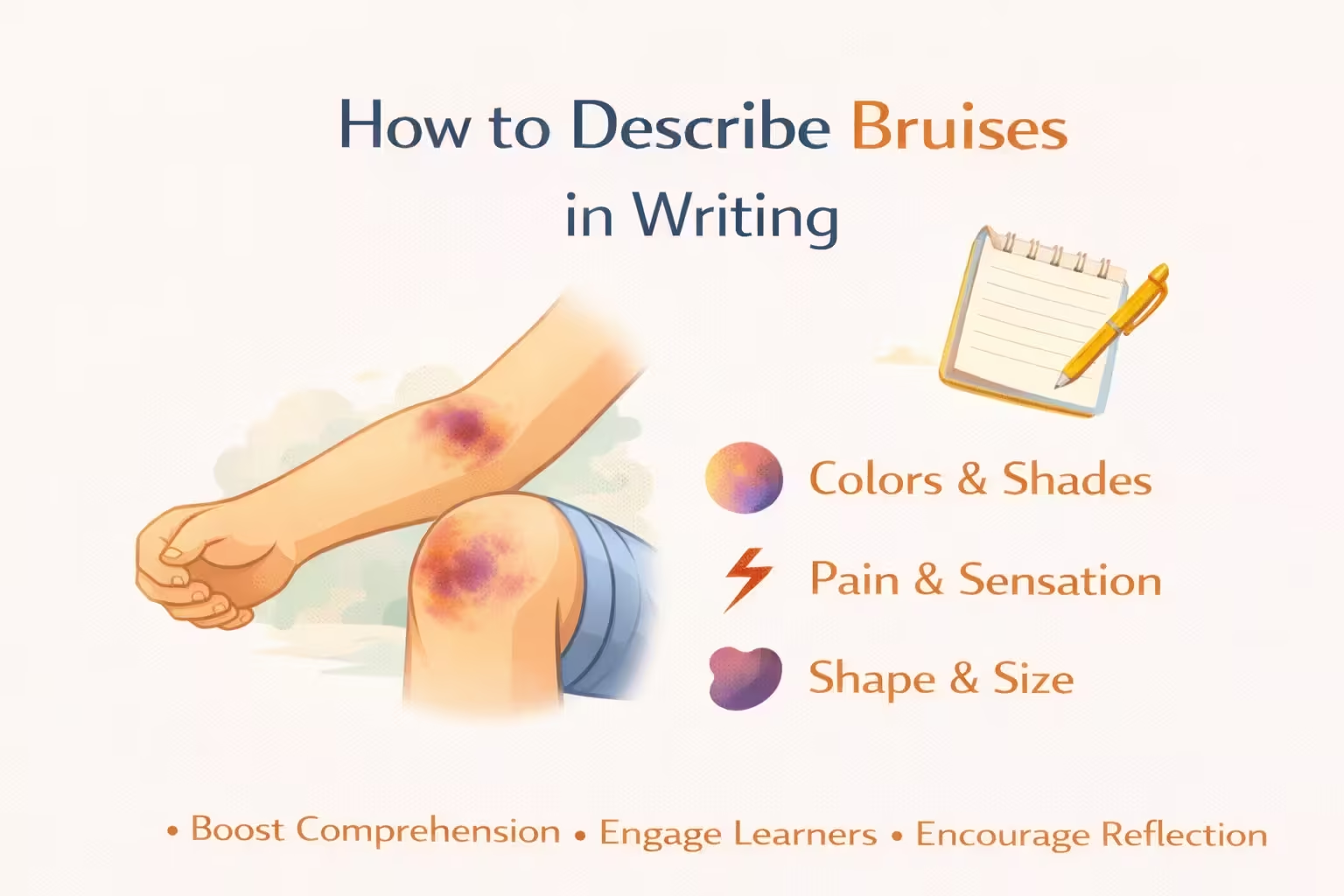
Have you ever struggled to describe a bruise in your story, medical report, or creative writing assignment? You’re not alone. After teaching English writing for over twelve years, I’ve noticed students often repeat the same basic words: “blue,” “purple,” or “painful.” While these words aren’t wrong, they don’t create vivid pictures in readers’ minds.
Learning how to describe bruises in writing effectively helps you create more realistic characters, write better medical documentation, craft compelling fiction, and improve your overall descriptive writing skills. Whether you’re a student working on a creative writing piece, an ESL learner building vocabulary, or a professional documenting injuries, this guide will teach you practical techniques with clear examples you can use immediately.
Why Accurate Bruise Description Matters in Writing
In my writing workshops, I often ask students: “Why does description matter?” The answer is simple—good description brings your writing to life.
When you describe bruises accurately, you:
- Help readers visualize scenes clearly: Instead of just saying “she had a bruise,” you paint a complete picture
- Add realism to medical or incident reports: Precise description provides important details for documentation
- Create emotional impact in stories: A well-described injury makes readers feel something
- Build more believable characters: Realistic physical details make fictional people seem real
- Demonstrate strong vocabulary skills: Teachers and employers notice detailed, specific writing
I remember one student, Maria, who was writing a personal statement for nursing school. Her first draft said, “The patient had bruises on her arm.” After our session on descriptive writing, she revised it to: “Dark purple bruises, some fresh and tender, others fading to greenish-yellow, covered her forearm.” The difference was remarkable—her writing suddenly showed observation skills essential for healthcare.
Understanding Bruise Basics Before You Describe Them
Before we dive into description techniques, let’s understand what bruises actually are. This knowledge will make your descriptions more accurate and believable.
A bruise (also called a contusion) happens when small blood vessels under the skin break, usually from impact or pressure. Blood leaks into surrounding tissue, creating the discoloration we see. This is why bruises change color over time—your body is gradually breaking down and reabsorbing that blood.
This biological process creates a predictable pattern that good writers should know:
Fresh bruises (0-2 days): Usually red or dark purple-blue because the blood is fresh and oxygen-rich. The area is often swollen and very tender to touch.
Developing bruises (2-5 days): Turn darker blue or purple as blood loses oxygen. Swelling may persist, and the bruise feels firm.
Healing bruises (5-10 days): Begin showing green or yellow tones around the edges as the body breaks down hemoglobin. The center may still appear dark.
Old bruises (10-14 days): Fade to yellowish-brown or light brown before disappearing completely. Usually no longer painful.
Understanding this timeline helps you write realistic descriptions that match your story’s timeframe or report’s accuracy needs.
The Five Senses Approach to Describing Bruises
In my classroom, I teach what I call the “Five Senses Method” for descriptive writing. While you won’t always use all five senses for bruises, thinking through each sense helps you create richer, more complete descriptions.
Visual Description (What You See)
This is usually the primary way we describe bruises. Focus on:
Color: Instead of just “blue,” be specific. Is it navy blue, midnight blue, or purple-blue? Fresh bruises might be “deep plum” or “wine-dark.” Healing bruises could be “sickly yellow-green” or “faded mustard yellow.”
Size and Shape: Compare to familiar objects. “A bruise the size of a golf ball” or “finger-shaped marks” or “a sprawling bruise covering most of his bicep.”
Texture and Definition: Are the edges sharp and defined, or do they fade gradually? Is the bruise flat or raised?
Example: “An angry purple bruise, roughly the size of a tennis ball, bloomed across her knee. The edges blurred into lighter violet, like watercolor bleeding on paper.”
Touch Description (What You Feel)
Even if characters aren’t touching the bruise, describing how it would feel adds dimension:
- Tender, swollen, firm
- Hot or warm to touch (fresh bruises)
- Sensitive, painful when pressed
- Hard lump underneath (deeper tissue damage)
Example: “He winced when his fingers grazed the swollen bruise on his ribs—even the lightest touch sent sharp pain radiating across his chest.”
Combined Sensory Description
The strongest descriptions often combine visual and tactile elements:
Example: “Dark purple-black bruises ringed her wrist like bracelets, the skin puffy and hot. Each mark was roughly thumb-width, painful even without direct pressure.”
Color Vocabulary: Beyond “Blue” and “Purple”
One of the most common problems I see in student writing is limited color vocabulary. Let’s expand your word bank with specific, vivid color descriptions organized by bruise stage.
Fresh Bruise Colors
Instead of generic terms, try these specific descriptions:
- Deep crimson
- Dark wine red
- Plum purple
- Eggplant purple
- Navy blue
- Midnight blue
- Purple-black
- Blue-black
- Inky blue
Mid-Healing Bruise Colors
- Royal purple
- Violet
- Deep indigo
- Slate blue
- Stormy blue
- Dusty purple
- Blue-grey
Late-Healing Bruise Colors
- Olive green
- Moss green
- Sickly green
- Yellow-green
- Chartreuse
- Mustard yellow
- Pale yellow
- Greenish-yellow
- Brown-yellow
- Faded amber
Fading Bruise Colors
- Tan
- Light brown
- Yellowish-brown
- Faint yellow
- Dirty beige
Practice Tip: I always tell my students to create comparison sentences. Don’t just say “green”—say “green like old celery” or “the yellow of a fading banana peel.” These comparisons help readers instantly visualize the exact shade you mean.
Explore more interesting topics here:
- 150+ Best Transition Words and Phrases for Writing
- What Is a Content Writing Job? (Definition and Examples)
- The Complete Guide to Academic and Professional Writing
- English Grammar Rules for Writing Formal Emails
- ChatGPT vs Grammarly: Which Is Better for English Writing?
Size and Shape Descriptions That Work
Size matters in bruise description, but avoid vague terms like “big” or “small.” Instead, use concrete comparisons and measurements.
Size Comparisons
Use everyday objects readers can immediately visualize:
- “The size of a quarter”
- “About as large as my palm”
- “A bruise spreading across an area the size of a dinner plate”
- “Small, dime-sized marks”
- “As big around as a baseball”
- “Covering an area roughly the size of a smartphone screen”
Shape Descriptions
Shapes tell stories about how the bruise happened:
- Round or oval: Blunt impact from a single object
- Finger-shaped: Grabbing or gripping
- Linear or stripe-like: Impact from a narrow object
- Irregular or sprawling: Fall or large surface impact
- Clustered: Multiple impacts in one area
Example: “Four oval bruises, each about the size of a grape, dotted her upper arm in a pattern that clearly showed someone’s grip.”
Location-Specific Bruise Descriptions
Different body areas bruise differently, and mentioning location adds important context. In my years teaching medical writing students, I’ve learned that location details matter tremendously for accuracy.
Common Bruise Locations and How to Describe Them
Arms and hands: “Defensive bruises scattered across her forearms” or “A deep purple bruise mottled his knuckles”
Legs: “His shin bore a nasty purple-blue bruise, swollen and tender” or “The bruise on her thigh had spread, creating a map of purple and yellow”
Face: “A greenish-yellow bruise shadowed his cheekbone” or “Dark purple discoloration ringed her eye, the swelling nearly closing it shut”
Torso: “Bruises bloomed across his ribs like dark flowers” or “A large, irregularly shaped bruise spread across her lower back”
Describing Distribution: Sometimes bruises appear in patterns. You might describe them as “scattered,” “clustered,” “isolated,” or “widespread.”
Adding Emotional and Physical Context
Pure physical description is important, but adding context makes your writing more engaging and meaningful. This is where many of my creative writing students really improve their work.
Physical Sensations
Don’t just describe how bruises look—describe how they affect the person:
- “The bruise throbbed with each heartbeat”
- “Sharp pain radiated from the tender purple mark whenever he moved”
- “The swollen bruise made it painful to grip anything”
- “Stiffness spread from the bruised area, limiting her range of motion”
Emotional Impact
How does the person feel about the bruise? This adds depth to character writing:
- “She touched the bruise gingerly, embarrassed by the questions it would invite”
- “He stared at the darkening marks, anger rising in his chest”
- “The small bruises were badges she wore proudly after her first boxing class”
Contextual Details
Explain how the bruise happened or its significance:
Example: “The fingerprint bruises on her wrist were three days old—fading from deep purple to sickly yellow-green—but still tender when she accidentally bumped them against the desk.”
Writing Different Types of Bruise Descriptions
The way you describe bruises should match your writing purpose. I teach my students to adjust their style based on what they’re writing.
Creative Writing and Fiction
For stories, use vivid, sensory language that creates emotional impact:
Example: “Dark purple bruises, fresh and angry, bloomed across his jaw like poisonous flowers. Each one told a story he wasn’t ready to share. When Sarah’s fingers moved toward his face, he flinched—not from pain, but from the tenderness in her eyes.”
Medical or Professional Documentation
For reports, use precise, objective language:
Example: “Multiple contusions noted on the patient’s upper extremities. A purple-blue bruise approximately 5cm in diameter is present on the right forearm, with slight swelling and tenderness upon palpation. Additional smaller bruises (1-2cm) are visible on both forearms in various stages of healing, ranging from dark purple to greenish-yellow.”
Academic or Descriptive Essays
For essays, balance detail with clarity:
Example: “Bruises change color as they heal due to the body’s breakdown of hemoglobin. A fresh bruise appears dark purple or blue because oxygen-rich blood has pooled under the skin. As days pass, the bruise transitions through shades of green and yellow before fading completely, each color representing a different chemical stage in the healing process.”
Common Mistakes to Avoid When Describing Bruises
After reading thousands of student papers, I’ve identified several mistakes that weaken bruise descriptions. Let’s tackle these so you can avoid them.
Mistake 1: Using Only Generic Colors
Weak: “She had a blue bruise on her arm.”
Better: “A navy blue bruise, edged with lighter violet, marked her upper arm.”
Mistake 2: Ignoring the Healing Timeline
Unrealistic: “The bruise he got yesterday was yellow and fading.”
Realistic: “The bruise he got yesterday was a deep, angry purple, swollen and painful to touch.”
Mistake 3: Forgetting Physical Response
Incomplete: “There was a large bruise on his side.”
Complete: “A large purple bruise spread across his left side, making each breath a sharp reminder of yesterday’s fall.”
Mistake 4: Overusing the Same Descriptive Words
If every bruise in your writing is “purple” or “painful,” readers will tune out. Vary your vocabulary using the word banks in this guide.
Mistake 5: Being Too Vague About Size and Location
Vague: “He had bruises.”
Specific: “Three finger-width bruises, dark purple and fresh, marked his right forearm just below the elbow.”
Practical Writing Exercises to Improve Your Skills
Theory is important, but practice makes perfect. Here are exercises I use in my writing classes that consistently help students improve.
Exercise 1: Color Observation
Take a photo of a real bruise (your own or from a medical reference) and list ten different ways to describe its color without using “blue,” “purple,” or “yellow.” Push yourself to use comparisons: “the green of old lettuce,” “purple like a plum skin.”
Exercise 2: Timeline Writing
Write three separate descriptions of the same bruise at different healing stages:
- Day 1 (fresh)
- Day 5 (mid-healing)
- Day 12 (fading)
This trains you to think about realistic progression and varied vocabulary.
Exercise 3: Purpose-Based Description
Describe the same bruise three different ways:
- As it would appear in a medical report
- As you’d describe it in a short story to create sympathy for a character
- As you’d explain it in an informational article
Notice how purpose changes your word choice and sentence structure.
Exercise 4: Sensory Expansion
Take a basic sentence like “The bruise hurt.” Expand it to include visual description, tactile sensation, and emotional response in 2-3 sentences.
Real Examples from Different Writing Contexts
Let me share real examples from my students’ work (with permission) to show these techniques in action.
Example 1: Creative Fiction
From a high school student’s short story:
“Maya’s knees bore the evidence of her skateboarding ambition—a constellation of bruises in varying stages of healing. Fresh purple-blue marks, tender and swollen, overlapped with fading yellow-green remnants of last week’s falls. She wore them like badges of honor, proof she was getting braver, falling less.”
Why it works: Vivid colors, emotional context, tells us about the character’s personality.
Example 2: Personal Essay
From an ESL student’s college application essay:
“The bruise on my shin from my first soccer practice was spectacular—a deep purple spreading to the size of my hand, with edges that bled into lighter violet. It hurt every time I walked, but I found myself looking at it throughout the week, watching it transform through shades of green and yellow. That bruise taught me that healing happens in stages, and that pain is often part of growth.”
Why it works: Uses bruise description as metaphor, includes healing timeline, connects physical to emotional.
Example 3: Incident Report
From a nursing student’s clinical documentation practice:
“Patient presents with multiple contusions on bilateral upper extremities. Right forearm displays a purple-blue bruise measuring approximately 7cm x 4cm with moderate swelling and tenderness on palpation. Left forearm shows several smaller bruises (2-3cm diameter) in various stages of healing—some dark purple (recent), others greenish-yellow (7-10 days old). Patient reports all bruises resulted from falls related to mobility issues.”
Why it works: Precise measurements, objective language, includes relevant medical context.
Your Action Plan for Better Bruise Descriptions
Now that you’ve learned these techniques, here’s how to apply them immediately:
Start with observation: Before writing, visualize or observe the bruise clearly. Note color, size, shape, and location.
Choose your vocabulary carefully: Use the specific color words and size comparisons from this guide instead of generic terms.
Add context: Include how the bruise affects the person physically or emotionally, depending on your writing purpose.
Match style to purpose: Adjust your descriptive approach based on whether you’re writing fiction, documentation, or academic content.
Practice regularly: Use the exercises in this guide to build your descriptive skills systematically.
Learning how to describe bruises in writing effectively takes practice, but these techniques will immediately improve the vividness and accuracy of your work. Remember that good description serves your reader—whether that’s creating an emotional connection in a story, providing clear documentation in a report, or demonstrating vocabulary skills in an assignment.
In my years of teaching, I’ve watched hundreds of students transform their writing by simply paying attention to specific, sensory details. You can do the same. Start with one piece of writing today—maybe a story you’re working on or a practice paragraph—and apply these bruise description techniques. The difference in your writing will be noticeable right away.