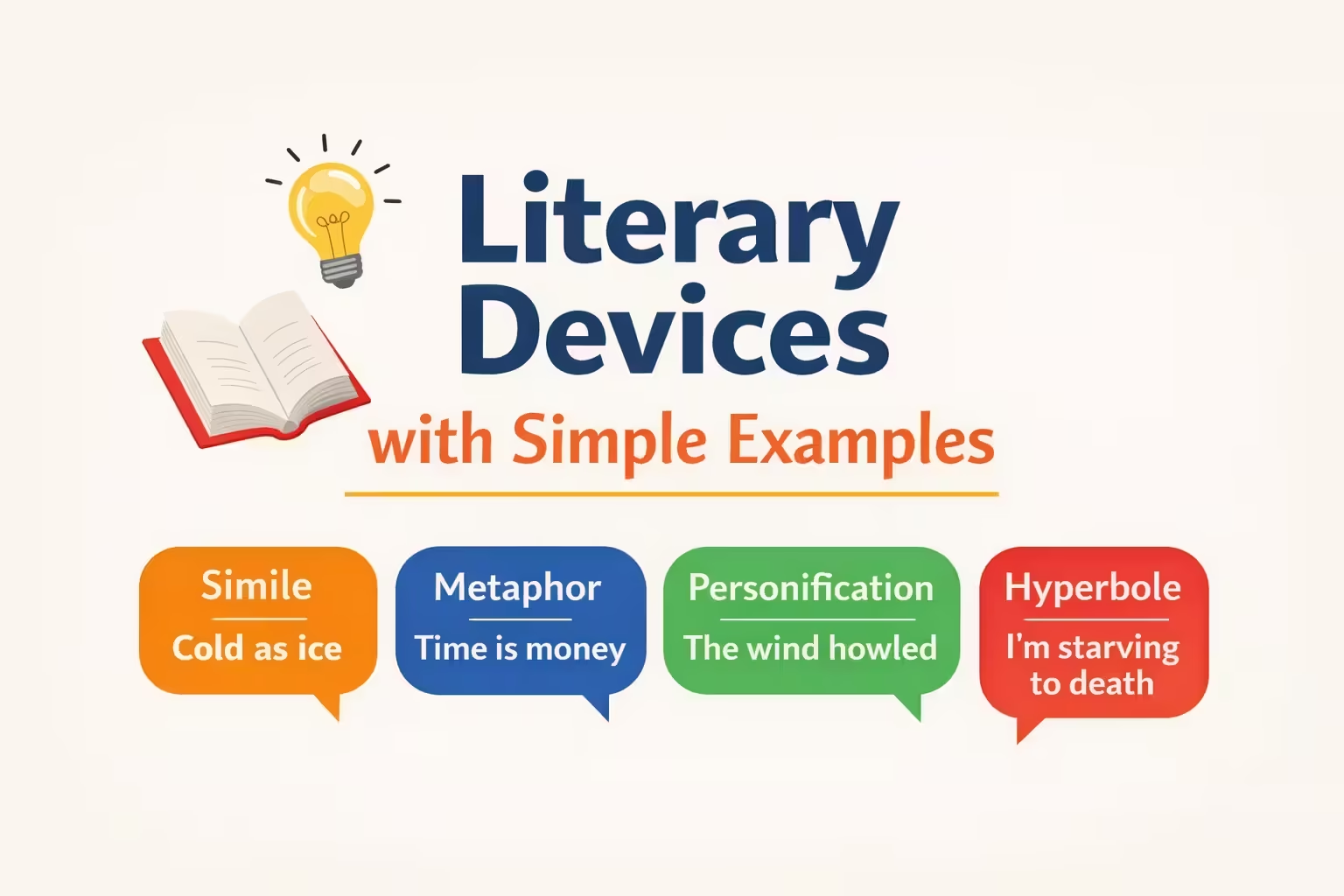
Introduction: Why Literary Devices Feel So Confusing (And How to Fix That)
If you have ever read a poem or a story and thought, “I know something special is happening here, but I don’t know what it’s called,” you are not alone. Literary devices with simple examples are one of the most searched topics by students, ESL learners, and even teachers who want a refresher. And the good news? Once you see these devices in action, they become surprisingly easy to recognize and use.
I have been teaching English for over ten years, both in physical classrooms and online. One thing I notice every single year is the same frustration: students feel intimidated by terms like “metaphor,” “alliteration,” or “irony.” They think these are complicated academic ideas meant only for university professors. But that is simply not true. These are tools that writers use to make their words more powerful, more beautiful, and more memorable. And once you learn them, you will start seeing them everywhere, from song lyrics to movie dialogues to social media captions.
I will walk you through the most important literary devices with clear, simple examples you can actually remember. I will also share classroom tips, common mistakes students make, and quick practice tasks to help you apply what you learn. Let’s get started.
What Are Literary Devices?
Literary devices are techniques or tools that writers use to tell a story or express ideas in a more effective way. Think of them like a carpenter’s tools. A hammer, a screwdriver, and a saw all do different jobs, but together they help build something great. Literary devices do the same thing for writing.
Some devices work with sound, like alliteration. Some work with meaning, like metaphor or simile. Others work with structure, like foreshadowing or flashback. All of them have one goal: to make writing more interesting and impactful.
You will find these devices in novels, poems, plays, speeches, songs, and even everyday conversation. Understanding them helps you become a better reader, a stronger writer, and a more confident communicator in English.
The Most Common Literary Devices with Simple Examples
Let us go through the most important literary devices one by one. For each one, I will give you a simple definition, a clear example, and a classroom moment from my own teaching experience.
1. Simile
A simile compares two things using the words “like” or “as.”
Simple example: “She runs as fast as a cheetah.”
Another example: “His voice sounded like thunder.”
In my classroom, I always introduce similes first because they feel the most natural. Students immediately connect with them. I once asked a class to describe their Monday mornings using a simile. One student said, “Monday feels like a wet sock.” Everyone laughed, but that student had just created a perfect simile. That is the kind of creative thinking these devices unlock.
Why it works: Similes help your reader picture something more clearly. Instead of saying “he was angry,” you say “he was as angry as a bull.” The image sticks.
Quick practice: Complete these sentences.
- The baby’s skin is as soft as __________.
- Life without music is like __________.
2. Metaphor
A metaphor also compares two things, but without using “like” or “as.” It says one thing IS another thing.
Simple example: “Life is a journey.”
Another example: “Time is money.”
The difference between simile and metaphor is something many students confuse. Here is the easy way to remember it: a simile says “like” or “as,” and a metaphor just says it directly. “She is like a lion” is a simile. “She is a lion” is a metaphor.
I remember one student who kept mixing these up. I told her to think of a metaphor as a bold statement. It does not apologize or compare gently. It just declares the truth dramatically. After that, she never confused them again.
Common mistake: Students sometimes call every comparison a metaphor. Remember, if you see “like” or “as,” it is a simile, not a metaphor.
3. Alliteration
Alliteration is when words that are close together start with the same sound.
Simple example: “Peter Piper picked a peck of pickled peppers.”
Another example: “She sells seashells by the seashore.”
Alliteration is used a lot in advertising, poetry, and song titles. It makes phrases easier to remember and more fun to say. Think of brand names like Coca-Cola, Dunkin’ Donuts, or Best Buy. All of them use alliteration.
In my spoken English classes, I use alliteration as a pronunciation exercise. Getting students to repeat alliterative phrases helps them practice specific sounds and builds fluency. It is especially useful for ESL learners who struggle with consonant clusters.
Quick practice: Create your own alliterative phrase using the letter “B.” For example: “Brave birds build beautiful bridges.”
4. Personification
Personification means giving human qualities to non-human things like animals, objects, or ideas.
Simple example: “The wind whispered through the trees.”
Another example: “The sun smiled down on us.”
Wind does not actually whisper. The sun does not actually smile. But when we write it this way, the description comes alive. It creates emotion and makes the reader feel something.
I once had a student write a short paragraph about a rainy day using personification. She wrote, “The rain knocked angrily on my window, demanding to come in.” The whole class agreed it was more interesting than simply writing, “It was raining heavily.” That is the power of personification.
5. Hyperbole
Hyperbole is an extreme exaggeration used for effect. It is not meant to be taken literally.
Simple example: “I have told you a million times!”
Another example: “I am so hungry I could eat a horse.”
You have probably used hyperbole without even knowing it. We use it in everyday speech all the time. “I am dying of laughter.” “This bag weighs a ton.” None of these are literally true, but they express strong feelings very effectively.
Students love this one because they realize they already use it in their daily conversations. It is a great confidence booster for ESL learners to discover that they already understand and use literary devices naturally.
Common mistake: Do not use hyperbole in formal writing like job applications, academic essays, or business emails. Save it for creative writing and casual conversation.
6. Onomatopoeia
Onomatopoeia refers to words that sound like the thing they describe.
Simple example: “The bees buzzed around the flowers.”
Another example: “The fire crackled and hissed.”
Words like buzz, hiss, crack, splash, thud, and bang are all examples of onomatopoeia. They bring writing to life because they engage the reader’s sense of hearing.
This is one of my favorite devices to teach in pronunciation lessons. I ask students to say the words out loud and notice how the sound of the word matches its meaning. It is a fun and memorable way to build vocabulary and improve spoken English at the same time.
7. Irony
Irony is when what is said or what happens is the opposite of what is expected.
Simple example: A fire station burns down.
Another example: A police station gets robbed.
There are three main types of irony: verbal irony (saying the opposite of what you mean), situational irony (when the opposite of what is expected happens), and dramatic irony (when the audience knows something a character does not).
Irony can be tricky for ESL learners because it depends a lot on tone and context. In spoken English, verbal irony often sounds like sarcasm. If someone fails a test and says, “Well, that went brilliantly,” they are using verbal irony.
Classroom tip: I always use real-life examples and video clips to teach irony. Seeing it acted out makes it much easier to understand than just reading a definition.
8. Foreshadowing
Foreshadowing is a hint or clue about what will happen later in a story.
Simple example: In a movie, a character says, “I have a bad feeling about this trip,” just before something terrible happens.
Another example: At the start of a story, a character finds a broken lock on a door. Later, someone breaks into the house.
Foreshadowing creates suspense and keeps the reader engaged. Good writers plant these clues carefully so that when the event finally happens, the reader thinks, “I should have seen that coming!”
I always ask students to watch their favorite movie or TV show and try to spot foreshadowing. This makes the concept stick because they are applying it in a context they enjoy.
9. Flashback
A flashback takes the story back in time to show something that happened earlier.
Simple example: A character in a present-day story suddenly remembers a conversation she had with her mother ten years ago.
Flashbacks give the reader important background information. They explain why a character behaves a certain way or how they became who they are.
Many movies use flashbacks. Think of any film where a character stares into the distance and the scene shifts to the past. That is a flashback.
10. Symbolism
Symbolism is when an object, person, place, or event represents something beyond its literal meaning.
Simple example: A dove often symbolizes peace. A red rose often symbolizes love.
Another example: In a story, a character always carries an old, broken compass. The compass symbolizes their inability to find direction in life.
Symbolism adds depth to writing. It invites the reader to look deeper and think about hidden meanings. This is one of the devices I spend the most time on with advanced students because it requires critical thinking.
Common student mistake: Students sometimes try to find symbolism in everything and overthink it. Remind yourself that not every detail is symbolic. Focus on objects or images the writer keeps repeating or emphasizing.
Explore more interesting topics here:
- Allegory: Definition, Types, and Examples for Literature Students
- 60 Best Sonnet Examples (With Explanation)
- Dark Romance: Tropes, Themes & Best Examples
- What Is Web Novels: Everything You Need to Know
- Essay on Teacher’s Day for Students and Children
How to Practice Literary Devices in Real Life
Learning the definitions is just the first step. Here is how to actually make these devices part of your reading and writing skills.
Read more actively. When you read a novel, poem, or even a news article, pause when something sounds unusual or beautiful. Ask yourself, “Is this a simile? A metaphor? Personification?” This habit builds recognition over time.
Write a little every day. Pick one literary device each day and try to use it in three sentences. It does not need to be perfect. The goal is practice, not perfection.
Listen to song lyrics. Songs are full of literary devices. Metaphors, similes, hyperbole, and personification appear constantly in popular music. Next time you listen to your favorite song, look up the lyrics and try to identify the devices.
Watch films with subtitles. Dialogue in movies often includes irony, metaphor, and other devices. Watching with subtitles helps you catch phrases you might miss when just listening.
Teach it to someone else. Explaining a concept to another person is one of the best ways to truly understand it yourself. Try teaching one literary device to a friend or family member using your own example.
Common Mistakes Students Make with Literary Devices
After ten years of teaching, I have seen the same mistakes come up again and again. Here are the most common ones and how to avoid them.
Confusing simile and metaphor. This is by far the most frequent mistake. Always check for the words “like” or “as.” If they are there, it is a simile. If not, it is probably a metaphor.
Calling every exaggeration hyperbole. Hyperbole is a strong, obvious exaggeration used for effect. A small stretch of the truth is not hyperbole.
Overusing devices in writing. Using too many literary devices in one piece of writing makes it feel forced and unnatural. Good writers choose their devices carefully. Quality over quantity.
Ignoring context when identifying irony. Irony depends heavily on context and tone. A sentence can sound ironic in one situation and completely sincere in another. Always consider the surrounding text.
Forgetting that symbolism is intentional. Not every object or color in a story has hidden meaning. Symbolism is intentional on the part of the writer. Look for patterns and repetition.
Practical Classroom Applications
If you are a teacher, here are some quick activities that work well both in physical classrooms and online settings.
Device of the Week. Introduce one literary device per week. Have students find examples in their reading and share them at the start of each class. This builds awareness gradually without overwhelming them.
Creative Writing Challenges. Give students a prompt and ask them to include a specific literary device. For example, “Write a paragraph about your school day using at least one metaphor and one personification.”
Spot the Device. Read aloud a short passage from a book or song lyrics. Ask students to raise their hand or type in the chat when they hear a literary device, then identify which one it is.
Peer Review. Have students exchange their writing and highlight examples of literary devices in each other’s work. This builds both reading comprehension and writing skills at the same time.
Conclusion: Literary Devices with Simple Examples Are Closer Than You Think
Understanding literary devices with simple examples is not about memorizing complicated definitions. It is about learning to see language in a new way. When you recognize a metaphor in a song, spot foreshadowing in a movie, or use personification in your own writing, you are connecting with one of the most human things there is: the art of telling a story.
Start small. Pick two or three devices from this guide and focus on those first. Look for them in your reading, try them in your writing, and share them with others. Progress takes time, but every step moves you forward.
Whether you are a student preparing for an exam, a teacher planning your next lesson, or simply someone who loves reading and wants to understand it better, these tools are for you. Literature is not locked behind difficult language. It is open to everyone, and now you have the key.
FAQs: Literary Devices with Simple Examples
Q1: What is the easiest literary device to learn first?
Most students find simile the easiest to start with because it uses the recognizable words “like” or “as.” Once you are comfortable with simile, metaphor becomes much easier to understand by comparison.
Q2: How many literary devices are there?
There are dozens of literary devices, but most teachers and exams focus on around fifteen to twenty of the most common ones. The ones covered in this guide are a strong foundation to build on.
Q3: Do literary devices appear in everyday speech?
Absolutely. Hyperbole, simile, and metaphor appear in everyday conversation all the time. Expressions like “I am starving,” “he is a rock,” or “she moves like water” are all examples of literary devices in normal speech.
Q4: How can I remember all these literary devices?
The best way is to associate each device with one strong, personal example. Do not try to memorize a list. Instead, create your own sentences using each device. Personal examples are much easier to remember.
Q5: Are literary devices important for standardized tests?
Yes. Tests like the SAT, ACT, IELTS, and many school-leaving exams include questions about literary devices in reading comprehension sections. Understanding them gives you a real advantage in these tests.