Introduction
Do you ever feel confused when speaking or writing in English? Do you mix up past, present, and future tenses? You are not alone. Millions of English learners struggle with tenses every single day.
Understanding all tenses in English (with rules, examples & practice) is one of the most important steps in mastering the language. Tenses tell us when something happens. They are the backbone of English grammar. Without them, your sentences lose meaning and clarity.
In this guide, you will learn every English tense in a simple, easy-to-follow way. You will see real examples, understand the rules, and get practical tips to practice on your own. Whether you are a complete beginner or someone who wants to polish their skills, this article is for you.
Let’s get started.
Find more grammar posts in English Grammar category.
What Are All the Tenses in English?
A Simple Definition
A tense is a form of a verb that shows the time of an action or event. It tells your listener or reader whether something is happening now, happened before, or will happen in the future.
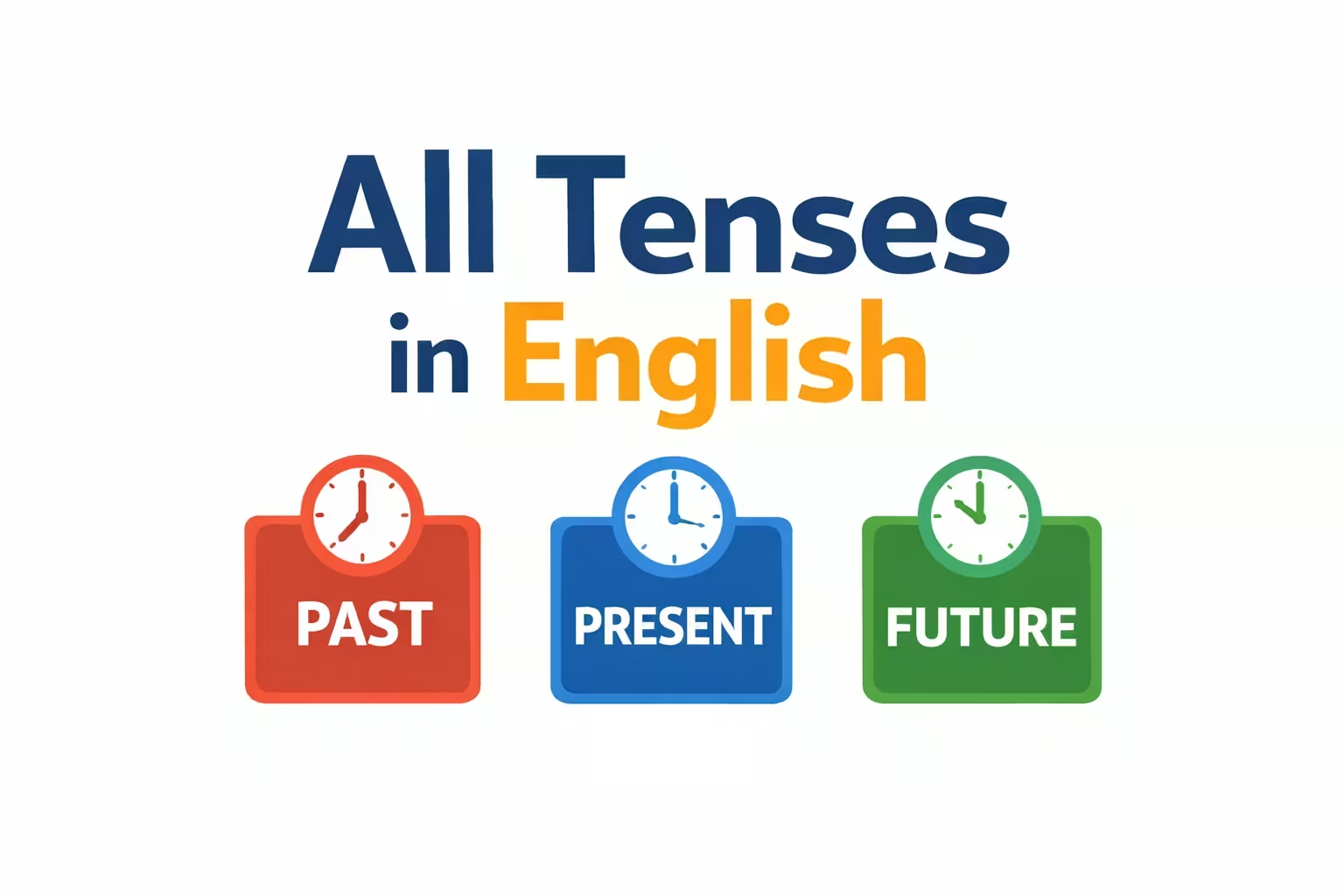
English has three main tenses:
- Present Tense – actions happening now or regularly
- Past Tense – actions that already happened
- Future Tense – actions that will happen later
Each of these three main tenses is then divided into four forms:
- Simple
- Continuous (also called Progressive)
- Perfect
- Perfect Continuous
This gives us a total of 12 tenses in English. Do not worry. Each one follows a clear pattern and rule. Once you learn the structure, everything becomes much easier.
Why Is It Important to Learn All Tenses in English?
Learning all tenses in English is not just about passing a grammar test. It has real benefits in your everyday life.
1. Better Communication
When you use the correct tense, people understand you more clearly. You avoid confusion and misunderstandings.
2. More Confidence in Speaking
Knowing your tenses helps you speak without hesitation. You stop second-guessing yourself mid-sentence.
3. Career Growth
Job interviews, emails, presentations, and professional conversations all require correct grammar. Tenses are a huge part of that.
4. Stronger Writing Skills
Whether you are writing an essay, a message, or a report, correct tenses make your writing polished and professional.
5. Better Understanding of English Content
When you read books, watch movies, or listen to podcasts in English, knowing tenses helps you understand what is being said and when it happened.
The 12 Tenses in English – Detailed Explanation With Rules and Examples
Let’s go through all 12 tenses one by one. For each tense, you will see:
- The rule (structure)
- A formula
- Clear examples
- A tip to remember it easily
Present Tenses
1. Simple Present Tense
Use it for:
- Habits and routines
- General facts and truths
- Fixed schedules
Formula: Subject + base verb (+ s/es for he/she/it)
Examples:
- I drink coffee every morning.
- She works at a hospital.
- The sun rises in the east.
Tip: Add -s or -es when the subject is he, she, or it.
2. Present Continuous Tense
Use it for:
- Actions happening right now
- Temporary situations
- Future plans (when confirmed)
Formula: Subject + am/is/are + verb-ing
Examples:
- I am reading a book right now.
- She is cooking dinner.
- They are travelling to London next week.
Tip: Look for time expressions like “now,” “at the moment,” and “currently.”
3. Present Perfect Tense
Use it for:
- Actions completed at an unspecified time in the past
- Experiences in your life
- Actions that still affect the present
Formula: Subject + have/has + past participle
Examples:
- I have visited Paris.
- She has finished her homework.
- They have never tried sushi.
Tip: Use “have” with I, you, we, they. Use “has” with he, she, it.
4. Present Perfect Continuous Tense
Use it for:
- Actions that started in the past and are still continuing
- Actions that recently stopped but have a present result
Formula: Subject + have/has + been + verb-ing
Examples:
- I have been studying for three hours.
- She has been working at this company since 2020.
- It has been raining all day.
Tip: This tense often uses “for” (duration) and “since” (starting point).
Past Tenses
5. Simple Past Tense
Use it for:
- Completed actions in the past
- A specific time in the past
Formula: Subject + past form of verb (verb + -ed for regular verbs)
Examples:
- I visited my grandmother last Sunday.
- She called me yesterday.
- He broke his leg two years ago.
Tip: Many common verbs are irregular. Learn them by heart. Examples: go → went, eat → ate, see → saw.
6. Past Continuous Tense
Use it for:
- An action that was in progress at a specific time in the past
- Two actions happening at the same time in the past
- A background action interrupted by another action
Formula: Subject + was/were + verb-ing
Examples:
- I was sleeping when the phone rang.
- She was reading while he was cooking.
- They were playing football at 5 p.m. yesterday.
Tip: Use “was” with I, he, she, it. Use “were” with you, we, they.
7. Past Perfect Tense
Use it for:
- An action that happened before another action in the past
- The “earlier” of two past events
Formula: Subject + had + past participle
Examples:
- I had already eaten when she arrived.
- He had left before the party started.
- By the time we reached the station, the train had gone.
Tip: Think of it as “the past of the past.” The past perfect describes what happened first.
8. Past Perfect Continuous Tense
Use it for:
- An action that was ongoing in the past before another past event happened
Formula: Subject + had + been + verb-ing
Examples:
- She had been waiting for two hours before the doctor came.
- They had been arguing before the teacher walked in.
- I had been working on that project for a month before it was cancelled.
Tip: This tense emphasizes duration before a past event. Look for “for” and “since” in these sentences.
Future Tenses
9. Simple Future Tense
Use it for:
- Decisions made at the moment of speaking
- Predictions and beliefs about the future
- Promises and offers
Formula: Subject + will + base verb
Examples:
- I will call you tonight.
- It will rain tomorrow.
- She will help you with your homework.
Tip: “Will” is used for all subjects without any change. No -s, no -ing.
10. Future Continuous Tense
Use it for:
- Actions that will be in progress at a specific time in the future
- Planned future actions
Formula: Subject + will + be + verb-ing
Examples:
- This time tomorrow, I will be flying to Dubai.
- She will be working late tonight.
- They will be celebrating their anniversary next week.
Tip: Think of it as “will be happening.” It is the future version of the past and present continuous.
11. Future Perfect Tense
Use it for:
- Actions that will be completed before a specific time in the future
Formula: Subject + will + have + past participle
Examples:
- By 10 p.m., I will have finished my report.
- She will have graduated by next year.
- They will have left by the time you arrive.
Tip: Look for the phrase “by the time” or “by + future time expression.” These are strong clues for the future perfect.
12. Future Perfect Continuous Tense
Use it for:
- An action that will have been in progress for a certain duration before a future point
Formula: Subject + will + have + been + verb-ing
Examples:
- By next month, I will have been living here for five years.
- She will have been teaching for 20 years by the time she retires.
- They will have been working on this project for six months by December.
Tip: This is the most advanced tense. Use it to emphasize how long something will have continued by a future point in time.
Quick Reference: All 12 Tenses in English at a Glance
Here is a simple summary table to help you remember all tenses:
Present Tenses:
- Simple Present → Subject + V1 (s/es)
- Present Continuous → Subject + am/is/are + V-ing
- Present Perfect → Subject + have/has + V3
- Present Perfect Continuous → Subject + have/has + been + V-ing
Past Tenses:
- Simple Past → Subject + V2
- Past Continuous → Subject + was/were + V-ing
- Past Perfect → Subject + had + V3
- Past Perfect Continuous → Subject + had + been + V-ing
Future Tenses:
- Simple Future → Subject + will + V1
- Future Continuous → Subject + will + be + V-ing
- Future Perfect → Subject + will + have + V3
- Future Perfect Continuous → Subject + will + have + been + V-ing
V1 = base verb, V2 = past form, V3 = past participle, V-ing = present participle
Common Mistakes to Avoid When Using English Tenses
Even advanced learners make tense mistakes. Here are the most common errors and how to avoid them:
Mistake 1: Using simple present instead of present continuous
- Wrong: I eat right now.
- Right: I am eating right now.
- Why: “Right now” signals an action in progress, so you need the continuous form.
Mistake 2: Confusing simple past with present perfect
- Wrong: I have seen him yesterday.
- Right: I saw him yesterday.
- Why: “Yesterday” is a specific time. Use simple past, not present perfect.
Mistake 3: Forgetting to add -s or -es in simple present
- Wrong: She go to school every day.
- Right: She goes to school every day.
- Why: He, she, it require -s or -es with the base verb in simple present.
Mistake 4: Using will for plans already decided
- Wrong: I will meet my friend tonight. (if already decided and confirmed)
- Right: I am meeting my friend tonight.
- Why: Use present continuous for confirmed future plans, not “will.”
Mistake 5: Using past perfect incorrectly
- Wrong: I had eaten before I will sleep.
- Right: I had eaten before I went to sleep.
- Why: Past perfect must be paired with another past action, not a future one.
Mistake 6: Saying “I am knowing” or “I am liking”
- Wrong: I am knowing the answer.
- Right: I know the answer.
- Why: Certain verbs are called stative verbs (know, like, love, believe, want, need). They are not normally used in continuous forms.
Mistake 7: Double past
- Wrong: She didn’t went to school.
- Right: She didn’t go to school.
- Why: When using “did/didn’t,” the main verb stays in its base form.
Practical Tips to Master All Tenses in English
Learning tenses takes time and practice. Here are the best strategies to help you improve faster:
Tip 1: Learn One Tense at a Time
Do not try to learn all 12 tenses at once. Start with simple present and simple past. Practice them until they feel natural. Then move on to the next one.
Tip 2: Use Tenses in Context
Do not just memories rules. Use each tense in real sentences about your own life. For example:
- Simple past: What did you do last weekend?
- Present perfect: What have you done this week?
Tip 3: Keep a Grammar Journal
Write five sentences every day using the tense you are currently studying. This builds muscle memory for correct tense usage.
Tip 4: Watch English Content With Subtitles
Watch movies, TV shows, and YouTube videos in English. Pay attention to how native speakers use different tenses in conversations. Subtitles will help you connect the spoken word to its written form.
Tip 5: Do Daily Practice Exercises
Use grammar workbooks or free online exercises to test yourself. Websites and apps like Grammarly, British Council, and BBC Learning English offer excellent free tense exercises.
Tip 6: Practice Speaking Aloud
Pick a tense each day and speak about your routine, plans, or memories using only that tense. For example, spend Monday practicing the past perfect. Speak out loud, even to yourself.
Tip 7: Use Flashcards for Irregular Verbs
Irregular verbs are one of the biggest challenges in tense learning. Make flashcards with the base form, past form, and past participle of common irregular verbs. Review them regularly.
Tip 8: Find a Language Partner
Practice with a friend or online language exchange partner. Real conversation is the fastest way to improve tense usage naturally.
Tip 9: Record Yourself Speaking
Record yourself using different tenses. Play it back and listen for errors. This self-correction method is very powerful and often underused by learners.
Tip 10: Be Patient and Consistent
Mastering English tenses is a marathon, not a sprint. Even 15 minutes of daily practice leads to massive improvement over time. Consistency matters more than intensity.
Real-Life Applications of English Tenses
Understanding all tenses in English is not just a classroom skill. It has powerful real-world applications.
In Job Interviews
Interviewers often ask questions that require specific tenses:
- “Tell me about your experience.” → Simple past and present perfect
- “Where do you see yourself in five years?” → Simple future
- “What were you doing in your last role?” → Past continuous
Using the correct tense during an interview shows professional command of the language.
In Travel
When you travel to English-speaking countries, tenses are everywhere:
- “The train has already departed.” → Present perfect
- “The museum is closing at 6 p.m.” → Present continuous
- “Will you need any assistance?” → Simple future
Knowing your tenses makes navigating foreign places much easier.
In Academic Writing
Essays and reports require precise tense usage:
- Literature reviews → Present perfect (“Studies have shown…”)
- Historical events → Simple past (“The war ended in 1945.”)
- Findings → Simple present (“The data suggests…”)
In Social Conversations
Everyday small talk also depends on tenses:
- “What have you been up to?” → Present perfect continuous
- “Did you watch the match last night?” → Simple past
- “I’m meeting Sarah for lunch tomorrow.” → Present continuous for future
Short Practice Dialogue Using Multiple Tenses
Here is a short conversation that shows how tenses work together naturally:
Riya: Hey Arjun! You look tired. What happened?
Arjun: I know! I have been studying for the exam all night. I didn’t sleep at all.
Riya: Oh no! When is your exam?
Arjun: It’s tomorrow at 10 a.m. By the time it starts, I will have been awake for 30 hours!
Riya: You need to rest. When will you finish studying?
Arjun: I think I’ll stop in an hour. I was planning to review notes, but I had already read them twice.
Riya: Good luck! Let me know how it goes.
Notice how naturally this conversation moves between present perfect continuous, simple past, future perfect, and simple future. That is how native speakers talk. Your goal is to reach that level of comfort.
Frequently Asked Questions (FAQs)
Q1: How many tenses are there in English?
A: There are 12 tenses in English. They are divided into three main groups: Present (4 tenses), Past (4 tenses), and Future (4 tenses). Each group includes Simple, Continuous, Perfect, and Perfect Continuous forms.
Q2: Which tense is used most in everyday English?
A: The Simple Present and Simple Past tenses are used most commonly in everyday conversation. Present Continuous and Present Perfect are also very frequently used in spoken English.
Q3: What is the difference between Simple Past and Present Perfect?
A: Simple Past is used for actions completed at a specific time in the past. Example: “I ate dinner at 7 p.m.” Present Perfect is used for actions completed at an unspecified time, or actions that still connect to the present. Example: “I have eaten dinner.” The key rule: if you mention a specific past time (yesterday, last week, in 2010), use simple past.
Q4: How can I improve my use of English tenses quickly?
A: The fastest way is to combine three things: study the rules clearly, practice daily with real sentences, and consume English content like movies, books, and podcasts. Active use through speaking and writing is more effective than passive study.
Q5: What are stative verbs and why can’t they use continuous tenses?
A: Stative verbs describe states or conditions rather than actions. Common stative verbs include: know, believe, love, hate, want, need, understand, remember, and seem. These verbs are not normally used in continuous tenses because they describe ongoing states, not active processes. So instead of “I am knowing the answer,” you say “I know the answer.”
Q6: Is “going to” a future tense in English?
A: Yes. “Going to” is considered an alternative future form and is widely used. It is typically used for plans already decided before the moment of speaking. Example: “I am going to visit my parents this weekend.” “Will” is usually used for decisions made at the moment of speaking or for predictions.
Q7: What is the easiest way to remember all 12 tenses?
A: Organize them into a simple grid. Across the top, write: Simple, Continuous, Perfect, Perfect Continuous. Down the side, write: Present, Past, Future. Fill in the formula for each box. Review this grid daily and write your own sentences for each tense. Visual learning combined with active practice is the most effective method.
Conclusion
Learning all tenses in English (with rules, examples & practice) might seem like a big task, but it is absolutely achievable. You have now covered all 12 tenses, their rules, real-life examples, and common mistakes to avoid. You have also discovered practical strategies to make tense learning part of your daily routine.
Here is a quick summary of what you learned today:
- English has 12 tenses: 4 present, 4 past, and 4 future
- Each tense follows a clear formula that you can memorize and practice
- Common mistakes are easy to avoid once you know the rules
- Real-life practice through speaking, writing, and listening is the key to mastery
- Consistency and patience are your most powerful tools
Remember, language learning is a journey. Every sentence you write or speak brings you one step closer to fluency. Do not be afraid of making mistakes. Every mistake is a lesson in disguise.
Your next step: Pick one tense from this article that you find difficult. Write ten sentences using that tense about your own life. Come back tomorrow and do the same for another tense. In just 12 days, you will have practised every tense in English.
If you found this guide helpful, share it with a friend who is also learning English. And if you have any questions about English tenses, drop them in the comments below. Happy learning!
Want to improve your English further? Explore our guides on how to speak English fluently, how to build vocabulary fast, and the best daily habits for English learners.
Master other topics here:
- How to Use Future Tenses Correctly in English: A Simple Guide
- Common Mistakes in Tense Usage with Examples and Corrections
- How to Stay Focused While Studying (Even If You Get Distracted Easily)
- How to Think in English While Reading and Writing
Want to learn more? Find similar topics here on English Grammar & Usage.
📚 Continue Learning English
Choose your next lesson and keep improving your English skills with our free English learning resources.