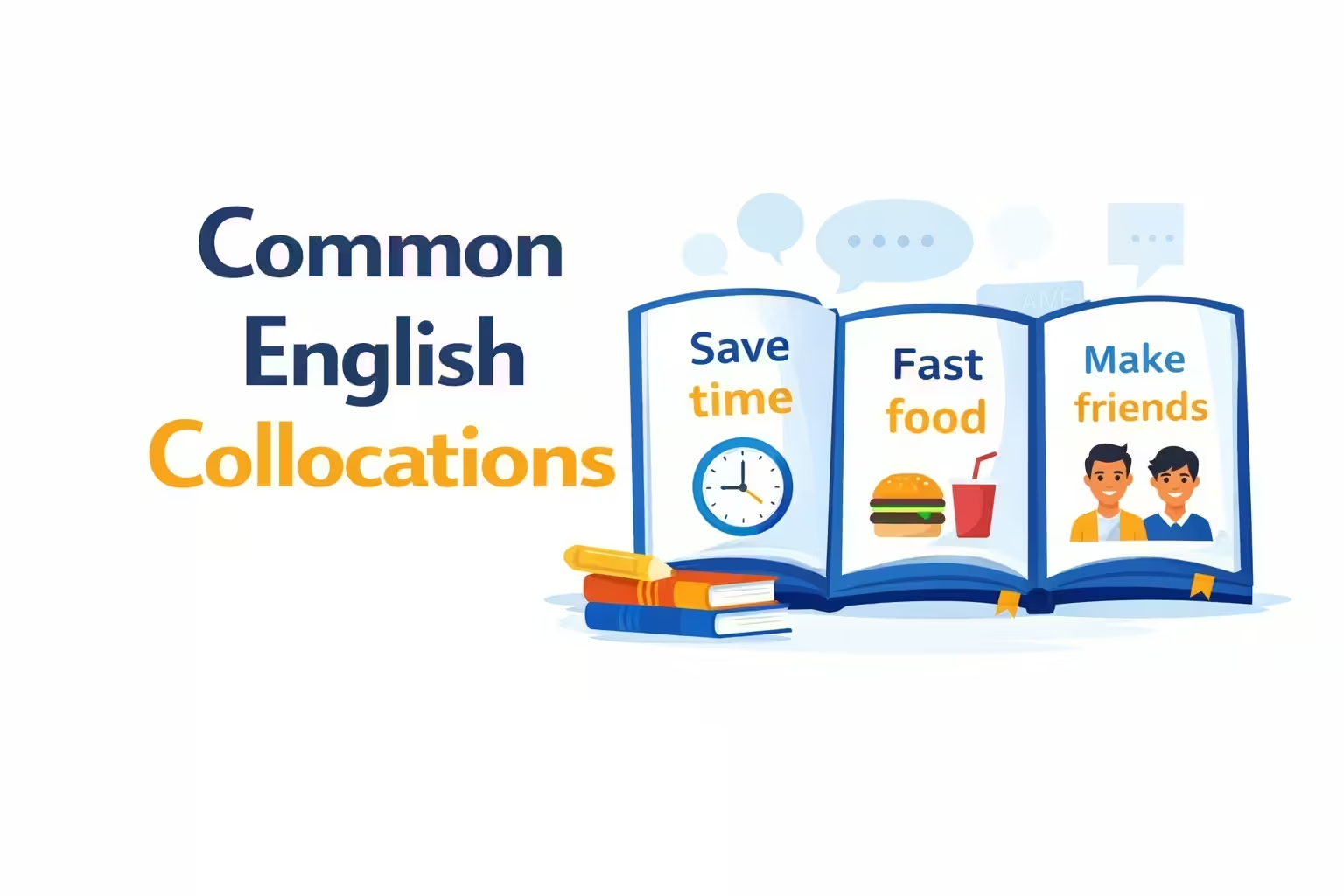
Introduction: Why Collocations Are the Secret to Fluent English
Have you ever studied English for years but still feel like something is missing? You know grammar. You know vocabulary. But your English still doesn’t sound natural. The secret most learners miss is collocations.
In this guide on 1000+ Common English Collocations (With Meanings), you will learn exactly what collocations are, why they matter, and how to use them correctly in real life. Whether you are a student, a working professional, or someone who just wants to speak English more confidently, this article is for you. By the end, your English will sound smoother, more natural, and more impressive.
Let’s get started.
What Are 1000+ Common English Collocations (With Meanings)?
A collocation is a pair or group of words that naturally go together in English. Native speakers use these word combinations all the time without even thinking about it.
For example:
- We say “make a decision” — NOT “do a decision”
- We say “heavy rain” — NOT “strong rain”
- We say “take a shower” — NOT “have a shower” (in American English)
These are collocations. They are fixed word partnerships. When you learn 1000+ common English collocations with meanings, you are learning how English really works in daily conversation.
Think of collocations like puzzle pieces. Each word alone is fine. But when the right words fit together, your English suddenly sounds natural, confident, and fluent.
The meaning of a collocation comes from the combination, not just the individual words. That is why learning collocations is one of the fastest ways to improve English speaking skills.
Why Is Learning English Collocations So Important?
Many English learners focus only on single words or grammar rules. But native speakers do not think in single words. They think in phrases and word combinations. This is why collocations are so powerful.
Here are the key reasons why learning 1000+ common English collocations with meanings will change your English forever:
1. You Will Sound More Natural
When you use the right word combinations, native speakers immediately notice. Your English will stop sounding like a translation and start sounding like real, fluent speech.
2. You Will Communicate Faster
You will not need to stop and think about every word. Collocations help your brain find the right phrase quickly. This makes your speech smoother and more confident.
3. You Will Understand Native Speakers Better
Movies, podcasts, news, and conversations are full of collocations. Once you know them, you will understand native speakers much more easily.
4. You Will Write Better English
Collocations are essential for writing emails, essays, reports, and messages that sound professional and polished.
5. You Will Boost Your Career
In job interviews, presentations, and business meetings, using correct collocations makes a huge difference. It shows you have a high level of English proficiency.
6. You Will Build Confidence
Knowing the right phrases gives you confidence to speak without fear of making mistakes. Confidence is one of the most important parts of spoken English fluency.
Types and Categories of English Collocations
To understand 1000+ common English collocations with meanings, it helps to know the different types. Collocations fall into several categories based on the words that combine.
Verb + Noun Collocations
This is the most common type. A verb is paired with a specific noun.
Examples:
- Make a mistake (NOT do a mistake)
- Take a break (NOT have a break in American English)
- Give advice (NOT say advice)
- Pay attention (NOT give attention)
- Keep a promise (NOT hold a promise)
Adjective + Noun Collocations
Here, an adjective naturally pairs with a specific noun.
Examples:
- Strong coffee (NOT powerful coffee)
- Heavy traffic (NOT big traffic)
- Fast food (NOT quick food in this context)
- High temperature (NOT big temperature)
- Deep sleep (NOT heavy sleep… well, some overlap, but context matters)
Adverb + Adjective Collocations
An adverb strengthens or modifies an adjective in a natural way.
Examples:
- Deeply sorry (NOT very deeply sorry in formal use)
- Highly recommended (NOT greatly recommended)
- Perfectly clear (NOT completely clear is okay too, but perfectly clear is more natural)
- Absolutely exhausted (NOT very exhausted in formal speech)
- Fully aware (NOT completely aware — both work, but context differs)
Noun + Noun Collocations
Two nouns combine to form a natural partnership.
Examples:
- Traffic jam
- Business meeting
- Job interview
- Coffee break
- Bank account
Verb + Adverb Collocations
A verb pairs with a specific adverb.
Examples:
- Sleep soundly
- Work hard
- Smile broadly
- Speak fluently
- Think clearly
Verb + Prepositional Phrase Collocations
These involve a verb followed by a preposition and noun.
Examples:
- Depend on someone
- Listen to music
- Apply for a job
- Believe in yourself
- Look forward to something
1000+ Common English Collocations With Meanings: Detailed Examples by Category
Now let us dive deep into the most useful collocations in everyday English. These are organized by topic so they are easy to learn and remember.
Daily Life Collocations
These collocations are used in everyday situations at home, on the street, and in social settings.
Collocation — Meaning — Example Sentence
- Make breakfast — to prepare the morning meal — “She makes breakfast every morning at 7 AM.”
- Do the dishes — to wash plates and cups — “Can you do the dishes after dinner?”
- Take a nap — to sleep for a short time — “He takes a nap every afternoon.”
- Go shopping — to visit shops and buy things — “We are going shopping this weekend.”
- Run an errand — to complete a small task outside — “I need to run a few errands before lunch.”
- Set the table — to arrange plates and cutlery for a meal — “Please set the table before the guests arrive.”
- Make the bed — to tidy up the bed in the morning — “Always make your bed when you wake up.”
- Do the laundry — to wash clothes — “I do the laundry every Sunday.”
- Take out the trash — to remove garbage from the house — “Don’t forget to take out the trash tonight.”
- Cook a meal — to prepare food — “He cooked a delicious meal for the whole family.”
Work and Career Collocations
These are essential for job interviews, office life, and professional communication.
- Apply for a job — to formally request a job position — “She applied for a job at the new company.”
- Land a job — to successfully get a job — “He finally landed his dream job.”
- Meet a deadline — to finish work on time — “We need to meet the deadline by Friday.”
- Make a presentation — to speak formally in front of others — “She made a brilliant presentation.”
- Hold a meeting — to have a formal group discussion — “The manager held a meeting this morning.”
- Take notes — to write down important information — “Always take notes during lectures.”
- Do research — to study and find information — “We did extensive research before writing the report.”
- Reach a target — to achieve a goal — “The sales team reached their monthly target.”
- Give feedback — to offer comments on someone’s work — “The teacher gave helpful feedback on the essay.”
- Work overtime — to work extra hours beyond normal time — “She worked overtime to finish the project.”
Education Collocations
Perfect for students and ESL learners who want to improve English speaking skills.
- Take an exam — to sit for a test — “He took the English exam last week.”
- Pass an exam — to succeed in a test — “She passed her driving exam on the first try.”
- Fail an exam — to not succeed in a test — “Don’t worry if you fail an exam. You can try again.”
- Study hard — to put great effort into learning — “You need to study hard to improve.”
- Make progress — to improve over time — “My English has made great progress this year.”
- Do homework — to complete tasks given by a teacher — “Always do your homework before the next class.”
- Attend a lecture — to go to a formal educational talk — “We attended an interesting lecture on grammar.”
- Write an essay — to compose a formal piece of writing — “He wrote a 1000-word essay on climate change.”
- Submit an assignment — to hand in work — “Please submit your assignment by Monday.”
- Graduate from university — to complete a university degree — “She graduated from university with honors.”
Health and Body Collocations
- Take medicine — to swallow pills or liquid drugs — “Take your medicine with water.”
- Have a headache — to feel pain in the head — “I have a terrible headache today.”
- Catch a cold — to become ill with a common cold — “He caught a cold last week.”
- Feel under the weather — to feel slightly ill — “She is feeling a bit under the weather.”
- Get enough sleep — to sleep for the right amount of time — “Make sure you get enough sleep every night.”
- Keep fit — to maintain good physical health — “She goes jogging to keep fit.”
- Do exercise — to engage in physical activity — “Try to do exercise at least three times a week.”
- Break a bone — to fracture a part of the body — “He broke his arm during football.”
- Go on a diet — to eat controlled meals to lose weight — “She went on a diet before her wedding.”
- Make a full recovery — to become completely healthy again — “The doctor says he will make a full recovery.”
Travel Collocations
Useful for anyone learning English for travel or tourism purposes.
- Book a flight — to reserve a seat on a plane — “She booked a flight to London.”
- Pack a bag — to put things into a bag before travel — “He packed his bag the night before the trip.”
- Miss a flight — to fail to board an airplane — “We missed our flight because of traffic.”
- Go sightseeing — to visit famous places as a tourist — “We went sightseeing in Paris.”
- Check in to a hotel — to register at a hotel — “They checked in to the hotel after a long journey.”
- Get lost — to not know where you are — “We got lost in the old part of the city.”
- Take a tour — to follow a guided visit — “We took a guided tour of the museum.”
- Exchange currency — to change money into another type — “You should exchange currency at the airport.”
- Make a reservation — to book a table, seat, or room — “Please make a reservation at the restaurant.”
- Travel light — to carry very little luggage — “It is always better to travel light on short trips.”
Emotion and Feeling Collocations
- Feel nervous — to experience anxiety — “She felt nervous before the interview.”
- Burst into tears — to suddenly start crying — “He burst into tears when he heard the sad news.”
- Lose your temper — to become very angry — “Try not to lose your temper in public.”
- Fall in love — to begin to love someone romantically — “They fell in love in college.”
- Break someone’s heart — to cause deep emotional pain — “She broke his heart when she left.”
- Feel at ease — to feel comfortable and relaxed — “I always feel at ease when I am at home.”
- Get excited — to feel enthusiastic and eager — “She got excited when she heard the news.”
- Have mixed feelings — to feel both good and bad about something — “I have mixed feelings about moving abroad.”
- Stay calm — to remain relaxed in a difficult situation — “Always try to stay calm in emergencies.”
- Cheer someone up — to make someone feel happier — “He told jokes to cheer her up.”
Money and Finance Collocations
- Save money — to keep money instead of spending it — “You should save money for emergencies.”
- Spend money — to use money to buy things — “He spent a lot of money on new clothes.”
- Earn a living — to make money through work — “She earns a living as a freelance writer.”
- Pay a bill — to give money for a service — “Don’t forget to pay the electricity bill.”
- Take out a loan — to borrow money from a bank — “They took out a loan to buy a house.”
- Go into debt — to owe money you cannot pay — “Try not to go into debt on unnecessary things.”
- Make a profit — to earn more than you spend — “The company made a huge profit last year.”
- Live within your means — to spend only what you earn — “It is wise to live within your means.”
- Open a bank account — to create an account at a bank — “He opened a bank account when he started working.”
- Cut expenses — to reduce the amount you spend — “They cut expenses to save more money.”
Communication and Language Collocations
These are perfect for anyone trying to improve English speaking skills and fluency.
- Make a point — to express an idea clearly — “She made an important point during the discussion.”
- Have a conversation — to talk with someone — “We had a great conversation over dinner.”
- Give a speech — to speak formally in public — “He gave an impressive speech at the ceremony.”
- Ask a question — to seek information — “Don’t be afraid to ask a question if you are confused.”
- Express an opinion — to share your thoughts — “Everyone should feel free to express an opinion.”
- Keep in touch — to maintain contact with someone — “Let’s keep in touch after the course ends.”
- Break the ice — to start a conversation in a social situation — “He told a joke to break the ice.”
- Get the point — to understand the main idea — “Do you get the point of what I am saying?”
- Change the subject — to start talking about something different — “She changed the subject to avoid the question.”
- Lose track of the conversation — to stop following what is being said — “The meeting was so long I lost track of the conversation.”
Common Mistakes to Avoid When Using English Collocations
Even advanced learners make collocation mistakes. Here are the most common errors and why they are wrong:
- Saying “do a mistake” instead of “make a mistake” — The verb “make” is the correct partner for “mistake.” Always say “make a mistake.”
- Saying “strong rain” instead of “heavy rain” — In English, “heavy” describes rain, not “strong.” This is a fixed combination.
- Saying “do a decision” instead of “make a decision” — “Decision” always collocates with “make.” Never with “do.”
- Saying “tell a lie” but then saying “say a lie” in a different context — “Tell” is correct. Always say “tell a lie.”
- Saying “get success” instead of “achieve success” or “become successful” — “Get success” is not a natural English collocation. Use “achieve success” instead.
- Saying “highly possible” instead of “very possible” or “quite possible” — “Highly” collocates with adjectives like “recommended,” “qualified,” and “unlikely,” but not always “possible.”
- Saying “do progress” instead of “make progress” — Always use “make” with “progress.” This is one of the most common spoken English mistakes.
- Translating collocations directly from your native language — This almost always leads to errors. English collocations must be learned as fixed phrases, not translated word by word.
Top Tips and Strategies to Learn English Collocations Fast
Learning 1000+ common English collocations with meanings does not have to be boring. Here are practical, easy-to-follow strategies:
- Learn collocations in context, not in isolation. Always study the full phrase with an example sentence. Do not just memorize “heavy rain.” Learn it in a sentence: “There was heavy rain last night.”
- Keep a collocation notebook. Write down new collocations you hear or read every day. Organize them by topic. Review them weekly.
- Use flashcards. Write the collocation on one side and the meaning and example on the other. Apps like Anki are great for this.
- Read in English every day. Read newspapers, blogs, and books. Underline collocations you notice. The more you read, the more natural English will feel.
- Listen to native English speakers. Podcasts, YouTube videos, TV shows, and movies are excellent resources. Pay attention to how native speakers combine words.
- Speak with a partner. Practice using new collocations in real conversations. You can find language exchange partners on apps like Tandem or HelloTalk.
- Practice one category per week. Focus on daily life collocations this week. Work and career collocations next week. This method stops you from feeling overwhelmed.
- Repeat what you hear. When you hear a collocation in a movie or podcast, pause and repeat it aloud. This builds muscle memory in your speaking.
- Write short paragraphs using new collocations. Try to use five new collocations in a short paragraph each day. This forces active use, which is the fastest way to remember.
- Test yourself regularly. Cover the meaning and try to recall the collocation. Or cover the collocation and try to recall it from the meaning. Regular testing boosts long-term memory.
Real-Life Applications of English Collocations
Learning collocations is not just for English exams. Here is how knowing 1000+ common English collocations with meanings helps you in real life:
At School or University
Students who know collocations write better essays. They use phrases like “conduct research,” “draw a conclusion,” “support an argument,” and “make a reference.” Teachers and professors immediately notice the difference in quality.
In Job Interviews
Job interviews in English are much easier when you know the right collocations. Phrases like “I have extensive experience,” “I work well under pressure,” “I am highly motivated,” and “I thrive in a team environment” make a powerful impression on interviewers.
While Travelling
At airports, hotels, and tourist spots, collocations help you communicate without stress. Knowing how to say “check in to a hotel,” “exchange currency,” “book a table,” and “ask for directions” makes travel smooth and enjoyable.
In Social Conversations
Making friends in English is easier when you can keep the conversation flowing naturally. Collocations like “break the ice,” “catch up with friends,” “make small talk,” and “have a good time” help you connect with native speakers.
In Business and Professional Settings
Professional collocations are essential for emails, reports, and meetings. Phrases like “reach an agreement,” “close a deal,” “meet a deadline,” and “exceed expectations” show that you are a serious, competent professional.
In Online Communication
Social media, emails, and messaging apps all require natural English. Knowing collocations helps you write messages that sound friendly, professional, and clear — not robotic or awkward.
Frequently Asked Questions (FAQs)
Q1: What are the most common English collocations for beginners?
Some of the most common collocations for beginners include: make a mistake, take a break, do homework, have breakfast, go shopping, feel nervous, and save money. These appear in daily conversations and are perfect starting points for ESL learners.
Q2: How many English collocations should I learn per day?
Start with 5 to 10 new collocations per day. Focus on one category or topic per week. Consistency is more important than quantity. Learning 5 collocations properly every day will teach you over 1800 collocations in a year.
Q3: What is the difference between a collocation and an idiom?
A collocation is a natural word combination where the meaning is clear from the words themselves — for example, “make a decision.” An idiom is a fixed phrase where the meaning is different from the literal words — for example, “bite the bullet” means to endure pain, not literally bite anything. Both are important for fluent English, but collocations are easier to learn.
Q4: Can learning collocations help me pass English exams like IELTS or TOEFL?
Absolutely. IELTS and TOEFL examiners specifically look for the correct use of collocations in writing and speaking. Using accurate collocations like “highly significant,” “conduct an experiment,” or “make a significant contribution” can improve your band score in IELTS writing from a 6 to a 7 or even 8.
Q5: How do I know if a word combination is a collocation or not?
The best way is to search the combination in a reliable English dictionary like Oxford Collocations Dictionary or use tools like Ludwig.guru or the Corpus of Contemporary American English (COCA). If native speakers commonly use the combination, it is likely a collocation.
Q6: Are collocations the same in British English and American English?
Most collocations are the same in both varieties. However, there are some differences. For example, British English says “have a shower” while American English says “take a shower.” British English says “at the weekend” while American English says “on the weekend.” When in doubt, check which variety you are learning and stick to it.
Q7: Is it better to learn collocations by topic or by grammar type?
For most learners, learning by topic is easier and more practical. Organizing collocations by topic (travel, work, emotions, health) means you can use them in real-life situations faster. Grammar-based learning (verb + noun, adjective + noun) is more useful for advanced learners who want to understand the structure deeply.
Conclusion: Start Using Collocations Today and Transform Your English
Learning 1000+ common English collocations with meanings is one of the smartest investments you can make in your English journey. Grammar rules and individual vocabulary words are important, but collocations are what make your English truly fluent, natural, and impressive.
To summarize everything you have learned:
- Collocations are natural word partnerships used by native speakers every day.
- There are different types: verb + noun, adjective + noun, adverb + adjective, and more.
- Collocations help you in school, work, travel, social situations, and professional settings.
- Avoid common mistakes like “do a mistake” or “strong rain.”
- The best way to learn is through reading, listening, speaking, and daily practice.
Now it is your turn to take action.
Start with 10 new collocations from this list today. Write them in a notebook. Use them in a sentence. Then practice saying them aloud. Do this every single day, and within just a few months, your English will sound completely transformed.
Share this article with a friend who is learning English. And if you found this guide helpful, bookmark it and come back whenever you need a quick reference for common English collocations with meanings. Your fluency journey starts right here.
Keep learning. Keep practicing. Keep growing. Fluent English is closer than you think.
Enjoy more interesting topics here:
- The Complete Guide to English Collocations: Rules, Examples, and Tips
- English Collocations for Describing Work and Career (Easy Guide for English Learners)
- English Collocations for Talking About Weather (Examples and Usage Guide)
- Common English Collocations with Nouns in English (Easy Guide for English Learners)
- English Collocations for Giving and Receiving Advice (Easy Guide for English Learners)
Want to learn more? Explore similar topics with English Collocations.


