If you’ve ever finished a lesson, looked out at your students, and thought “Did any of that actually land?” — you’re not alone. Every English Language Arts teacher faces this moment. The uncomfortable truth is that traditional end-of-unit tests often tell you what students didn’t learn after it’s too late to help them. That’s exactly why formative assessment ideas for ELA are so valuable.
Formative assessment is the practice of checking student understanding during the learning process, not just at the end. Done well, it helps you adjust your teaching in real time, catch confusion before it becomes failure, and give every student a better chance to succeed. This guide will walk you through the most effective, practical, and creative formative assessment strategies for your ELA classroom — whether you teach in person or online.
What Is Formative Assessment and Why Does It Matter in ELA?
Let’s clear something up right away. Formative assessment is not a test. It’s not even always graded. It’s simply a way of gathering information about where your students are in their learning so you can respond thoughtfully.
In English Language Arts, this matters enormously. ELA covers a wide range of skills — reading comprehension, writing, vocabulary, grammar, speaking, and listening. Students don’t develop these skills evenly. One student might read beautifully but struggle to put ideas on paper. Another might write well but freeze during class discussion. Formative assessment helps you see these differences clearly and act on them.
The best part? Most effective formative assessment techniques take five to fifteen minutes. They don’t require elaborate preparation. And they tell you far more about your students than a Friday quiz ever could.
The 3-2-1 Exit Ticket: Simple, Powerful, and Instantly Useful
Exit tickets are one of the most widely used formative assessment ideas for ELA, and for good reason. They take about three to five minutes at the end of class, they require no special materials, and they give you immediate insight into what students understood and what confused them.
The 3-2-1 format is particularly effective. Here’s how it works. Students write down three things they learned, two things they found interesting, and one question they still have. That last part — the one question — is the gold. It tells you exactly where to start next class.
I’ve used this in both physical classrooms and in online teaching environments. In online classes, I have students type their responses into a shared document or a quick Google Form. I review the responses before the next session and open with addressing the most common questions. Students notice when their confusion is acknowledged. It builds trust and engagement.
Try it now: After your next reading lesson, give students three minutes to complete a 3-2-1. Read through the “one question” responses before you plan tomorrow’s class.
Think-Pair-Share: Checking Understanding Through Conversation
Think-Pair-Share is one of the most effective classroom assessment techniques for ELA because it checks both comprehension and communication at the same time.
Here’s how it works. You pose a question — about a text, a vocabulary word, a writing strategy, or a grammar concept. Students think quietly for sixty seconds. Then they turn to a partner and discuss. Finally, pairs share their thinking with the class.
Why does this work? Because the thinking stage forces every student to process the question independently before leaning on a partner. The pairing stage lets students test their understanding in a low-pressure environment. And the sharing stage gives you direct evidence of where understanding is strong and where gaps exist.
I remember using this during a unit on identifying theme. I asked students to think about the central theme of a short story we’d just read. When pairs shared out, I immediately noticed that about half the class was confusing theme with plot summary. Instead of moving forward, I stopped and spent ten more minutes on the difference. That adjustment wouldn’t have happened without the real-time information Think-Pair-Share gave me.
In online classes, this works beautifully in breakout rooms. Assign pairs, give them a focused question, and set a two-minute timer. When they return to the main room, ask a few pairs to share. You’ll know within five minutes where your class stands.
Formative Assessment Ideas for ELA: Vocabulary Strategies That Actually Work
Vocabulary is a persistent challenge in ELA. Students often think they understand a word until they try to use it. These quick formative checks reveal the truth.
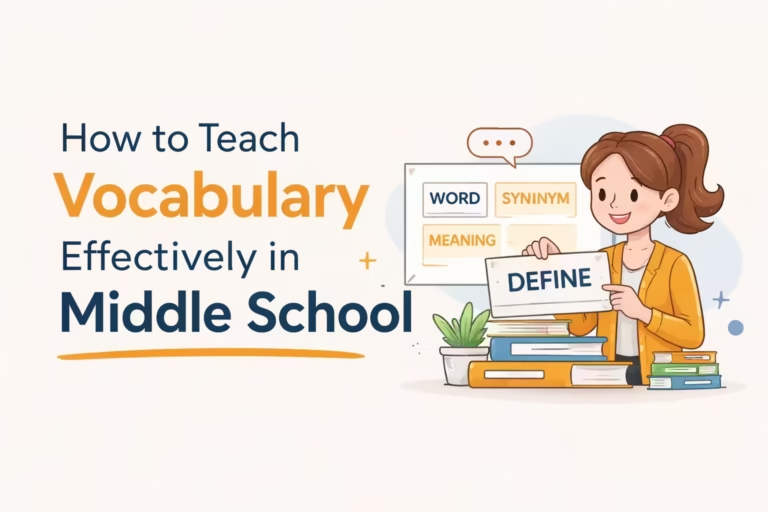
Frayer Model (Quick Version). Give students an index card or a simple four-square template. Ask them to write the word in the center, then fill in the four squares: definition in their own words, an example sentence, a non-example, and a quick sketch or symbol. This takes about five minutes and immediately shows you whether a student truly understands a word or is just recognizing it.
Vocabulary Voting. Read a sentence aloud that uses a vocabulary word in context. Then ask students to vote on the meaning — give them two or three choices and have them hold up fingers for their answer. This is fast, visual, and instantly shows you where confusion lives. In online classes, use the polling feature in your video platform.
Word Sort. Give students ten to twelve vocabulary words on slips of paper or in a digital format. Ask them to sort the words into categories — perhaps by theme, by part of speech, or by positive versus negative connotation. The sorting process reveals how deeply students understand word meaning and relationships.
These strategies work because they make thinking visible. You’re not asking students if they understand — you’re watching them demonstrate understanding in real time.
Explore more interesting topics here:
- Independent Reading Activities for Middle School ELA
- Reading Comprehension C2: Globalization in the 21st Century
- Online Reading Websites: Your Gateway to Endless Stories
- How to Build a Daily Reading Habit in English (Simple Tips for Learners)
- How to Build Your Vocabulary Using Reading (Step-by-Step Guide)
Reading Comprehension Checks That Go Beyond “Did You Read It?”
One of the most common classroom assessment mistakes is asking students questions that only reveal whether they read the text, not whether they understood it. Here are better options.
Somebody-Wanted-But-So-Then. This is a comprehension summarizing structure that works brilliantly as a formative check. Students fill in: Somebody (the main character) Wanted (their goal) But (the conflict) So (what they did) Then (the outcome). It takes three to four minutes and immediately reveals whether students grasped the essential story structure.
Sticky Note Annotation. As students read, they place sticky notes at moments that confused them, surprised them, or made a strong connection with their own experience. After reading, collect the sticky notes or do a quick gallery walk. The pattern of notes tells you immediately what the class understood and where the text lost them.
One-Sentence Summary Challenge. After reading a passage, ask students to summarize it in exactly one sentence — no more. This sounds simple. It’s actually quite hard. Writing a one-sentence summary requires students to identify the most important information and leave out the details. When students struggle with this, it usually means they haven’t grasped the main idea. That’s important information for you as a teacher.
Comprehension Confidence Rating. After a reading activity, ask students to rate their own comprehension on a scale of one to five. Then ask them to write two sentences explaining their rating. Students who give themselves a three or below are telling you they need support. Act on that before moving forward.
Writing Formative Assessments: Checking Progress Without Grading Everything
One of the great fears of ELA teachers is the paper pile. Formative writing assessment doesn’t mean grading every word. It means gathering useful information efficiently.
Quick Writes. Give students five minutes to write freely about a topic, prompt, or question related to the lesson. You’re not looking for polish — you’re looking for thinking. A quick read-through of the class’s quick writes takes about fifteen minutes and tells you volumes about where students are in their thinking.
One Focused Paragraph. Instead of assigning a full essay for practice, ask students to write one paragraph with a specific focus. If you’re teaching evidence-based writing, ask for one paragraph with a claim, one piece of evidence, and one explanation. Read only for that structure. Circle what’s missing. Return it the next day. This is fast, focused, and far more instructive than grading a full essay draft.
Peer Response with Sentence Starters. Have students exchange their writing and respond using sentence starters: “One thing I understood clearly was…” and “I had a question about…” and “A suggestion I have is…” This builds both reading and writing skills simultaneously, and the written responses give you formative data on both the writer and the responder.
In online teaching, shared Google Docs work perfectly for peer response. You can also monitor responses in real time, which gives you an immediate sense of class-wide understanding.
Speaking and Listening Formative Assessment Ideas
ELA is not just about reading and writing. Speaking and listening are core skills, and they’re often the least assessed. Here are practical ways to check these skills formatively.
Fishbowl Discussion. A small group of students discusses a text or question in the center of the room while the rest observe and take notes. After the discussion, observers share what they noticed — strong arguments, unclear points, interesting ideas. This gives you formative data on both the speakers and the listeners.
Partner Retell. After reading or listening to a passage, one partner retells what they heard while the other listens and gently corrects or adds information. Switch roles. Walk around and listen. You’ll hear immediately who understood and who is confused about details.
Discussion Tracker. Keep a simple class roster on a clipboard or digital document. As students speak during discussion, make a small mark next to their name. At the end of class, you’ll see clearly who participated and who stayed silent. The silent students aren’t necessarily disengaged — they might be confused, anxious, or unsure. Follow up with them.
For online classes, use the chat box actively. Ask discussion questions and have all students respond in the chat simultaneously. Reading through thirty short chat responses takes about two minutes and gives you an immediate picture of class understanding.
Common Mistakes Teachers Make With Formative Assessment
Even experienced teachers fall into these patterns. Recognizing them is the first step to avoiding them.
Using formative assessment as a gotcha. If students feel like every quick check will be used against them, they’ll perform rather than reveal their real understanding. Be clear with students that these activities are for learning, not punishment.
Collecting data without acting on it. This is the most common mistake. You do a beautiful exit ticket. You read the responses. And then you move on with your planned lesson anyway. Formative assessment only works when you actually respond to what you learn. That might mean re-teaching a concept, forming a small support group, or simply starting the next class with a quick clarification.
Only using one type of formative assessment. Some students express understanding better in writing. Others shine in discussion. Others need to draw or sort or act. Vary your formative strategies so every type of learner has a chance to show you what they know.
Making it feel like a test. If students are anxious, they won’t give you accurate information. Keep the tone low-stakes, curious, and supportive. Tell students regularly: “I’m checking to see how I can teach you better, not to see how well you’re performing.”
Skipping formative assessment during reading. Many teachers only check comprehension after reading. But checking during reading — pausing to ask a quick question, using a partner retell, or doing a quick vocabulary check — catches confusion before students have processed the whole text incorrectly.
A Sample Week of Formative Assessment in an ELA Classroom
Here’s how you might naturally integrate formative assessment throughout a single week without disrupting your lesson flow.
Monday: Open class with a vocabulary voting activity on the week’s new words. Close with a 3-2-1 exit ticket after the reading lesson.
Tuesday: Use Think-Pair-Share during discussion of the text. Walk the room and listen during pair discussions. Take quick notes on what you hear.
Wednesday: Quick write at the start of class responding to a prompt about the text. Read through responses during independent work time.
Thursday: Fishbowl discussion on a key theme or question. Listeners complete a simple observation form.
Friday: Students write a one-focused paragraph. Collect and skim for one specific skill. Return Monday with targeted feedback.
This rhythm feels natural rather than disruptive. Students get used to regular small checks and stop associating assessment with anxiety.
FAQs: Formative Assessment Ideas for ELA
What is the difference between formative and summative assessment?
Formative assessment happens during learning. It’s designed to give teachers information so they can adjust their teaching. Summative assessment happens at the end of a unit or course and evaluates what students learned overall. Both are important, but formative assessment is what actually shapes your teaching day to day.
How often should I use formative assessment in my ELA class?
Ideally, some form of formative check should happen every class period. This doesn’t mean a formal activity every day. Sometimes it’s as simple as listening carefully during a discussion or scanning a quick write. The goal is to never go more than a day or two without a clear sense of where your students are.
Can formative assessment be graded?
It can, but it works best when it isn’t — or when it counts very little toward a student’s grade. When students know a formative check is low-stakes, they’re more honest about their confusion. That honesty is exactly what makes formative assessment so useful.
How do I manage formative assessment in a large class?
Focus on patterns, not individuals. You don’t need to read every word of thirty quick writes — you need to identify the most common misunderstandings. Sampling ten to fifteen responses gives you enough information to act on. Use whole-class activities like voting and chat responses for instant data.
How do I use formative assessment data to differentiate instruction?
After identifying patterns of confusion, group students accordingly. Students who demonstrated strong understanding can move to extension tasks or peer mentoring roles. Students who showed confusion receive a small-group reteaching session or targeted written feedback. You don’t need to reach every student individually — you need to reach every level.
Conclusion
Formative assessment ideas for ELA don’t have to be complicated to be powerful. Exit tickets, quick writes, vocabulary checks, discussion observations, and partner activities are all within your reach right now. The key is using them consistently, responding to what you learn, and keeping the tone in your classroom low-stakes and supportive.
After more than ten years in ELA classrooms and online teaching environments, the most important thing I can tell you is this: the teachers who know their students best are the teachers whose students succeed most. Formative assessment is simply the tool that helps you know your students — their confusions, their strengths, their questions, and their growth.
Start with one strategy this week. Try a 3-2-1 exit ticket. Listen during a Think-Pair-Share. Read through a set of quick writes with fresh eyes. You’ll be surprised how much you learn, and how quickly you can act on it.
Your students are trying to tell you where they are. Formative assessment helps you hear them.
Want to learn more? Visit our English Teaching Resources for similar topics.
📚 Continue Learning English
Choose your next lesson and keep improving your English skills with our free English learning resources.