Introduction: Why a Tense Review Can Change Everything
If you have ever said something in English and watched someone look confused, there is a good chance the tense was the problem.
English tense review is one of the most important grammar topics for students, ESL learners, job seekers, and anyone who wants to communicate more clearly in English.
Tenses tell us when something happens. Did it happen yesterday? Is it happening right now? Will it happen tomorrow? Without the right tense, your message can become confusing — or even change meaning completely.
In my ten years of teaching English, both in classrooms and online, I have seen this happen hundreds of times.
A student means to say, “I finished the report,” but says, “I finish the report,” and suddenly the listener does not know if the work is done or not. That small mistake can cause a big misunderstanding at work, in school, or in daily life.
This guide is your complete English tense review.
We will go through the most important tenses in clear, simple steps.
You will see real examples, understand common mistakes, and get practice exercises you can use today.
What Are Tenses and Why Do They Matter?
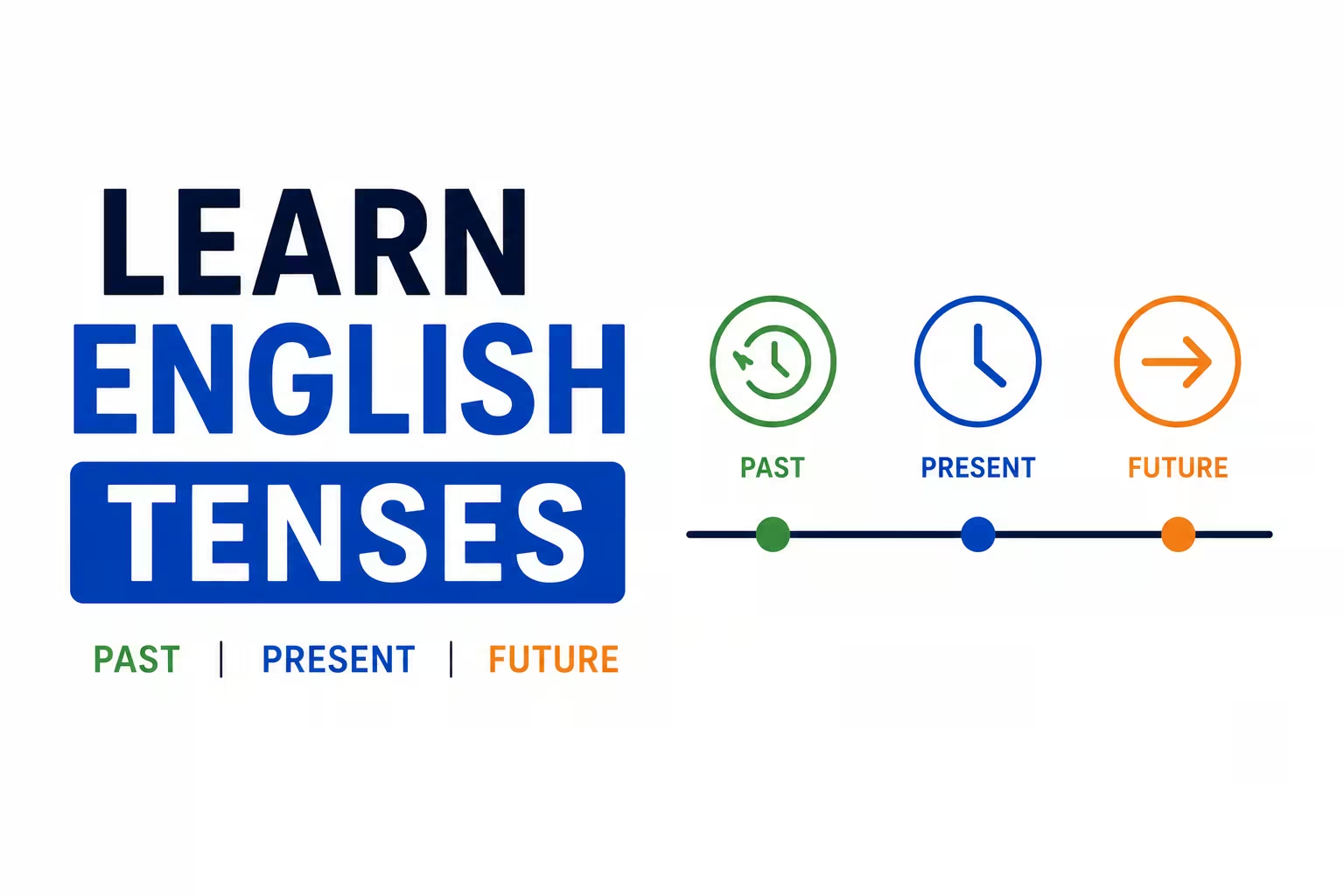
Tenses are verb forms that show time. English has three main time periods:
- Past — something that already happened
- Present — something happening now or regularly
- Future — something that will happen
Within each time period, there are different tenses that give more detail.
For example, the past simple and the past continuous are both past tenses, but they tell us different things about what happened.
Understanding tenses is not just about passing a grammar test.
It helps you speak with confidence, write professional emails, tell stories clearly, and be understood in everyday conversations.
This is why a proper English tense review matters so much for real-world communication.
Part 1: The Present Tenses
Present Simple
The present simple is used for habits, facts, and things that are always true.
Structure: Subject + base verb (add -s/-es for he/she/it)
Examples:
- I work at a school.
- She teaches English every morning.
- Water boils at 100 degrees Celsius.
Common student mistake: Forgetting the -s for third person singular.
❌ She teach every day. ✅ She teaches every day.
In my classroom, I always tell students: “He, she, it — don’t forget the s or it!” It sounds a little silly, but students remember it.
Present Continuous
Use this tense for things happening right now or around this period of time.
Structure: Subject + am/is/are + verb-ing
Examples:
- I am writing a blog post right now.
- They are studying for their exams this week.
- She is not feeling well today.
Common mistake: Using present continuous for habits.
❌ I am eating rice every day. ✅ I eat rice every day.
Present Perfect
This tense connects the past to the present. Use it when the exact time is not important, or when the result of a past action still matters now.
Structure: Subject + have/has + past participle
Examples:
- I have visited London three times.
- She has just finished her assignment.
- We have lived here for five years.
Common student mistake: Mixing up present perfect and past simple.
❌ I have visited London last year. ✅ I visited London last year. (specific time = past simple)
This is one of the most confused tenses in English grammar for learners. A simple rule: if you say when something happened, use past simple. If you don’t mention when, present perfect is usually fine.
Part 2: The Past Tenses
Past Simple
The past simple is used for completed actions in the past, especially when we say or know when it happened.
Structure: Subject + past form of verb (regular: add -ed; irregular: learn the form)
Examples:
- I walked to school yesterday.
- She went to the doctor last Monday.
- They finished the project on time.
Common mistake: Using “did” with a past verb in positive sentences.
❌ I did went to the store. ✅ I went to the store.
I always show students this simple formula: In positive sentences, just use the past form. “Did” is only for questions and negatives.
Past Continuous
Use the past continuous for an action that was in progress at a specific time in the past, or an action that was interrupted.
Structure: Subject + was/were + verb-ing
Examples:
- I was watching TV when the phone rang.
- They were playing football at 5 PM yesterday.
- She was not listening during the meeting.
Teaching tip from my classroom: I use a visual. Draw a timeline. Show a long action in the middle — that’s the past continuous. Then show a short action interrupting it — that’s the past simple. Students understand this much faster than reading rules alone.
Past Perfect
The past perfect is used when you want to show that one past action happened before another past action.
Structure: Subject + had + past participle
Examples:
- By the time I arrived, she had already left.
- He had studied English before he moved abroad.
- They had never eaten sushi before that trip.
This tense is especially useful in storytelling, academic writing, and professional communication.
Part 3: The Future Tenses
Will (Simple Future)
Use will for spontaneous decisions, predictions, and promises.
Structure: Subject + will + base verb
Examples:
- I will help you with that right now.
- It will rain tomorrow, I think.
- She will call you back soon.
Going To (Planned Future)
Use going to when you have already made a plan or when something is very likely based on evidence.
Structure: Subject + am/is/are + going to + base verb
Examples:
- I am going to start a new course next month.
- Look at those clouds — it is going to rain.
- We are going to move to a bigger apartment.
Common student mistake: Using will for all future situations.
❌ I will visit my parents tomorrow. (This is okay, but “going to” is more natural for a clear plan.) ✅ I am going to visit my parents tomorrow. (planned, decided already)
Future Continuous
Use this to describe an action that will be in progress at a specific time in the future.
Structure: Subject + will be + verb-ing
Examples:
- At this time tomorrow, I will be flying to Dubai.
- She will be working when you arrive.
Common Tense Mistakes — And How to Fix Them
After teaching thousands of students, I have noticed these are the most frequent tense mistakes:
1. Confusing past simple and present perfect
The fix: Ask yourself — do I know when this happened? If yes, use past simple.
2. Forgetting the third-person -s in present simple
The fix: Practice speaking aloud. Say “He runs, she runs, it runs” until it becomes automatic.
3. Using will for all future plans
The fix: Remember — spontaneous = will. Already planned = going to.
4. Using present tense instead of past tense in stories
The fix: When telling a story about the past, check every verb. Did it already happen? Use past form.
5. Overusing the present continuous
The fix: Not all actions in progress are continuous. Stative verbs (know, believe, want, love) are rarely used in continuous form.
Practice Section: Test Your Tense Knowledge
Try these exercises. Choose the correct tense.
Exercise 1 — Fill in the blank:
- She ______ (study) English for three years. (present perfect)
- When I arrived, he ______ (leave) already. (past perfect)
- I ______ (call) you tomorrow morning. (will/future)
- They ______ (watch) a movie right now. (present continuous)
- He ______ (work) in a bank before he retired. (past simple)
Answers:
- has studied
- had already left
- will call
- are watching
- worked
Exercise 2 — Correct the mistakes:
- I have seen him yesterday.
- She is knowing the answer.
- They was playing when the bell rang.
Answers:
- I saw him yesterday.
- She knows the answer.
- They were playing when the bell rang.
Practical Classroom Applications
Whether you are a teacher designing a lesson or a student wanting to practice, here are activities that actually work:
1. Timeline Activity
Draw a timeline on a whiteboard or paper. Place events on it and ask students to identify which tense describes each event. This makes tense logic visual and easy to understand.
2. Story Retelling
Give students a short story in the present tense. Ask them to rewrite it in the past tense. This forces them to think about every verb they use.
3. Daily Diary Exercise
Ask students to write 5 sentences every day — one for each major tense. This builds tense awareness naturally over time.
4. Conversation Cards
Create question cards with prompts like “Tell me about something you have done this week” or “What were you doing at 9 PM last night?” These cards make tense practice feel like real conversation.
5. Error Correction Practice
Show students sentences with tense mistakes and ask them to find and correct the errors. Students enjoy being “grammar detectives,” and it sharpens their ability to self-correct in real time.
In my online classes, I often use a shared Google Doc where students write sentences using a target tense, and then we correct together live. This works just as well as an in-person class, and students stay engaged because they can see each other’s responses.
A Note on Spoken English and Tense Confidence
One thing I always remind my students: knowing a tense on paper and using it in a conversation are two different skills. Many learners understand the rules but freeze when speaking.
The solution is simple: practice out loud every day.
Read your exercises aloud. Narrate what you are doing throughout the day in English. Talk to yourself in the mirror. Record voice notes on your phone. The more you say the tenses, the more natural they will feel.
Building tense fluency takes time. Do not expect perfection in one week. Expect small, steady progress every day. That is what real language learning looks like.
Conclusion: Keep Practicing Your English Tense Review
An English tense review is not a one-time event. It is an ongoing part of learning and improving your English.
Whether you are a beginner or an advanced learner, revisiting tenses regularly keeps your grammar sharp and your communication clear.
Here is a quick recap of what we covered:
- Present tenses — present simple, continuous, and perfect
- Past tenses — past simple, continuous, and perfect
- Future tenses — will, going to, and future continuous
- Common mistakes and how to fix them
- Practice exercises you can use today
- Classroom activities for teachers and self-learners
The most important thing is to keep going. Set realistic expectations. Make mistakes — that is part of the learning process. Fix them. Move forward.
Your English will improve with consistent, focused practice.
Frequently Asked Questions (FAQs)
Q1: How many English tenses are there?
English has 12 main tenses, divided into past, present, and future — each with simple, continuous, perfect, and perfect continuous forms. However, the most commonly used tenses in everyday speech are the six covered in this guide.
Q2: What is the difference between past simple and present perfect?
Past simple is used when you know when something happened (e.g., “I visited Paris last year”). Present perfect is used when the time is not mentioned or when the result still matters now (e.g., “I have visited Paris”).
Q3: How can I practice English tenses at home?
The best ways include writing a daily diary, doing fill-in-the-blank exercises, recording yourself speaking, and narrating your own daily activities out loud in English.
Q4: Why do ESL learners struggle most with English tenses?
Many learners struggle because their native language may not use tenses the same way English does. For example, some languages do not distinguish between present perfect and past simple. Awareness of this difference — and lots of practice — helps overcome this challenge.
Q5: Which tense should I focus on first as a beginner?
Start with the present simple and past simple. These two tenses cover a large portion of everyday English communication. Once you are comfortable with them, move on to present perfect and the future forms.
Found this article helpful? Share it with a student, colleague, or friend who is learning English. Consistent grammar practice is the fastest path to confident communication.
Explore more topics here:
- Present Tense: Definition, Structure, Types, Rules and Examples
- Past Continuous Tense: How and When to Use It
- How Do I Use the Present Perfect Tense Correctly? (Easy Guide)
- Difference Between Could and Would in English Grammar