After teaching English to thousands of students over the past twelve years, I’ve noticed something interesting: proper nouns confuse learners more than almost any other grammar topic. Just last week, one of my online students wrote “i live in bangalore and work at microsoft” in an email assignment. When I pointed out the capitalization errors, she looked genuinely surprised. “But miss,” she said, “how do I know which words need capital letters?”
This question comes up constantly in my classroom, both with ESL learners and native English speakers who want to polish their writing. Understanding proper nouns isn’t just about passing grammar tests—it’s about writing clearly, professionally, and correctly in real-world situations like job applications, business emails, and academic papers.
In this comprehensive guide, I’ll share 550 proper noun examples across different categories, explain exactly what makes a noun “proper,” and give you practical tips I’ve developed through years of teaching experience. Whether you’re a student preparing for exams, a parent helping with homework, a teacher planning lessons, or a professional improving your writing skills, this article will answer all your questions about proper nouns.
What Are Proper Nouns? (Simple Explanation)
Let me explain this the way I do in my beginner classes: A proper noun is the specific name of a particular person, place, or thing. It always starts with a capital letter, no matter where it appears in a sentence.
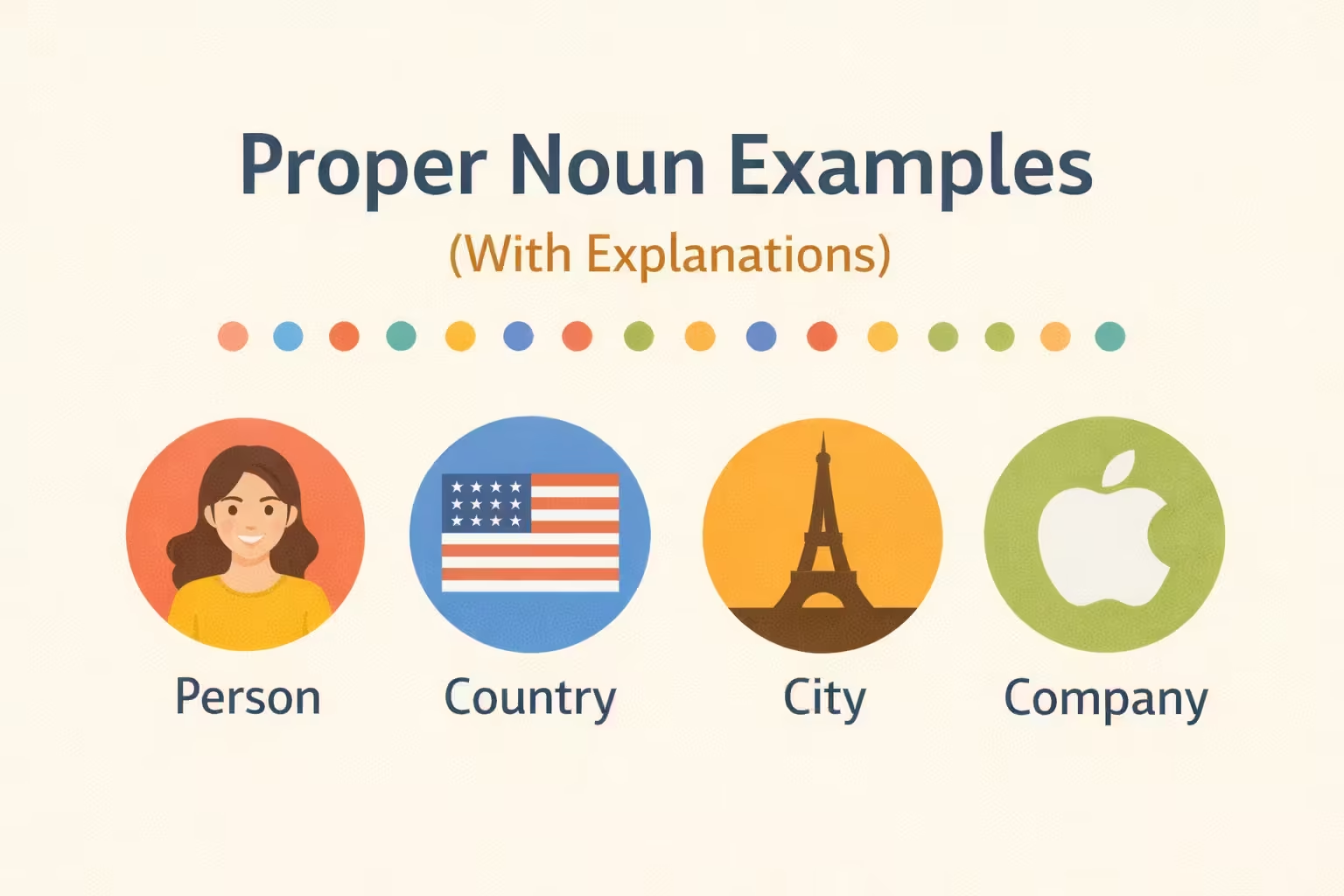
Think of it this way: “city” is a common noun because it could mean any city in the world. But “Mumbai” is a proper noun because it names one specific city. “Woman” is common, but “Mary Johnson” is proper. “Company” is common, but “Amazon” is proper.
Here’s the golden rule I teach my students: If you can point to one specific thing and say “that exact one,” you’re probably dealing with a proper noun.
The opposite of a proper noun is a common noun—words like dog, teacher, country, or building. These refer to general categories, not specific names.
Why Proper Nouns Matter in Real Life
In my teaching career, I’ve seen students lose job opportunities because their resumes contained capitalization errors. I’ve watched learners struggle to write professional emails because they weren’t sure whether to capitalize job titles or company departments. Understanding proper nouns isn’t just academic—it affects how others perceive your education and professionalism.
When you capitalize proper nouns correctly, you show:
- Attention to detail
- Professional writing skills
- Respect for names and titles
- Clear communication abilities
Now, let’s dive into the categories with hundreds of examples.
1. People’s Names (Proper Noun Examples)
This is the easiest category for most students. Every person’s name is a proper noun, including first names, middle names, last names, and nicknames.
First Names: Alexander, Priya, Muhammad, Sarah, Wei, Carlos, Fatima, James, Yuki, Isabella, Ahmed, Emma, Diego, Aisha, Chen, Olivia, Luis, Zara, Kenji, Sophia
Last Names: Smith, Patel, García, Johnson, Kim, O’Brien, Zhang, Williams, Martinez, Brown, Singh, Wilson, Rodriguez, Taylor, Nguyen, Anderson, Lee, Thomas, Jackson, White
Full Names: William Shakespeare, Marie Curie, Nelson Mandela, Malala Yousafzai, Albert Einstein, Maya Angelou, Leonardo da Vinci, Rosa Parks, Mahatma Gandhi, Jane Austen, Martin Luther King Jr., Frida Kahlo, Steve Jobs, Oprah Winfrey, Abraham Lincoln
Nicknames: Mike (for Michael), Liz (for Elizabeth), Tony (for Anthony), Kate (for Katherine), Sam (for Samantha or Samuel), Alex (for Alexander or Alexandra)
Teaching tip from my classroom: Students often forget to capitalize names in the middle of sentences. I always tell them: “If it’s someone’s name, it gets a capital letter—period. Even if it’s in the middle or at the end of a sentence.”
2. Places: Cities, Countries, States, and Regions
Geography gives us hundreds of proper noun examples. Every specific location name needs capitalization.
Countries: United States, India, Brazil, China, Canada, Australia, Germany, Japan, Mexico, France, Italy, South Africa, Egypt, Russia, Argentina, Nigeria, Thailand, Spain, Indonesia, United Kingdom
Cities: New York, London, Paris, Tokyo, Delhi, São Paulo, Beijing, Cairo, Moscow, Sydney, Toronto, Berlin, Dubai, Singapore, Mumbai, Los Angeles, Chicago, Rome, Amsterdam, Barcelona
States and Provinces: California, Texas, Maharashtra, Ontario, Queensland, Bavaria, Guangdong, New South Wales, Punjab, Florida
Continents: Africa, Antarctica, Asia, Australia, Europe, North America, South America
Regions: Middle East, Southeast Asia, Caribbean, Scandinavia, Mediterranean, Midwest, New England, Pacific Northwest, Latin America, Sub-Saharan Africa
Landmarks and Specific Locations: Eiffel Tower, Grand Canyon, Great Wall of China, Statue of Liberty, Taj Mahal, Niagara Falls, Mount Everest, Buckingham Palace, Pyramids of Giza, Golden Gate Bridge
Addresses: 123 Main Street, 42 Park Avenue, 789 Oak Drive (Note: “Street,” “Avenue,” and “Drive” are capitalized when part of a specific address)
Explore more English grammar topics here:
- Common Collocations with Nouns in English
- English Nouns: Definition, Types, and Examples
- Understanding Plural Nouns: Rules and Examples
- What Are Singular Nouns, and How Do They Work?
- Understanding the Difference Between Nouns and Pronouns
3. Organizations, Companies, and Brands
This category causes confusion in my business English classes. Students often ask, “Do I capitalize ‘the’ in ‘The New York Times’?” (Yes, if it’s officially part of the name.)
Technology Companies: Apple, Microsoft, Google, Amazon, Facebook, Tesla, Samsung, Intel, IBM, Oracle, Adobe, Netflix, Spotify, Twitter (X), LinkedIn
Retail Brands: Walmart, Target, Nike, Adidas, IKEA, McDonald’s, Starbucks, Coca-Cola, Pepsi, Toyota, Ford, Honda, Zara, H&M, Uniqlo
Organizations: United Nations, World Health Organization, Red Cross, UNICEF, NATO, European Union, World Bank, Amnesty International, Greenpeace, Save the Children
Educational Institutions: Harvard University, MIT, Oxford University, Stanford University, Yale University, Cambridge University, Princeton University, University of California, IIT Delhi, National University of Singapore
Government Bodies: Congress, Senate, Parliament, Supreme Court, House of Representatives, Department of Education, Federal Bureau of Investigation, Central Intelligence Agency
Teaching note: My students often write “I work at microsoft” or “I bought it from amazon.” I explain that company names are like people’s names—they deserve respect and capitalization.
4. Days, Months, and Holidays (Proper Nouns)
Many ESL learners from countries where these aren’t capitalized struggle with this rule in English.
Days of the Week: Monday, Tuesday, Wednesday, Thursday, Friday, Saturday, Sunday
Months: January, February, March, April, May, June, July, August, September, October, November, December
Holidays: Christmas, Easter, Ramadan, Diwali, Hanukkah, Thanksgiving, New Year’s Day, Independence Day, Labor Day, Memorial Day, Veterans Day, Chinese New Year, Eid al-Fitr, Kwanzaa, Cinco de Mayo
Important note: Seasons (spring, summer, fall/autumn, winter) are NOT proper nouns and should not be capitalized unless they start a sentence.
5. Titles and Positions (When They’re Proper Nouns)
This is where my intermediate students get tricky questions wrong. The rule: capitalize titles when they come before a name or when used as a direct address.
Political Titles: President Biden, Prime Minister Modi, Queen Elizabeth, King Charles, Senator Warren, Governor Newsom, Mayor Adams, Chancellor Merkel
Professional Titles: Dr. Smith, Professor Johnson, Dean Martinez, Judge Brown, Captain Anderson, Chief Executive Officer Tim Cook
Religious Titles: Pope Francis, Dalai Lama, Archbishop Tutu, Rabbi Cohen, Imam Khan, Pastor Williams
Family Titles Used as Names: “I asked Mom for help” (proper) vs. “I asked my mom for help” (common)
In my classes, I use this test: If you can replace the title with the person’s actual name and the sentence still makes sense, capitalize it. “I spoke with President Biden” works the same as “I spoke with Joe Biden.”
6. Languages, Nationalities, and Ethnic Groups
Languages: English, Spanish, Mandarin, Hindi, Arabic, French, German, Portuguese, Russian, Japanese, Korean, Italian, Turkish, Vietnamese, Bengali
Nationalities: American, Indian, Chinese, Brazilian, Mexican, Nigerian, Egyptian, Australian, Canadian, British, French, Japanese, German, Italian, South African
Ethnic Groups: Hispanic, Asian, African American, Latino, Indigenous, Aboriginal, Maori, Cherokee, Navajo, Zulu
7. Religions and Religious Terms
Religions: Christianity, Islam, Hinduism, Buddhism, Judaism, Sikhism, Jainism, Taoism, Shinto, Zoroastrianism
Religious Texts: Bible, Quran (Koran), Torah, Vedas, Bhagavad Gita, Tripitaka, Guru Granth Sahib
Deities: God, Allah, Vishnu, Shiva, Buddha, Jesus Christ, Krishna, Zeus, Thor
8. Historical Events and Periods
Wars and Conflicts: World War I, World War II, American Civil War, French Revolution, Cold War, Vietnam War, Gulf War
Historical Periods: Renaissance, Industrial Revolution, Middle Ages, Bronze Age, Enlightenment, Reformation, Victorian Era, Roaring Twenties
Specific Events: D-Day, Pearl Harbor, Boston Tea Party, Moon Landing, Fall of the Berlin Wall
9. Books, Movies, Songs, and Creative Works
All words in titles are capitalized except small words (articles, short prepositions, conjunctions) unless they’re the first word.
Books: To Kill a Mockingbird, Harry Potter and the Sorcerer’s Stone, The Great Gatsby, Pride and Prejudice, 1984, The Catcher in the Rye
Movies: The Godfather, Titanic, Inception, The Shawshank Redemption, Forrest Gump, The Dark Knight, Pulp Fiction
Songs: “Bohemian Rhapsody,” “Imagine,” “Like a Rolling Stone,” “Billie Jean,” “Hey Jude,” “Smells Like Teen Spirit”
TV Shows: Friends, Breaking Bad, Game of Thrones, The Office, Stranger Things, The Crown
Newspapers and Magazines: The New York Times, The Guardian, Time Magazine, National Geographic, The Washington Post, Forbes
10. Transportation: Planes, Ships, and Vehicles
Ships: Titanic, USS Enterprise, HMS Victory, Queen Mary, Mayflower
Spacecraft: Apollo 11, Space Shuttle Columbia, Voyager 1, International Space Station
Famous Trains: Orient Express, Bullet Train (Shinkansen), Trans-Siberian Railway
11. Awards and Prizes
Nobel Prize, Academy Award (Oscar), Grammy Award, Pulitzer Prize, Booker Prize, Emmy Award, Tony Award, Golden Globe, Fields Medal, Olympic Gold Medal
12. Products and Specific Models
iPhone 14, PlayStation 5, Samsung Galaxy, MacBook Pro, iPad Air, Honda Civic, Toyota Camry, Boeing 747, Coca-Cola Classic, Big Mac
13. Scientific and Medical Terms (Specific Names)
Diseases Named After People: Alzheimer’s Disease, Parkinson’s Disease, Down Syndrome, Hodgkin’s Lymphoma
Medications (Brand Names): Tylenol, Advil, Lipitor, Prozac, Aspirin (when referring to Bayer’s brand)
Note: Generic medical terms like “diabetes” or “cancer” are common nouns.
14. Currency Names
Dollar, Euro, Pound Sterling, Yen, Rupee, Peso, Yuan, Franc, Real, Ruble
15. Special Days and Events
Super Bowl, Olympics, World Cup, Boston Marathon, Cannes Film Festival, Met Gala, Coachella, Kentucky Derby, Wimbledon, Tour de France
16. Buildings and Structures
Empire State Building, Burj Khalifa, Sydney Opera House, White House, Pentagon, Capitol Building, Tower of London, Colosseum, Big Ben, Gateway of India
17. Parks and Natural Features
Yellowstone National Park, Central Park, Sahara Desert, Amazon Rainforest, Pacific Ocean, Atlantic Ocean, Mississippi River, Lake Superior, Rocky Mountains, Himalayas
18. Streets and Specific Roads
Fifth Avenue, Route 66, Sunset Boulevard, Abbey Road, Champs-Élysées, Wall Street, Pennsylvania Avenue, Lombard Street, Rodeo Drive
19. Teams and Clubs
Sports Teams: Los Angeles Lakers, New York Yankees, Manchester United, Real Madrid, Chicago Bulls, New England Patriots, Barcelona FC, Golden State Warriors
Organizations: Boy Scouts, Girl Scouts, Rotary Club, Lions Club, Kiwanis International
20. Programming Languages and Technology
Java, Python, JavaScript, C++, Ruby, Swift, HTML, CSS, SQL, PHP
Common Mistakes I See in My Classroom
After years of teaching, these are the errors I correct most often:
Mistake 1: Writing “i went to paris last summer” Correct: “I went to Paris last summer.”
Mistake 2: “My Mother works at Apple.” Correct: “My mother works at Apple.” (unless starting a sentence or using “Mother” as a name)
Mistake 3: “I speak spanish and french.” Correct: “I speak Spanish and French.”
Mistake 4: “We celebrate christmas in December.” Correct: “We celebrate Christmas in December.”
Mistake 5: “The president will visit tomorrow.” Correct: “The president will visit tomorrow.” (lowercase unless you mean a specific president with their title: “President Biden will visit tomorrow.”)
Quick Practice Exercise
I use this with my intermediate students. Identify the proper nouns that need capitalization:
- “my friend sarah works at google in california.”
- “we’re reading to kill a mockingbird in english class.”
- “dr. patel will speak at harvard university next monday.”
Answers:
- My friend Sarah works at Google in California.
- We’re reading To Kill a Mockingbird in English class.
- Dr. Patel will speak at Harvard University next Monday.
Teaching Tips for Parents and Teachers
Based on my classroom experience, here’s what works:
For Young Learners: Use color coding. Have students highlight all proper nouns in a passage with a specific color. This visual approach helps them recognize patterns.
For ESL Students: Create comparison charts showing common nouns next to their proper noun counterparts: city/New York, river/Nile, language/English.
For Everyone: Read well-edited published writing. Notice capitalization in newspapers, books, and professional websites. This builds natural recognition.
Practice Consistently: Just like spoken fluency requires regular conversation practice, proper noun mastery requires regular writing with immediate feedback.
Conclusion: Mastering Proper Nouns Takes Practice
Understanding proper noun examples and their capitalization rules is a fundamental writing skill that impacts how others perceive your education and professionalism. From people’s names to company brands, from holidays to historical events, recognizing which nouns are “proper” becomes easier with practice and real-world application.
In my twelve years of teaching, I’ve watched countless students transform their writing by mastering this single grammar concept. The 550 proper noun examples I’ve shared here cover the categories you’ll encounter most often in daily communication, academic writing, and professional correspondence.
Remember: every time you write someone’s name, a specific place, a company, a day of the week, a holiday, or any other particular thing that deserves special recognition, ask yourself, “Am I naming something specific?” If yes, capitalize it. If it’s a general category, keep it lowercase.
Start paying attention to proper nouns in everything you read today. Notice them in news articles, emails, books, and social media posts. With consistent awareness and practice, correct capitalization will become automatic—just like it has for thousands of my students who once struggled with this same concept.
Keep practicing, stay patient with yourself, and remember that every professional writer once had to learn these same rules. You’re on the right path to clearer, more confident writing.