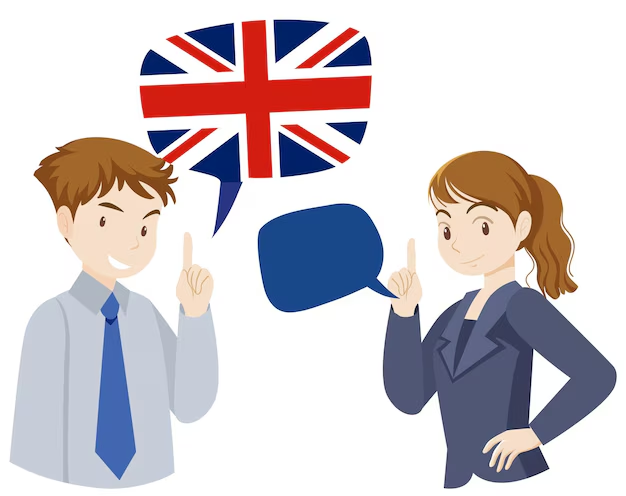
Success in the US job market depends on more than technical knowledge. Employers value strong soft skills and communication in English for US workplaces just as much as professional expertise.
From participating in meetings and writing professional emails to handling feedback and resolving conflicts, clear and confident communication plays a key role in career growth.
Understanding workplace culture, tone, and expectations can help you build better relationships and stand out as a reliable team member.
In this guide, Soft Skills and Communication in English for US Workplaces, you will learn essential business English phrases, workplace communication strategies, and practical soft skills such as teamwork, leadership, and problem-solving.
Whether you are an international professional, job seeker, or employee aiming for promotion, this article will help you improve your professional English communication and succeed in the American workplace environment.
This topic is part of our English Learning for English learners.
What Are Soft Skills? (And Why They Matter More Than You Think)
Soft skills are personal qualities and interpersonal abilities that help you work well with others. Unlike “hard skills” (technical abilities like programming, accounting, or operating machinery), soft skills are about how you interact, communicate, and handle workplace situations.
Think of it this way: hard skills show you can do the job, while soft skills show you can do the job well with other people.
In US workplaces, soft skills are incredibly important. A 2023 LinkedIn survey found that 92% of hiring managers say soft skills are just as important as technical skills, and sometimes even more important. Why? Because companies know they can train you on technical tasks, but qualities like communication, teamwork, and problem-solving are much harder to teach.
The Most Important Soft Skills for American Workplaces
Let’s break down the key soft skills that US employers value most:
1. Communication Skills
Communication is the foundation of everything you’ll do at work. In American business culture, clear and direct communication is highly valued. This includes:
Verbal communication: Speaking clearly during meetings, presentations, and everyday conversations. Americans typically appreciate when people get to the point rather than using indirect language.
Written communication: Writing professional emails, reports, and messages. Good written English shows attention to detail and professionalism.
Active listening: Paying attention when others speak, asking clarifying questions, and showing you understand. Americans often say “active listening” because it’s not just hearing words but truly engaging with what someone is saying.
Non-verbal communication: Your body language, eye contact, and facial expressions. In the US, maintaining appropriate eye contact shows confidence and engagement. A firm handshake is still common in professional settings.
2. Teamwork and Collaboration
American workplaces often emphasize team projects and collaborative work. Being a “team player” means:
- Contributing your ideas while respecting others’ opinions
- Sharing credit for successes
- Supporting colleagues when they need help
- Being flexible and adaptable when working with different personalities
Here’s an important cultural note: In the US, speaking up and sharing your ideas is encouraged, even if you’re new to the team. Your input is valued, so don’t wait to be asked for your opinion in every situation.
3. Problem-Solving and Critical Thinking
Employers want people who can identify problems and propose solutions. This doesn’t mean you need to solve every problem alone, but you should be able to:
- Analyze situations logically
- Consider different solutions
- Make recommendations based on facts
- Think creatively when standard approaches don’t work
When you bring a problem to your manager, try to also bring potential solutions. Americans often call this “bringing solutions, not just problems.”
4. Emotional Intelligence (EQ)
Emotional intelligence is your ability to understand and manage your own emotions while also recognizing and responding to others’ emotions. This includes:
- Self-awareness: Knowing your strengths, weaknesses, and how your emotions affect your work
- Empathy: Understanding how others feel and responding with compassion
- Emotional regulation: Staying calm and professional, even in stressful situations
- Social skills: Building positive relationships with colleagues
High emotional intelligence helps you navigate office politics, handle conflicts gracefully, and build strong professional relationships.
5. Time Management and Organization
American work culture often moves quickly, with multiple projects happening simultaneously. You’ll need to:
- Prioritize tasks effectively
- Meet deadlines consistently
- Manage your schedule independently
- Balance multiple responsibilities
Being organized shows professionalism and reliability, two qualities highly valued in US workplaces.
6. Adaptability and Flexibility
The American business environment changes rapidly. Technology evolves, priorities shift, and unexpected challenges arise. Employers value people who can:
- Adjust to new situations quickly
- Learn new skills when needed
- Handle ambiguity and uncertainty
- Stay positive during change
Saying “I’m willing to learn” or “I can adapt to that” demonstrates the flexible mindset American employers appreciate.
English Communication Patterns in US Workplaces
Now let’s talk specifically about how English is used in American professional settings. Understanding these patterns will help you communicate more effectively.
Direct Communication Style
Americans generally prefer direct, straightforward communication in business settings. This might feel uncomfortable if you come from a culture that values indirect communication, but it’s important to understand.
What this means in practice:
Instead of saying: “Maybe we should possibly consider perhaps looking at other options if that’s okay with everyone…”
Americans typically say: “Let’s explore other options.”
Instead of: “I’m very sorry to bother you, but if you have time, would it be possible to maybe…”
Say: “Could you help me with this when you have a moment?”
Being direct doesn’t mean being rude. You can still be polite and direct at the same time by using phrases like “Could you…” “Would you mind…” and “I’d appreciate if…”
Small Talk and Building Rapport
Americans often start meetings or conversations with small talk. Common topics include:
- Weather: “Crazy weather we’re having, right?”
- Weekend plans: “Any fun plans for the weekend?”
- Sports: “Did you catch the game last night?”
- General current events: “Have you been following the news about…?”
Avoid controversial topics like politics, religion, or personal finances during workplace small talk, especially with new colleagues.
Meeting Culture and Expectations
American business meetings have specific communication norms:
Punctuality matters: Arrive on time or a few minutes early. If you’ll be late, send a quick message.
Speak up: Don’t wait for an invitation to share your thoughts. Phrases like “I’d like to add something” or “Building on what Sarah said…” help you enter conversations smoothly.
Ask questions: If something is unclear, ask for clarification. Americans respect people who ask questions rather than pretend to understand.
Action items: Meetings typically end with clear “action items” (specific tasks people will complete). Make sure you understand what you’re responsible for before the meeting ends.
Email Communication
Email is a primary communication tool in US workplaces. Here are key practices:
Subject lines: Make them clear and specific. Example: “Question about Q2 Budget Report” instead of just “Question”
Greeting: Start with “Hi [Name],” or “Hello [Name],” for most workplace emails. Very formal situations might use “Dear [Name],”
Get to the point quickly: Americans prefer concise emails. State your purpose in the first sentence or two.
Professional tone: Even in casual workplaces, emails should maintain professionalism. Avoid excessive exclamation marks, emojis (unless your workplace culture uses them), or overly casual language.
Clear ask: If you need something, state it clearly. “Could you please send me the report by Thursday?” is better than “I was wondering if maybe you might have time to possibly send the report…”
Closing: Common closings include “Best,” “Thanks,” “Best regards,” or “Sincerely” followed by your name.
Practical Tips for Improving Your Workplace English
For Beginners
Start with essential phrases: Learn key workplace expressions like:
- “Could you repeat that, please?”
- “Let me make sure I understand…”
- “I’ll get back to you on that.”
- “Thanks for your help.”
Practice pronunciation of common words: Focus on words you’ll use frequently in your job. Practice saying them clearly, even if they’re challenging.
Build your vocabulary gradually: Learn 3-5 new workplace words or phrases each week. Use them in sentences so they become natural.
Don’t apologize excessively for your English: It’s fine to say “English is my second language” if needed, but constant apologies can undermine your confidence. Most Americans are patient with language learners.
Use clarifying techniques: It’s perfectly acceptable to say:
- “Could you explain that differently?”
- “I want to make sure I understand correctly…”
- “So what you’re saying is… [repeat in your own words]”
For Intermediate Learners
Expand your business vocabulary: Learn industry-specific terms and common business idioms like:
- “Let’s touch base” (let’s connect/talk)
- “Circle back” (return to a topic later)
- “On the same page” (having the same understanding)
- “Think outside the box” (be creative)
Practice active listening responses: Show engagement with phrases like:
- “That’s a great point.”
- “I see what you mean.”
- “That makes sense.”
- “I hadn’t thought of it that way.”
Work on your fluency: Focus less on perfect grammar and more on speaking smoothly and confidently. Native speakers make grammar mistakes too!
Join workplace conversations: Don’t just answer direct questions. Contribute observations, ask follow-up questions, and engage in discussions.
Record yourself: Practice presentations or difficult conversations by recording yourself. Listen back to identify areas for improvement.
For Advanced Learners
Master subtle communication: Work on nuances like:
- Adjusting formality based on context
- Reading between the lines in conversations
- Understanding humor and cultural references
- Recognizing when “yes” might actually mean “maybe” or “I’m not sure”
Develop your professional writing: Focus on writing clear, persuasive emails and reports. Study how successful colleagues write and adapt effective techniques.
Lead meetings and presentations: Volunteer to lead discussions or give presentations. This builds confidence and showcases your skills.
Mentor others: Helping newcomers or interns improves your communication skills and demonstrates leadership.
Seek feedback: Ask trusted colleagues for specific feedback on your communication. “How can I communicate more effectively in meetings?” gives you actionable information.
Common Communication Challenges (And How to Overcome Them)
Understanding Different Accents
American workplaces are diverse, with people from various regions and countries. If you struggle to understand someone’s accent:
- Ask them politely to repeat: “Sorry, could you say that again?”
- Request written follow-up for important information
- Don’t pretend to understand if you don’t
- Remember that others may also find your accent challenging, and that’s okay
Speaking Up in Meetings
Many non-native speakers feel nervous about speaking in meetings. Here’s how to build confidence:
- Prepare key points before meetings
- Start by asking questions if speaking up feels intimidating
- Use phrases like “I have a question about…” to ease into participation
- Remember that hesitation is normal, even for native speakers
Handling Misunderstandings
When miscommunication happens:
- Stay calm and don’t take it personally
- Clarify immediately rather than letting confusion continue
- Use humor when appropriate: “Sorry, I think something got lost in translation there!”
- Learn from the experience to prevent similar issues
Dealing with Fast Conversations
American conversations, especially in casual settings, can be very fast. If you feel lost:
- Ask someone to slow down: “Could you speak a bit more slowly, please?”
- Request written summaries of important conversations
- Focus on understanding the main points rather than every word
- Don’t feel bad about needing extra time to process information
Building Your Soft Skills: A Step-by-Step Action Plan
Ready to improve your soft skills and workplace communication? Here’s a practical plan:
Week 1-2: Self-Assessment
- Identify your strongest soft skills
- Recognize areas needing improvement
- Set specific, measurable goals
Week 3-4: Active Learning
- Read about American workplace culture
- Watch business English videos or TED talks
- Practice new vocabulary and phrases daily
Week 5-8: Application and Practice
- Use new skills in real workplace situations
- Volunteer for projects that stretch your abilities
- Ask for feedback from colleagues or mentors
Ongoing: Reflection and Adjustment
- Keep a journal of communication successes and challenges
- Adjust your approach based on what works
- Celebrate improvements, even small ones
Cultural Considerations for International Workers
Understanding American workplace culture helps you communicate more effectively:
Work-life balance: Americans generally separate work and personal life more than in some cultures. It’s normal to avoid discussing personal problems at work.
Hierarchy and authority: While hierarchy exists, American workplaces are often less formal than in other countries. Using first names with supervisors is common, and questioning decisions respectfully is usually acceptable.
Feedback culture: Americans typically give direct feedback. “This needs improvement” isn’t personal criticism but professional guidance.
Individualism vs. collectivism: American culture emphasizes individual achievement alongside team success. It’s appropriate to take credit for your contributions.
Networking importance: Building professional relationships is crucial for career advancement. Attend company events and connect with colleagues beyond your immediate team.
Your Path Forward
Developing strong soft skills and effective English communication takes time, practice, and patience. Remember that even native English speakers continuously work on these abilities throughout their careers.
The key is consistent effort and a willingness to learn from every interaction. Don’t aim for perfection; aim for progress. Each conversation, email, and meeting is an opportunity to improve.
Your unique perspective as someone who has learned English and navigated multiple cultures is actually an asset. You bring cross-cultural understanding, adaptability, and dedication that many employers highly value.
Start small. Choose one soft skill or communication technique from this guide to focus on this week. Practice it consistently. Then add another. Before you know it, these skills will become natural, and you’ll find yourself communicating with confidence and ease in your American workplace.
Your journey to professional success in the US workplace starts with that first step. You’ve already taken an important one by reading this guide. Now go out there and put these skills into practice.
Frequently Asked Questions (FAQs)
1. What are soft skills in the workplace?
Soft skills are personal and interpersonal abilities that help you communicate, collaborate, solve problems, and work effectively with others. They complement technical skills and are essential for career success.
2. Why are soft skills important in US workplaces?
US employers value soft skills because they improve teamwork, communication, leadership, adaptability, and workplace productivity. Strong soft skills also help employees build positive professional relationships.
3. What are the most important soft skills employers look for?
Some of the most valuable workplace soft skills include:
- Communication
- Teamwork
- Problem-solving
- Adaptability
- Emotional intelligence
- Time management
- Leadership
- Critical thinking
- Organization
- Active listening
4. How can I improve my communication skills in English?
Practice speaking regularly, expand your business vocabulary, listen actively during conversations, write professional emails, and ask for feedback to improve your workplace communication.
5. What is active listening, and why is it important?
Active listening means paying close attention, asking clarifying questions, confirming understanding, and responding thoughtfully. It helps prevent misunderstandings and builds stronger workplace relationships.
6. How should I communicate in US workplace meetings?
Speak clearly, contribute your ideas confidently, ask questions when needed, listen respectfully to others, and participate actively in discussions while maintaining a professional tone.
7. What communication style is common in American workplaces?
American workplace communication is generally direct, clear, respectful, and solution-oriented. Professionals are encouraged to express ideas openly while remaining polite and collaborative.
8. How important is teamwork in the workplace?
Teamwork is essential because most projects require collaboration. Employers value employees who share ideas, support colleagues, communicate effectively, and contribute to common goals.
9. How can I improve my Business English vocabulary?
Read business articles, learn workplace phrases, watch professional presentations, practice conversations, keep a vocabulary notebook, and use new expressions in real workplace situations.
10. What should I do if I don’t understand someone at work?
Politely ask for clarification using phrases such as:
- “Could you please repeat that?”
- “Could you explain that another way?”
- “I want to make sure I understand correctly.”
11. How can international professionals adapt to US workplace culture?
Learn common workplace communication styles, observe company culture, participate in meetings, ask respectful questions, practice professional English daily, and remain open to feedback.
12. What are common communication mistakes to avoid?
Avoid:
- Speaking too indirectly
- Interrupting others
- Ignoring active listening
- Using unclear or overly complex language
- Being afraid to ask questions
- Not confirming important information
13. How can I become more confident speaking English at work?
Prepare before meetings, practice workplace conversations, learn common business phrases, participate regularly in discussions, and focus on communicating clearly rather than speaking perfectly.
14. Who can benefit from improving workplace soft skills?
These skills are valuable for students, job seekers, international professionals, office employees, managers, team leaders, freelancers, and anyone working in an English-speaking professional environment.
15. What is the key to succeeding in a US workplace?
Success comes from combining strong technical knowledge with excellent communication, teamwork, adaptability, emotional intelligence, and continuous learning. Building these soft skills helps you earn trust, contribute effectively, and grow professionally.
You may also like these English learning articles:
- How to Speak English Fluently: 10 Practical Tips
- Fun And Engaging Techniques to Learn English
- How to Learn English Online Fast
- Advantages of Studying English Online
- How English Sounds to Foreign Ears
Want to improve more? Explore our Career Skills section for practical tips and lessons.
📚 Continue Learning English
Choose your next lesson and keep improving your English skills with our free English learning resources.