Introduction: Why So Many Students Struggle With This
If you have ever asked a student, “What is the main idea of this passage?” and watched them stare blankly at the page, you are not alone. Teaching theme and main idea is one of the most common challenges English teachers face — whether in a classroom, an online session, or a tutoring setting.
After more than ten years of teaching English to students of all ages and backgrounds, I can tell you one thing with confidence: most students are not confused because they are not smart. They are confused because no one has shown them a clear, simple way to think about these two concepts.
Knowing how to teach theme and main idea effectively can transform how your students read, listen, and communicate. It helps them understand stories more deeply, write better essays, and even improve their spoken English. In this guide, I will walk you through everything — from what these terms mean, to practical activities you can use in your very next lesson.
What Is Main Idea? A Simple, Clear Explanation
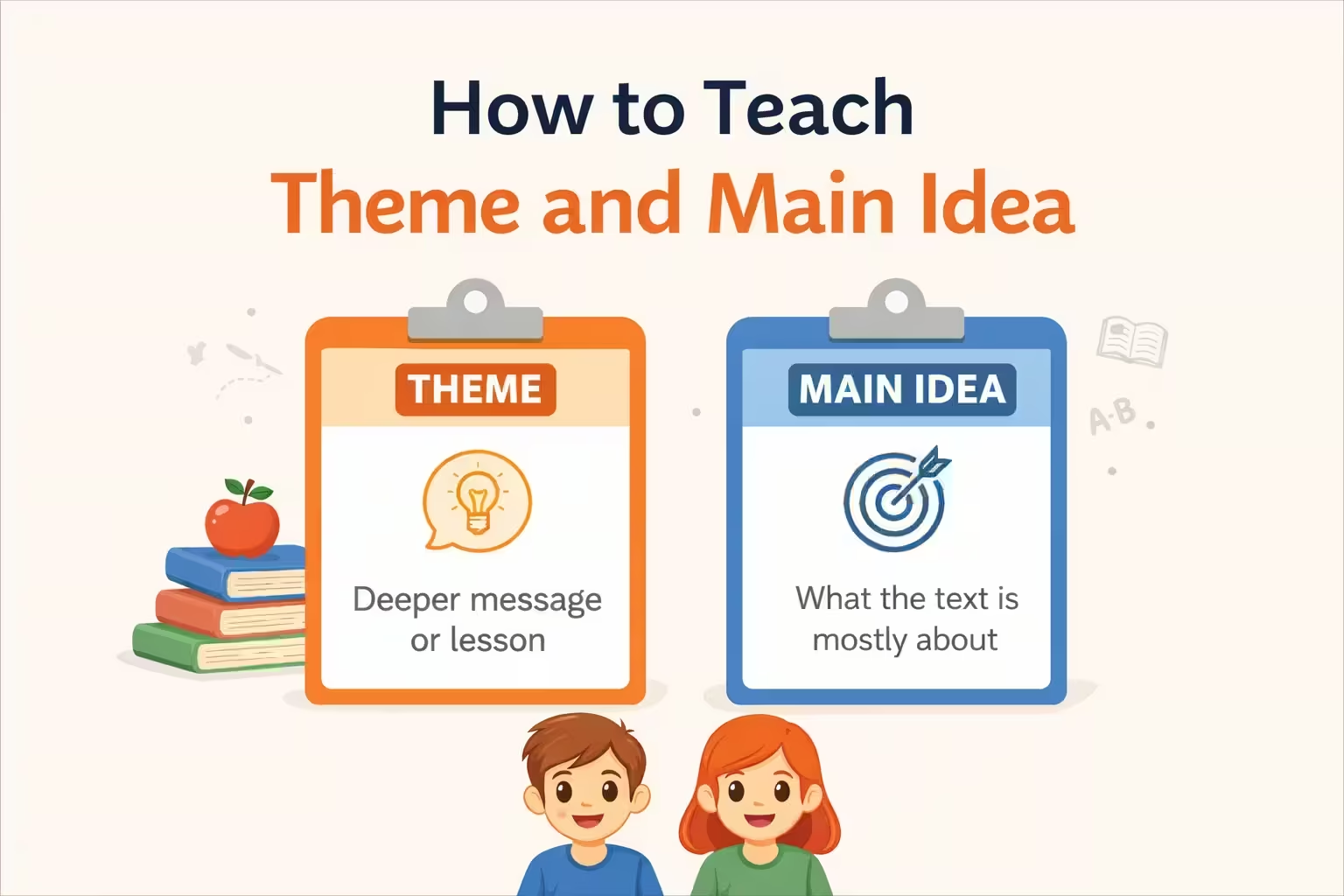
The main idea is what a paragraph or passage is mostly about. It is the central point the writer wants you to understand.
Think of it this way: if a paragraph were a pizza, the main idea would be the dough — the base that holds everything together. All the other sentences (the toppings) support or add detail to that base.
A Quick Example
Read this short paragraph:
“Dogs make wonderful pets. They are loyal, friendly, and easy to train. Many families enjoy having dogs because they are good with children. Dogs can also protect your home.”
The main idea here is: Dogs make great pets. Every other sentence gives a reason or example to support that point.
One of the most common mistakes I see students make is picking a detail and calling it the main idea. For example, a student might say, “The main idea is that dogs protect your home.” That is a detail. The main idea is bigger — it covers the whole paragraph.
What Is Theme? And How Is It Different?
Theme is a little deeper than main idea. While main idea refers to what a text is mostly about, theme is the life lesson or message the writer wants you to take away — especially in stories, poems, and novels.
Theme is usually not stated directly. You have to figure it out from what happens in the story and how the characters behave.
A Simple Way to Explain Theme to Students
I often use this sentence with my students: “Theme is what the story teaches you about life.”
Here are some common themes students will encounter:
- Friendship is worth fighting for
- Hard work leads to success
- Honesty is always the best choice
- Courage helps us overcome fear
- Family is more important than money
Notice that themes are not just one word like “friendship” or “courage.” A theme is a complete idea or message. This is another classic mistake students make — writing a single word as the theme instead of a full sentence.
Main Idea vs. Theme: The Key Differences
This is where most students get confused. Here is a simple comparison:
Main Idea:
- Found in informational texts, articles, and nonfiction passages
- Directly stated (or very clearly suggested)
- Answers the question: “What is this mostly about?”
Theme:
- Found in stories, novels, poems, and fiction
- Usually implied, not directly stated
- Answers the question: “What life lesson does this story teach?”
I use a simple classroom trick. I draw two columns on the board and label them “Nonfiction” and “Fiction.” I then ask: “When we read a news article, are we looking for a main idea or a theme?” Students usually figure it out on their own, which helps the lesson stick.
How to Teach Main Idea: Step-by-Step Strategies
Step 1: Start With Short Paragraphs
Do not start with full articles or long chapters. Use three to five sentence paragraphs first. Short texts allow students to practice the skill without feeling overwhelmed.
In my early teaching years, I made the mistake of giving students a full two-page article and asking them to find the main idea. The result? Panic. Silence. Frustration. When I switched to short paragraphs, everything changed.
Step 2: Teach the “Topic Sentence” Shortcut
Most well-written paragraphs begin with a topic sentence — and that topic sentence is often the main idea. Teach students to look at the first sentence carefully. Ask: “Does this sentence tell us what the whole paragraph is about?”
Of course, sometimes the main idea comes at the end or in the middle. Once students are comfortable with topic sentences, you can introduce those variations.
Step 3: Use the “Somebody-Wanted-But-So-Then” Method for Stories
This is a brilliant strategy for narrative texts. Ask students to fill in this frame:
- Somebody: Who is the main character?
- Wanted: What did they want?
- But: What problem got in the way?
- So: What did they do about it?
- Then: How did it end?
This method helps students summarize the text AND leads them naturally toward identifying the theme.
Step 4: Ask “So What?” After Every Summary
After a student summarizes a paragraph, ask: “So what? Why does this matter? What is the writer trying to tell us?” This single question is powerful. It pushes students beyond the surface and helps them find the deeper message.
Explore more interesting topics:
- Formative Assessment Ideas for ELA: A Practical Guide for Every Classroom
- Independent Reading Activities for Middle School ELA
- Responsive Teaching Strategies for ELA Teachers
- How To Become A Freelancer In 8 Steps: A Complete Guide
- 40 English Phrasal Verbs Related to Songs and Music
How to Teach Theme: Step-by-Step Strategies
Step 1: Use Short Fables or Folk Tales First
Fables are perfect for teaching theme because they are short, clear, and always have a moral. Start with classics like The Tortoise and the Hare or The Boy Who Cried Wolf.
Ask students: “What lesson did the character learn? What lesson can we learn from this story?”
Step 2: Look at Character Changes
Theme often hides in how a character changes from the beginning to the end of a story. Ask:
- How was the character at the start?
- What happened to them?
- How did they change by the end?
- What did they learn?
Their answer to the last question is usually very close to the theme.
Step 3: Look for Repeated Ideas
If a word, idea, or symbol keeps appearing in a story, it is probably connected to the theme. For example, if a story keeps mentioning doors — opening doors, closing doors, locked doors — the theme might be about opportunity or choices.
Step 4: Use a Theme Statement Frame
Give students this sentence frame to build a theme statement:
“In this story, the author shows us that ________.”
This simple structure forces students to write a complete thought rather than just one word.
Common Student Mistakes (And How to Fix Them)
Mistake 1: Confusing the Topic With the Main Idea
Students often say the main idea is “dogs” or “friendship.” Those are topics, not main ideas. Teach them that the main idea must be a full sentence that makes a point about the topic.
Fix: Practice with this question: “Can I ask ‘What about it?’ after your answer?” If yes, they have given a topic, not a main idea.
Mistake 2: Writing One Word as the Theme
As mentioned earlier, students write “courage” instead of “Courage helps us face our fears.” This is a very common shortcut that misses the point entirely.
Fix: Require students to always write themes as complete sentences. Make it a classroom rule from day one.
Mistake 3: Using Details to Explain Main Idea
A student might say, “The main idea is that dogs protect your home.” That is a supporting detail, not the main idea.
Fix: After a student gives a main idea, ask: “Does every sentence in the paragraph support this?” If the answer is no, they have found a detail, not the main idea.
Mistake 4: Stating the Plot Instead of the Theme
Students often write the theme as a plot summary: “The theme is that the rabbit lost the race.” That is what happened, not the lesson.
Fix: Ask: “What life lesson does that teach us?” Redirect them toward the message behind the event.
Practical Classroom Activities That Actually Work
Activity 1: Headline Writing
Give students a short paragraph and ask them to write a newspaper headline for it. A good headline usually captures the main idea. This is a fun, low-pressure way to practice.
Activity 2: Theme Sorting Cards
Write several theme statements on cards. Then write several short story summaries on other cards. Ask students to match each story to its theme. This works perfectly in both in-person and online classes using digital tools like Google Slides.
Activity 3: The “Delete and Check” Method
Ask students to cross out one sentence from a paragraph and check: “Does the paragraph still make sense without it?” Supporting details can be removed without losing the main point. The main idea cannot be removed — the paragraph falls apart without it.
Activity 4: Picture Book Analysis
Even for older students, picture books work beautifully for teaching theme. Books like The Giving Tree or Enemy Pie carry rich themes that can spark powerful discussions. Students feel less pressure with picture books, which means they participate more freely.
Activity 5: Quick Writes
After reading a short story or passage, give students two minutes to write: “The main idea is… The theme might be… because…”
This exercise combines reading comprehension with writing practice. It also helps you quickly assess who understands the concepts and who needs more support.
Teaching These Skills in Online Classes
Online teaching requires some adjustments, but the core strategies remain the same. Here is what works well in virtual settings:
Use breakout rooms to let small groups discuss theme and main idea before sharing with the class. Students often feel more confident speaking in small groups first.
Use the chat box for quick checks. Ask: “Type the main idea of paragraph one in the chat — ready, go!” This keeps all students engaged, not just the ones who raise their hands.
Use shared Google Docs where students highlight the main idea in yellow and supporting details in blue. Color-coding works surprisingly well for visual learners.
Screen-share short video clips from animated fables and pause to discuss: “What do you think the theme is so far?” This works brilliantly for younger learners and ESL students.
A Note for ESL and English Learners
If English is not your first language, these concepts might feel extra challenging. That is completely normal. Here is something encouraging: the ideas behind main idea and theme exist in every language and culture. Every story your grandmother ever told you had a theme. Every lesson your teacher gave you had a main idea.
Your job is simply to learn the English way of talking about something you already understand. Start with simple texts in topics you enjoy. Sports articles, food blogs, or short folk tales from your own culture can all be used to practice finding main idea and theme.
Progress takes time. Be patient with yourself. The more you read and discuss, the more natural it becomes.
Conclusion: Making Main Idea and Theme Simple
Knowing how to teach theme and main idea — or how to understand these concepts as a learner — is a skill that pays off in every area of English study. It improves reading comprehension, strengthens writing, and builds critical thinking.
The key is to keep things simple at first. Use short texts. Ask the right questions. Practice regularly. And always remember that mistakes are part of learning, not a sign of failure.
Whether you are a teacher designing your next lesson or a student working through a reading passage tonight, you now have clear steps, real examples, and practical tools to work with. Start small. Be consistent. And trust the process.
FAQs About Teaching Theme and Main Idea
Q1: What is the easiest way to explain main idea to beginners?
Tell them: “The main idea is what the whole paragraph is mostly about.” Ask them to imagine they have five seconds to tell a friend what they just read. That quick summary is usually the main idea.
Q2: How do I help students stop confusing theme with plot?
Remind them that plot is what happened and theme is what it means. Ask: “What lesson does the character learn? What lesson can we learn?” That redirects students from events to meaning.
Q3: Can I teach theme and main idea at the same time?
It is better to teach them separately at first. Once students are comfortable with each concept individually, you can introduce lessons that compare the two and practice both together.
Q4: What are the best texts for teaching theme to younger students?
Fables, picture books, and short folk tales work best. They are short, clear, and designed to communicate a message. Some excellent choices include Aesop’s fables, The Ugly Duckling, and Stone Soup.
Q5: How long does it take for students to master these skills?
Most students need consistent practice over several weeks before these skills become automatic. Short, regular practice sessions are more effective than occasional long lessons. Celebrate small progress along the way — it builds confidence and keeps students motivated.
