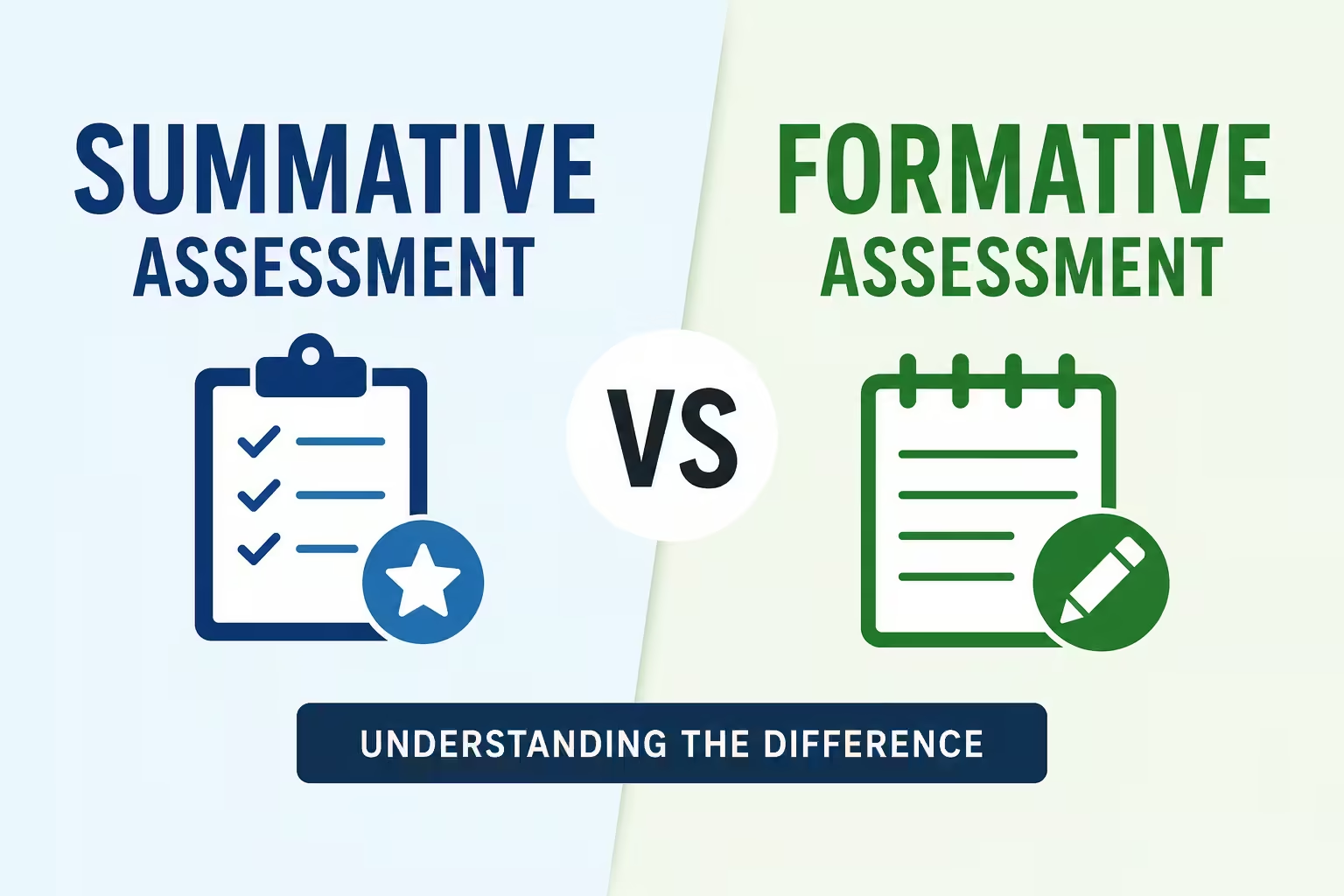
If you’ve ever wondered why some tests feel like checkpoints and others feel like final judgments, you’ve already noticed the difference between formative and summative assessment.
These two types of assessment are at the heart of how teachers measure learning — and understanding them can change the way you teach, study, or support a child in school.
Summative vs formative assessment is one of the most searched topics in education, and for good reason. Teachers want to use the right tools at the right time.
Parents want to understand how their children are being evaluated. Students want to know what to expect.
This guide breaks everything down in plain, simple language — with real classroom examples, practical strategies, and honest advice from over a decade of teaching experience.
By the end of this article, you’ll know exactly what each type of assessment means, how they work in real classrooms, and how to use both effectively.
Find similar topics in Teaching Resources category.
What Is Formative Assessment?
Formative assessment is any activity that checks student understanding during the learning process. The key word here is during. Formative assessment happens while students are still learning, not after.
Think of it like a health check-up in the middle of training for a race. You’re not testing the final result yet — you’re checking how the training is going so you can make adjustments.
In a typical classroom, formative assessments happen constantly. Sometimes they’re formal. Sometimes they’re as simple as asking the class a question and watching the responses. The purpose is always the same: to find out what students understand right now so the teacher can respond.
Common Examples of Formative Assessment
Here are some real examples you might recognize from a classroom:
- Exit tickets. At the end of a lesson, students write one thing they learned and one question they still have. The teacher reads these before the next class and adjusts the lesson accordingly.
- Think-pair-share. Students think about a question, discuss it with a partner, then share with the class. The teacher listens and assesses understanding in real time.
- Mini quizzes. Short, low-stakes quizzes at the start or end of class. These are not graded heavily — they’re used to check progress.
- Thumbs up / thumbs down. A quick visual check. “Thumbs up if you understood. Thumbs sideways if you’re not sure. Thumbs down if you’re lost.” Simple but powerful.
- Observation. The teacher walks around while students work and notes who is struggling and who is ready to move forward.
- Verbal questioning. Asking individual students questions during a lesson. The answers reveal understanding — or gaps in understanding.
In my own classroom, I use exit tickets almost every day. I’ve had lessons where I thought the class understood a grammar point perfectly, only to read the exit tickets and discover that more than half the students had the same misunderstanding.
That information allowed me to start the next class with a targeted five-minute review instead of moving forward and losing half the group.
That’s exactly what formative assessment is designed to do.
What Is Summative Assessment?
Summative assessment measures what a student has learned at the end of a learning period. It comes after instruction is complete. The purpose is to evaluate whether learning goals were achieved.
If formative assessment is the health check-up during training, summative assessment is the race itself. It measures the final result.
Summative assessments are usually formal. They often carry significant weight in a student’s grade. They typically mark the end of a unit, a term, or a course.
Common Examples of Summative Assessment
- End-of-unit tests. A test given after completing a full unit of study.
- Final exams. A comprehensive exam at the end of a semester or school year.
- Standardized tests. National or regional exams like SATs, GCSEs, or state assessments.
- Final essays or research papers. Written assignments submitted at the end of a learning period.
- Projects or presentations. Students demonstrate their full understanding of a topic through a completed project.
- Performance assessments. In language learning, a recorded spoken presentation assessed at the end of a course.
In my teaching experience, summative assessments are necessary — but they shouldn’t be the only measure of a student’s progress.
I’ve seen many capable, hardworking students perform poorly on final exams because of test anxiety, a bad day, or poor exam technique. When teachers rely only on summative results, they often miss the full picture of a student’s ability.
Summative vs Formative Assessment: The Key Differences Explained
Now that you understand each type separately, let’s look at them side by side. This is where the real clarity comes from.
Purpose: Formative assessment helps teachers and students improve learning while it’s happening. Summative assessment evaluates what was learned after the fact.
Timing: Formative assessment happens during learning — throughout a lesson, a week, or a unit. Summative assessment happens at the end of a unit, term, or course.
Stakes: Formative assessments are usually low-stakes or no-stakes. They may not count toward a grade at all, or carry very little weight. Summative assessments typically carry significant grade weight.
Feedback: Formative assessment gives immediate, specific feedback that helps students improve. Summative assessment gives a final score or grade that reflects overall performance.
Flexibility: After formative assessment, teachers can change their approach, re-teach, or slow down. After summative assessment, the learning period is over — there’s usually no opportunity to adjust.
Student anxiety: Most students feel less pressure with formative assessment because the stakes are low. Summative assessment can create significant stress, especially when it determines grades or advancement.
Here’s a simple way to remember the difference: formative is for forming — it shapes and guides learning as it happens. Summative is for summing up — it adds everything together to produce a final judgment.
Why Both Types of Assessment Matter
Some teachers focus almost entirely on summative assessments. They teach a unit, give a final test, and move on. This is common, especially in schools where exam results carry heavy pressure.
But research — and classroom experience — consistently shows that students learn better when formative assessment is used regularly alongside summative assessment. Here’s why.
Formative assessment creates a feedback loop. Students find out quickly what they’re getting wrong. They have time to fix it. They go into the summative assessment better prepared. The final result is more accurate and more fair.
Without formative assessment, students often arrive at a final exam with significant gaps in their understanding that no one caught in time. I’ve seen this pattern destroy student confidence — not because the student wasn’t capable, but because nobody noticed the problem until it was too late to address it.
Formative assessment also builds student self-awareness. When students regularly reflect on what they understand and what they don’t, they develop stronger learning habits. They start to self-assess. They ask better questions. They take more ownership of their progress.
Practical Classroom Applications: Using Both Assessments Effectively
Here’s how I structure a typical unit in my English classes to balance both types of assessment.
Week 1–2: Heavy on Formative
During the first part of a unit, almost everything I do is formative. I’m building knowledge and constantly checking understanding. I use:
- Warm-up questions at the start of each lesson.
- Think-pair-share activities after introducing new concepts.
- Short written responses that I read but don’t formally grade.
- Informal vocabulary checks through games or group activities.
- One-on-one check-ins during independent work time.
The information I collect here shapes every lesson that follows. If most students are confident with a concept, I move on. If many are struggling, I re-teach with a different approach.
Week 3: Bridge Activities
Toward the middle of the unit, I introduce slightly more formal formative tasks — short paragraphs, structured speaking tasks, or low-stakes quizzes. These are graded lightly, but more importantly, they prepare students for the summative task ahead.
I always tell students: “This practice task is like a rehearsal. The real performance is at the end. But what you learn in rehearsal is what makes the performance strong.”
Week 4: Summative Assessment
By the final week, students have received multiple rounds of feedback. They’ve practiced the skills. They’ve seen their mistakes and corrected them. The summative assessment — whether it’s a written test, an essay, or a spoken presentation — reflects genuine learning, not just performance under pressure.
This structure works in physical classrooms and in online teaching environments. In online classes, I use digital tools like Google Forms for exit tickets, shared documents for collaborative activities, and breakout rooms for peer feedback sessions. The principles are identical — only the delivery changes.
Common Mistakes Teachers Make with Assessment
After more than ten years of teaching and observing other teachers, I’ve noticed these patterns come up again and again.
Using only summative assessment. If the only measurement is the end-of-unit test, students have no way to identify and fix problems before it’s too late. Add formative check-ins throughout the unit.
Making formative assessment feel like a test. The moment students feel judged, they become anxious and less honest. Keep formative activities low-pressure and frame them as tools for growth, not judgment.
Not using formative data. This is perhaps the most frustrating mistake. A teacher gives exit tickets every day but never reads them. The data is wasted. Formative assessment only works if the teacher responds to what it reveals.
Grading everything. Some teachers feel that if it’s not graded, it doesn’t count. But over-grading creates anxiety, discourages risk-taking, and reduces the natural flow of learning. Not every formative activity needs a grade.
Ignoring student self-assessment. One of the most powerful formative tools is asking students to assess their own work. Teach students to use a simple checklist or rubric to evaluate their own writing or speaking. This builds metacognitive awareness — the ability to think about their own thinking — which is one of the strongest predictors of academic success.
Assessment in Language Learning: A Special Case
For English language learners and teachers of spoken English, the distinction between summative and formative assessment is especially important.
Language learning is a process. Fluency doesn’t arrive all at once. Pronunciation improves gradually. Grammar accuracy grows over time. Confidence in speaking builds lesson by lesson. This means that a single summative assessment — a final speaking test, for example — can never fully capture a student’s growth.
In my spoken English classes, I use formative assessment in almost every lesson. I might ask students to record themselves speaking for 60 seconds, listen back, and identify one thing they want to improve. That’s formative. It feeds directly into the next lesson.
I also use peer assessment as a formative tool. Students listen to each other’s recorded responses and give one piece of specific, kind feedback. This develops both listening skills and critical thinking. Students improve faster when they’re actively involved in the feedback process.
For pronunciation specifically, I ask students to self-record and compare their pronunciation to a model. They identify the gap themselves. This is more powerful than me simply correcting them because it builds self-awareness that lasts beyond the lesson.
Summative assessments still have a place in language learning — a formal speaking test at the end of a course provides an important benchmark. But the regular formative work throughout the course is what actually drives the improvement that the summative test eventually measures.
A Quick Reference: When to Use Each Type
Use formative assessment when:
- You’re introducing a new concept and want to check initial understanding.
- You’re mid-lesson and want to know if students are following along.
- Students have practiced something new and you want to see where they are.
- You’re preparing students for an upcoming summative task.
- A student seems confused but hasn’t said anything.
Use summative assessment when:
- A unit of learning is complete.
- You need to report on student achievement.
- You want to measure whether learning goals were met.
- Students need a clear benchmark of their progress.
- A formal qualification or grade is required.
The most effective teachers use both — formative consistently throughout, summative strategically at the end.
FAQs: Summative vs Formative Assessment
What is the simplest way to explain formative vs summative assessment?
Formative assessment checks learning while it’s happening so teachers can adjust. Summative assessment measures what was learned at the end of a period. Formative is ongoing feedback. Summative is a final result.
Can an assessment be both formative and summative?
Yes. A mid-term test can serve both purposes — it gives feedback on progress (formative) while also contributing to a grade (summative). The distinction depends on how the results are used, not just when the assessment happens.
Is homework formative or summative assessment?
Most homework functions as formative assessment. It’s practice. It gives students and teachers information about understanding. However, if homework is graded and counted heavily toward a final grade, it takes on a summative function.
Which type of assessment is better for student learning?
Neither is better on its own. Both serve different purposes. Formative assessment drives learning by providing ongoing feedback. Summative assessment measures final achievement. The best classroom practice uses both strategically.
How can parents support their children through both types of assessment?
For formative assessment, encourage your child to take low-stakes practice tasks seriously — these are the building blocks of their final performance. For summative assessments, help with preparation, sleep, and calm on the day. Remind them that one test is not a measure of their worth or intelligence.
Conclusion
Understanding summative vs formative assessment is not just useful for teachers — it’s valuable for anyone involved in education.
Whether you’re a student trying to understand how you’re being evaluated, a parent trying to support your child, or a teacher looking to improve your practice, the distinction matters.
Formative assessment keeps learning on track. It catches problems early, builds confidence, and prepares students for success.
Summative assessment provides an honest final measurement of what was learned. Together, they create a complete, fair, and effective picture of student progress.
The most important takeaway is this: don’t rely on one without the other. Regular formative check-ins combined with thoughtful summative evaluation give both teachers and students the information they need — at the right time, in the right way.
Progress in learning takes time. Be patient with the process. Use assessment as a tool for growth, not just judgment.
And remember — every check-in, every exit ticket, every low-stakes quiz is an investment in the final result you’re working toward.
Explore more topics here:
📚 Continue Learning English
Choose your next lesson and keep improving your English skills with our free English learning resources.