If you’ve ever stood in front of a class of 12-year-olds holding a copy of Romeo and Juliet, you know that look.
Eyes glazing over. Confused frowns.
The silent panic of a student trying to decode “What light through yonder window breaks?” You’re not alone.
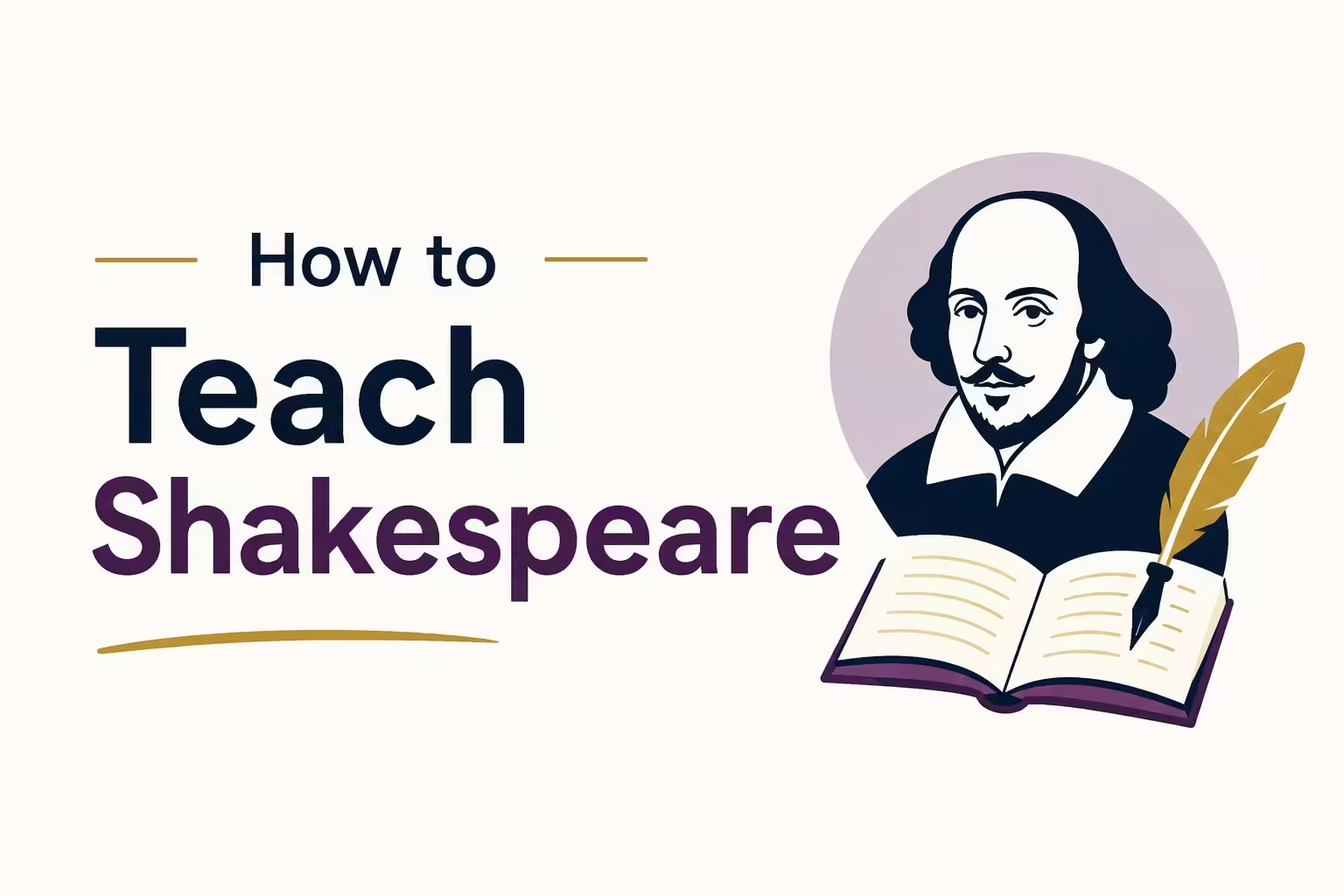
Teaching Shakespeare to middle school students is one of the most rewarding — and most challenging — things an English teacher can do.
The good news? It doesn’t have to be painful.
After more than a decade of teaching Shakespeare in classrooms and online, I can tell you with confidence: middle schoolers can absolutely love Shakespeare. They just need the right entry point.
I will show you exactly how to teach Shakespeare to middle school students in a way that’s fun, accessible, and genuinely meaningful.
Find similar topics in Teaching Resources category.
Why Shakespeare Still Matters for Middle Schoolers
Before we talk about how, let’s talk about why. Some teachers — and many parents — wonder if Shakespeare is still relevant for young students. The answer is yes, and here’s why.
Shakespeare’s plays are full of drama, conflict, jealousy, love, betrayal, and humor. These are emotions that every 12-year-old understands deeply.
The language may be old, but the stories are timeless. When students understand that Romeo and Juliet is essentially about two teenagers whose families hate each other, they immediately connect with it.
Shakespeare also builds vocabulary, reading comprehension, and critical thinking. Students who work through even one play develop stronger language skills. And in our era of standardized tests, those skills matter.
Start Before the Text: Building Background Knowledge
One of the biggest mistakes teachers make is opening the book on day one. Don’t do that.
Before your students read a single word of Shakespeare, spend two or three days building context. Here’s how I do it in my own classroom.
Tell the story first. Give students a simple, modern summary of the play. Use your own words. Keep it casual. I usually say something like, “Okay, so imagine two rival friend groups at school. One guy from each group falls in love with a girl from the other group. Everyone has a problem with this. Things go very badly.” Once students know the story, the language feels less scary.
Show the time period. Show pictures or a short video clip about Elizabethan England. Explain who Shakespeare was in simple terms. Students are often surprised to learn that Shakespeare wrote for regular working-class people, not just the educated elite. His plays were like the blockbuster movies of their time.
Introduce key vocabulary. Pick ten to fifteen words they’ll see often in the play. Practice them before reading. Make it playful — use flashcards, games, or quick matching activities.
This preparation phase sets students up for success. When they finally open the text, they have a map to follow.
How to Teach Shakespeare to Middle School Students: The Best Classroom Strategies
This is the heart of the guide. These are the specific strategies that actually work with middle schoolers, based on real classroom experience.
1. Read Aloud — But Do It Right
Shakespeare was written to be performed, not silently read. When students read quietly at their desks, the language feels like a wall. When it’s read aloud with energy, it suddenly becomes alive.
Here’s my approach. I always read the first scene aloud myself, with full expression and dramatic pauses. I want students to hear what it’s supposed to sound like. Then I invite volunteers. I assign parts and encourage students to use their voices — to be dramatic, silly, loud, or quiet depending on the scene.
Don’t worry about perfect pronunciation. I’ve had students mispronounce words in hilarious ways, and we all laugh, and then we figure out the right pronunciation together. That moment of discovery is worth more than a perfect recitation.
Pro tip: Record yourself reading key scenes and play it back. This also works well in online teaching environments where students can listen on their own time.
2. Use Modern Translations as a Bridge
There’s a lot of debate about this in the teaching world, but my experience is clear: using a modern translation alongside the original text helps students, it doesn’t replace learning.
I use a side-by-side format. On the left, Shakespeare’s original. On the right, a plain English version. We read both. Students quickly learn to compare them. They start asking things like, “Wait, so ‘wherefore’ doesn’t mean where?” That’s exactly the kind of engaged thinking we want.
Resources like No Fear Shakespeare (available free online through SparkNotes) are excellent for this. I’ve used them in both in-person and online classes with great results.
3. Act It Out
Middle schoolers are physical learners. They want to move. They want to express themselves. Use that energy.
After reading a scene, have small groups act it out. Give them five minutes to rehearse and then perform for the class. You don’t need costumes or sets. You need space, permission to be dramatic, and a teacher who won’t cringe when someone overacts.
I remember one class where two students had a mock sword fight during a scene from Macbeth using rulers. The entire class was riveted. That moment of physical engagement made the scene unforgettable.
For online classes, this works too. Students can use their home environment, props they find around the house, and even simple video filters to create a mood. I’ve had online students perform scenes in their kitchens, in their gardens, and one memorable student performed from inside a closet “for atmosphere.”
4. Paraphrase and Translate Together
Give small groups a passage — maybe six to eight lines — and ask them to rewrite it in modern English. This is one of the most powerful Shakespeare activities I know.
It forces students to read carefully. They can’t paraphrase what they haven’t understood. When groups share their translations with the class, you immediately see who got it and who is still confused. It opens the door for natural discussion.
Example activity: Give students this line from Romeo and Juliet: “What’s in a name? That which we call a rose by any other name would smell as sweet.”
Ask them: “What is Juliet trying to say here? Write it in your own words in one or two sentences.” You’ll get answers ranging from brilliant to hilariously wrong, and all of them create a teaching moment.
5. Connect It to Their World
Shakespeare’s themes are everywhere in modern life. Use that.
When teaching jealousy in Othello, ask students about times they’ve felt jealous or seen jealousy cause problems. When teaching ambition in Macbeth, ask them about wanting something so badly that you make bad decisions. When teaching love and family conflict in Romeo and Juliet, ask them about situations where family disapproval affects personal choices.
These conversations build emotional investment in the text. Students stop seeing Shakespeare as a museum piece and start seeing it as a story about real human feelings.
Common Mistakes Teachers Make (And How to Fix Them)
Even experienced teachers slip into these patterns. Here’s what to watch for.
Moving too fast. Shakespeare requires time. If you rush through pages to “cover the material,” students get lost and give up. Slow down. It’s better to deeply understand three scenes than to superficially read ten.
Focusing only on comprehension tests. If every Shakespeare activity ends with a quiz, students will learn to dread the text. Mix in creative responses — drawing scenes, writing diary entries from a character’s perspective, or creating a modern social media profile for a character.
Not differentiating for struggling readers. Some students in your class will find the language genuinely overwhelming. Have adapted versions or audiobooks available. Listening while reading helps many students with language processing. In online classes, I always provide audio files alongside the text.
Skipping the context. As mentioned above, jumping straight to the text is the number one mistake. Background knowledge is not optional — it’s essential.
Treating it as literature instead of theater. Shakespeare is a script. It was designed for a stage. Watching professional or student productions, even short clips on YouTube, transforms students’ understanding almost immediately.
A Sample Week-Long Shakespeare Lesson Plan
Here’s a rough structure you can adapt for any Shakespeare play. This is designed for five class sessions of about 45 to 50 minutes each.
Day 1 — Story First. Summarize the entire play in simple language. Show a short video or image presentation about Elizabethan England. Introduce key vocabulary. Generate excitement and curiosity.
Day 2 — First Read. Read the opening scene together as a class, aloud. Use the side-by-side format. Pause often to check understanding. Do not rush.
Day 3 — Dig Deeper. Students work in groups to paraphrase a key passage. Groups share and compare their versions. Discuss the scene’s themes and connect them to modern experiences.
Day 4 — Performance Day. Groups rehearse and act out a short scene. Focus on expression and understanding, not perfection. Celebrate effort.
Day 5 — Reflection and Response. Students write a creative response — a diary entry, a modern retelling, a letter from one character to another. Wrap up with discussion: what surprised you? What did you enjoy? What was hard?
This structure works in physical classrooms and in online teaching environments with minor adjustments.
Building Confidence: Why Students Fear Shakespeare (And How to Help)
Many middle schoolers approach Shakespeare with anxiety before they’ve even tried. They’ve heard it’s hard. They’ve heard it’s boring. This fixed mindset is one of the first things you need to address.
Start by normalizing confusion. Tell your students directly: “Everyone finds this hard at first, including adults. Even English teachers. The goal is not to understand every single word. The goal is to understand the story and the feelings.” This takes enormous pressure off.
Celebrate small wins. When a student correctly identifies what a passage means, make a big deal of it. When a group’s performance makes the class laugh or gasp, acknowledge it. These moments of success build the confidence to keep going.
In my experience teaching both in-person and online, students who feel safe to be wrong learn Shakespeare much faster than students who are afraid to make mistakes. Create that safe environment early, and your class will surprise you.
Practical Tips for Online Shakespeare Teaching
Online teaching presents unique challenges, but also unique opportunities.
Use breakout rooms for group activities like paraphrasing and performance rehearsal. Students often feel less self-conscious in small virtual groups. Use shared documents so groups can write their modern translations together in real time. You can watch their thinking as it happens.
Use YouTube clips generously. There are excellent filmed versions of almost every Shakespeare play, from traditional productions to modern adaptations. Short clips — two to four minutes — are more effective than long ones for keeping middle schoolers engaged online.
Use polls and quick-response tools to check comprehension during live sessions. Instead of asking “Does everyone understand?” (to which everyone nods), ask a specific comprehension question through a poll tool. The data tells you immediately where confusion lives.
FAQs: Teaching Shakespeare to Middle School Students
What is the best Shakespeare play to start with for middle school?
Most experienced teachers recommend A Midsummer Night’s Dream or Romeo and Juliet. Both have accessible themes, strong characters, and a mix of comedy and drama that engages young students. Romeo and Juliet is especially popular because of its relatable themes of love and family conflict.
How do I help students who struggle with Early Modern English?
Use side-by-side translations, audiobooks, and lots of oral reading. Normalize confusion. Focus on story and emotion first, language precision second. The language becomes less intimidating once students care about the characters.
How long should a middle school Shakespeare unit be?
Three to four weeks is ideal for most plays. This allows time for background knowledge, reading, activities, and creative response without rushing. If you only have two weeks, focus on key scenes rather than the full text.
Can I use movies or TV adaptations in my Shakespeare unit?
Absolutely, and you should. Adaptations like the 1996 Romeo + Juliet film, 10 Things I Hate About You (based on The Taming of the Shrew), or The Lion King (loosely based on Hamlet) are powerful hooks. They make the stories feel modern and relevant before students engage with the original text.
How do I assess Shakespeare without using traditional tests?
Creative assessments often reveal deeper understanding than multiple-choice tests. Consider diary entries, character social media profiles, modern retellings, illustrated scene summaries, or short video performances. These also tend to be far more enjoyable for students to complete — and for teachers to grade.
Conclusion
Teaching Shakespeare to middle school students is not about turning 12-year-olds into Elizabethan scholars. It’s about helping them discover that 400-year-old stories can still make them laugh, think, feel, and wonder.
The key is to meet students where they are. Build context before the text. Read aloud with energy. Act it out. Paraphrase together. Connect the themes to their lives. Move slowly enough for understanding to develop. And above all, create an environment where confusion is normal, effort is celebrated, and every student feels capable of understanding something extraordinary.
When you approach how to teach Shakespeare to middle school students with patience, creativity, and genuine enthusiasm, something remarkable happens.
Students who walked in saying “I hate this” walk out quoting lines they didn’t realize they’d memorized. That transformation, small as it might seem, is what great teaching looks like.
Start simple. Stay curious. Shakespeare will do the rest.
Explore more topics here:
📚 Continue Learning English
Choose your next lesson and keep improving your English skills with our free English learning resources.