Picture this. You’re preparing a lesson on essay writing. Half your class is struggling with grammar. A few students are bored because they already know the basics.
And you’re trying to reach all of them at the same time with the same materials. Sound familiar?
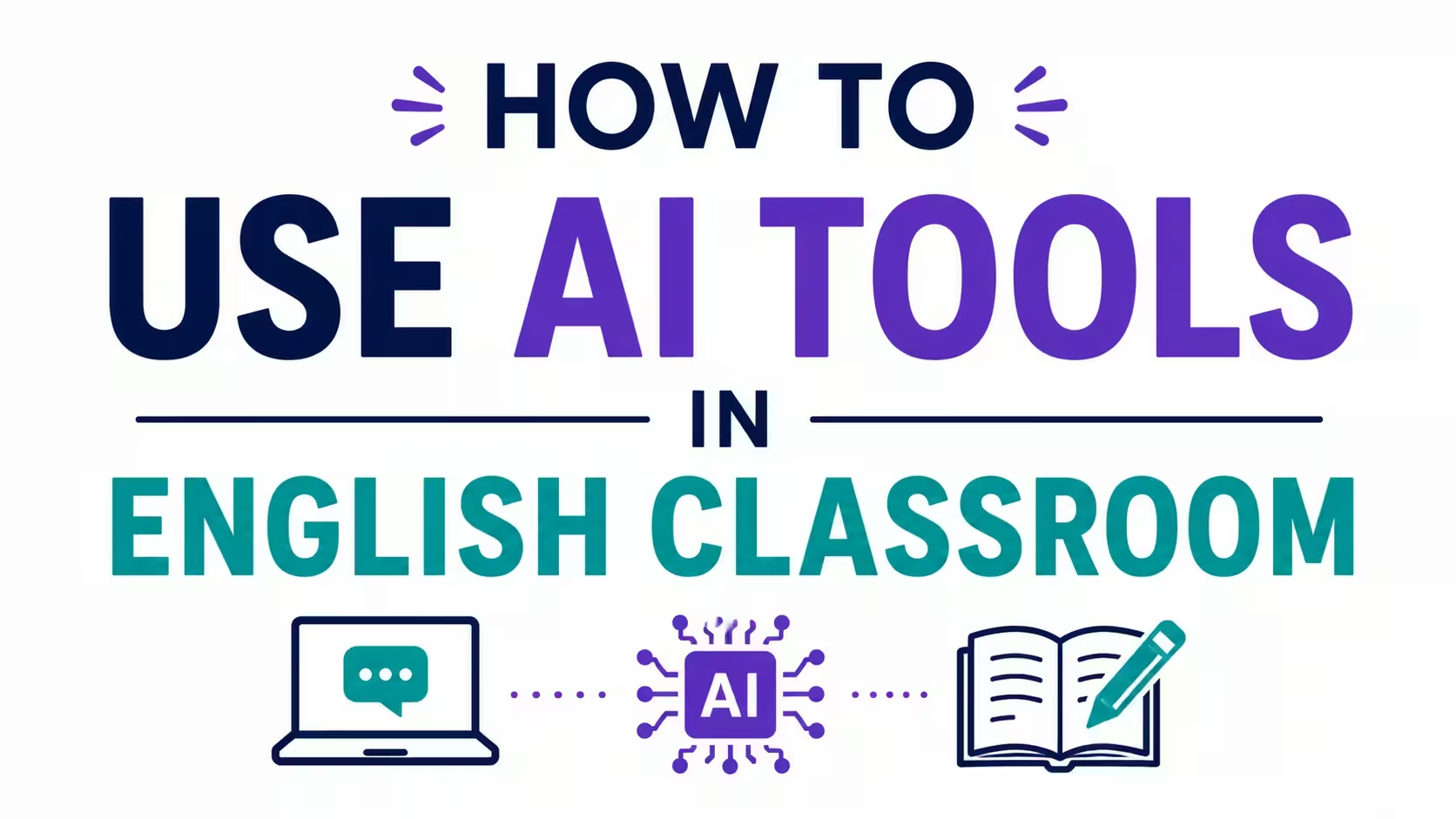
This is the daily reality for most English teachers. And it’s exactly the kind of challenge that AI tools in the English classroom are designed to help solve.
Over the past few years, artificial intelligence has moved from science fiction into actual classrooms — yours and mine.
I’ve been teaching English for more than ten years, in physical classrooms and online, and I can tell you honestly: AI tools have changed how I teach, how my students practice, and how quickly they improve.
I will show you exactly how to use AI tools in the English classroom in practical, realistic ways that genuinely help students learn.
What Are AI Tools and Why Do They Matter for English Teachers?
Let’s start with the basics. AI tools are software programs that use artificial intelligence to help with tasks like writing, grammar checking, reading comprehension, speaking practice, and personalized feedback. They include tools like ChatGPT, Grammarly, Google’s Read Along app, Speechify, and many others.
For English teachers, these tools matter because they do something we physically cannot do alone: they give every student individual attention at the same time.
In a class of thirty students, you can’t personally correct every grammar mistake, listen to every student’s pronunciation, or provide detailed feedback on thirty essays in forty minutes. AI tools can help with all of this — not as a replacement for teaching, but as a powerful support system.
The key is knowing which tools to use, when to use them, and how to use them in ways that actually improve learning rather than shortcut it.
The Most Useful AI Tools for English Language Teaching
Before diving into strategies, let’s look at the main categories of AI tools that work well in English classrooms. You don’t need all of them. Start with one or two that match your students’ needs.
Writing and Grammar Tools
These tools analyze student writing and suggest corrections, improvements, and explanations. Grammarly is the most well-known. It highlights errors, explains why something is wrong, and suggests alternatives. For ESL learners especially, this kind of immediate, specific feedback is incredibly valuable.
Conversation and Speaking Practice Tools
Tools like ChatGPT, Speak app, and ELSA (English Language Speech Assistant) allow students to practice speaking and writing in English with an AI that responds naturally. For students who are too nervous to speak in class, practicing with an AI first builds confidence.
Listening and Pronunciation Tools
Apps like ELSA Speak give students feedback on their pronunciation in real time. They hear themselves, see the mistake, and try again. This kind of focused repetition is hard to get in a traditional classroom setting.
Reading Comprehension Tools
Tools like Newsela and Google’s Read Along app adjust reading levels automatically, giving each student text that challenges them appropriately without overwhelming them.
Lesson Planning and Content Creation Tools
ChatGPT and similar AI writing assistants can help teachers create quizzes, discussion questions, exercises, and explanations in minutes. This is where I personally save the most time.
How to Use AI Tools in English Classroom: Practical Strategies That Work
This is the core of the guide. These are real strategies I use in my own teaching — both in physical classrooms and online environments.
Strategy 1: Use AI for Personalized Grammar Practice
One of my biggest frustrations as a teacher used to be this: I’d explain a grammar rule to the whole class, but only some students truly understood it. The rest needed more practice, more examples, more time — and I couldn’t always give that individually.
Now I use AI tools to close that gap.
Here’s a simple activity I use regularly. After teaching a grammar concept — let’s say present perfect tense — I ask students to write five sentences using the structure. They type their sentences into Grammarly or paste them into ChatGPT with the prompt: “Check these sentences for grammar errors and explain any mistakes.”
The AI gives them immediate feedback with explanations. Students can correct their work, try again, and keep going without waiting for me to reach their desk. This is especially powerful in large classes.
Why it works: Immediate feedback is one of the most effective tools in language learning. When students understand a mistake right after making it, they are far more likely to remember the correct form.
Strategy 2: AI Conversation Partners for Spoken English Practice
This strategy has been one of my most successful — and most surprising — discoveries.
Many students, especially ESL learners and shy students, are terrified to speak English in front of their classmates. The fear of making mistakes and being judged holds them back from practicing. This is one of the most common barriers to English fluency development.
AI conversation tools remove that fear entirely.
I assign students to have a ten-minute text conversation with ChatGPT on a given topic — for example, “Tell the AI about your favorite movie and why you like it” or “Ask the AI to explain how to cook a simple recipe and respond to its answers.” Students screenshot or copy their conversation and bring it to class.
In class, we review their conversations together. We look at vocabulary choices, sentence structure, and how naturally they expressed ideas. We then role-play similar conversations with each other, now that students have already practiced and feel more prepared.
For online classes: This works even better in virtual environments. Students practice in their own time, at their own pace, without the social anxiety of speaking in a video call.
Strategy 3: Build Listening Skills with AI-Powered Audio Tools
Listening is one of the four core English language skills, and it’s often the most neglected in traditional classrooms. AI tools are changing that.
I use a combination of podcast-style listening apps and AI-generated audio to give students regular, structured listening practice. Here’s one activity that works well.
Give students a topic — for example, climate change, healthy eating, or a historical event. Ask them to find a short audio or video clip (two to four minutes) on that topic using tools like YouTube, BBC Learning English, or VOA Learning English. Then ask them to use an AI tool or even simple note-taking to answer three questions: What is the main idea? What is one detail they found interesting? What is one word they didn’t know?
This builds listening comprehension, vocabulary in context, and critical thinking — all in one short activity.
Strategy 4: Use AI to Improve Student Writing Step by Step
Writing improvement is one area where AI tools genuinely shine, but only when used correctly.
The mistake I see many teachers make is allowing students to have AI write for them entirely. This teaches nothing. What works is using AI as a revision tool, not a creation tool.
Here is my process. Students write a first draft entirely on their own — no AI assistance. Then they use Grammarly or ChatGPT to check their draft. The AI suggests changes. But here’s the key step: students must explain to me, in writing or verbally, why they accepted or rejected each suggestion.
This forces them to think critically about language rather than blindly accepting corrections. It turns AI feedback into a genuine learning conversation.
Mini practice task you can use today: Ask students to write a short paragraph about their weekend. Then have them paste it into Grammarly and identify their three most common errors. Ask them to correct those errors and write one sentence explaining what the rule is. This takes about fifteen minutes and produces measurable improvement.
Strategy 5: Use AI Tools for Pronunciation Coaching
Pronunciation is a topic many English teachers feel unsure about teaching, especially in diverse classrooms where students come from many different language backgrounds. AI tools like ELSA Speak are specifically built for this.
ELSA listens to a student’s pronunciation and gives a score with specific feedback — not just “that was wrong” but “your vowel sound in this word was too short” or “the stress is on the second syllable.” This level of specific feedback is something most human teachers simply don’t have time to give thirty students individually.
I ask students to practice five target words or a short passage using ELSA outside of class, twice a week. They record their scores and bring a screenshot to the next session. In class, we discuss patterns — which sounds are challenging for most students, which students have specific difficulties, and what exercises help.
Why pronunciation matters for confidence: In my experience, students who can pronounce words accurately feel significantly more confident speaking in public and in professional settings. Pronunciation practice isn’t vanity — it’s a direct confidence-building tool.
Common Mistakes Teachers Make When Using AI in the Classroom
Even with good intentions, teachers sometimes use AI tools in ways that backfire. Here are the most common mistakes I’ve seen — including some I’ve made myself.
Letting AI replace thinking. If students use AI to generate their essays, responses, or answers without engaging their own minds, they learn nothing. AI should support thinking, not replace it. Always require students to contribute their own ideas first.
Using too many tools at once. I made this mistake in my second year of integrating AI into my teaching. I introduced five different apps in one month and confused everyone, including myself. Start with one tool. Use it well. Add a second tool only when the first is comfortable and routine.
Ignoring students who struggle with technology. Not every student has easy access to a smartphone or a reliable internet connection. Before assigning AI-based homework, check in with your class. Have alternative options ready. Equity matters.
Trusting AI feedback without verifying it. AI tools are very good but not perfect. They sometimes make grammar suggestions that are technically correct but stylistically awkward, or they miss cultural context. Teach students to question AI feedback, not just accept it. This critical thinking skill is valuable far beyond the English classroom.
Using AI only for correction, not for creation. AI tools can generate interesting discussion prompts, debate topics, creative writing starters, and reading comprehension questions. Use them for lesson preparation, not just student correction. This saves enormous amounts of teacher time.
A Sample Lesson Plan Using AI Tools
Here’s a 50-minute lesson plan integrating AI tools for an intermediate ESL class. You can adapt this for different levels.
Minutes 1–10 — Warm Up. Students have a five-minute written conversation with ChatGPT on the day’s theme (for example, technology in daily life). They bring one interesting sentence from the conversation to share with the class.
Minutes 11–20 — Vocabulary Building. Introduce five to eight key vocabulary words. Use an AI-generated gap-fill exercise that you prepared in advance using ChatGPT. Students complete it individually, then check their answers with a partner.
Minutes 21–35 — Reading and Comprehension. Students read a short AI-generated or AI-simplified text on the day’s topic. They answer three comprehension questions. Grammarly or a similar tool checks any written responses for grammar.
Minutes 36–45 — Speaking Practice. In pairs, students discuss the topic using a list of prompts you’ve prepared. Before speaking, they have two minutes to organize their ideas by typing a brief outline — this reduces the hesitation that often blocks spoken English fluency.
Minutes 46–50 — Reflection. Students write two sentences: one thing they learned today and one thing they want to practice more. These reflections help you plan the next lesson.
Realistic Expectations: What AI Can and Cannot Do
I want to be honest with you here, because I think some of the excitement around AI in education gets ahead of the reality.
AI tools can give immediate feedback. They can provide unlimited practice opportunities. They can personalize learning to some degree. They can save teachers time on routine tasks. These are real, significant benefits.
But AI cannot replace the human relationship between a teacher and a student. It cannot notice that a student seems discouraged today. It cannot feel the energy of a classroom and adjust accordingly. It cannot inspire a student who has given up. It cannot build the kind of trust that makes a nervous student finally raise their hand.
AI is a tool. A powerful one. But the teacher remains the heart of the classroom.
Progress in English also takes time, with or without AI. Students who use AI tools consistently over months will see real improvement. Students who use them occasionally for two weeks will not. Set honest expectations with your students and encourage the daily habit of practice.
FAQs: Using AI Tools in the English Classroom
Is it cheating if students use AI for their English assignments?
It depends entirely on how AI is used. Using AI to write an essay for you is cheating. Using AI to check your grammar after writing, practice conversation, or understand vocabulary in context is a legitimate and valuable learning strategy. The key is transparency — students should know when and how AI use is appropriate in your class, and you should design assignments that require genuine thinking even when AI is involved.
What is the best free AI tool for English learners?
For writing and grammar, Grammarly’s free version is excellent. For conversation practice, ChatGPT’s free tier works very well. For pronunciation, ELSA Speak has a free version with limited features that is still useful for regular practice. Google’s Read Along app is free and excellent for reading fluency, particularly for younger learners.
How do I introduce AI tools to students who are not tech-savvy?
Start with one very simple tool and spend an entire class session just getting comfortable with it. Walk through the interface together. Do the first activity as a group before assigning individual practice. Normalize the learning curve — it’s okay to find technology confusing at first. Most students become comfortable quickly once they see the tool in action.
Can AI tools help with English fluency development?
Yes, significantly — but only through consistent use over time. Fluency development requires massive amounts of practice. AI tools make that practice available anytime, anywhere, without the social pressure of a classroom. Students who practice speaking or writing with AI tools daily, even for just ten to fifteen minutes, typically show measurable fluency improvement within two to three months.
Are AI tools useful for advanced English learners or only beginners?
They are useful at every level. For beginners, AI tools help with basic grammar, vocabulary, and pronunciation. For advanced learners, they can provide sophisticated feedback on writing style, help explore nuanced vocabulary, and provide conversation practice on complex topics. The tools adapt to the level of input they receive.
Conclusion
Learning how to use AI tools in the English classroom is not about embracing every new technology that comes along. It is about choosing the right tools, using them purposefully, and keeping students’ genuine learning at the center of every decision.
The strategies in this guide — using AI for personalized grammar practice, spoken English development, listening skills, writing revision, and pronunciation coaching — are all grounded in what actually works in real classrooms with real students. They are practical, achievable, and immediately applicable.
Start small. Pick one AI tool this week. Try one activity. See how your students respond. Adjust, improve, and build from there.
The future of English language teaching is not AI replacing teachers. It is teachers using AI to do what they do best — inspire, guide, and connect — more effectively than ever before. That future is already here. The only question is how you choose to use it.
Explore more topics here:
- How to Design an ESL Curriculum for Beginner to Advanced Learners
- How to Teach Poetry Analysis: A Complete Guide for Teachers and Students
- How to Write a Letter in English: A Simple Guide
- How to Write Speaker Notes for Presentations
- English for Online Teaching: The Complete Guide for Beginners and Professionals
- How to Make Money Teaching Online: A Complete Guide
📚 Continue Learning English
Choose your next lesson and keep improving your English skills with our free English learning resources.