When Maria, a new English teacher from Spain, moved to Chicago to teach ESL classes, she thought her excellent English skills would be enough. But during her first week, she found herself confused at a restaurant when the server kept refilling her coffee without asking, unsure how much to tip her hairdresser, and worried she’d offended a colleague by asking about their salary. “I can teach English grammar,” she told me later, “but I wasn’t prepared for all these unwritten social rules!”
Maria’s experience is common. Understanding American etiquette isn’t just about being polite—it’s about feeling confident in everyday situations and helping your students navigate real American life. Whether you’re a teacher preparing international students, a parent guiding your children, or someone new to American culture, I will help you understand the practical manners and customs that Americans follow every day.
Why American Etiquette Matters for English Learners
Many ESL students can pass grammar tests but feel anxious in real social situations. They worry: “Did I tip enough?” “Was I too direct?” “Should I have brought a gift?” These aren’t language problems—they’re cultural knowledge gaps.
As teachers, when we teach etiquette alongside English, we give students the confidence to participate fully in American life. We help them avoid awkward moments and build genuine connections with Americans.
Understanding the American Social Style
Before diving into specific rules, it’s helpful to understand the general American approach to social interaction.
Friendliness and informality are valued in American culture. Americans often smile at strangers, make small talk in elevators, and use first names quickly—even with bosses or teachers. This can surprise students from more formal cultures.
Directness and efficiency shape communication. Americans typically say what they mean rather than hint. A simple “no, thank you” is polite and expected. Students often worry this sounds rude, but in American culture, it’s respectful because it doesn’t waste someone’s time.
Personal space and independence matter greatly. Americans usually stand about an arm’s length apart during conversations. They value self-reliance and often split bills rather than having one person pay for everyone.
Understanding these values helps explain why specific etiquette rules exist.
Dining Etiquette: From Fast Food to Fine Dining
Restaurant Basics
One of my students, Kenji from Japan, once waited 20 minutes at a restaurant entrance before someone told him he needed to seat himself. These unspoken rules can be confusing!
Entering and seating: At casual restaurants, a sign usually says “Please wait to be seated” or “Seat yourself.” If unsure, wait near the entrance and make eye contact with staff. At fast-food restaurants, you always order at the counter first.
The server relationship: In American restaurants, your server is your main contact. They’ll introduce themselves, take orders, check on you during the meal, and bring the bill. Make eye contact, smile, and treat them with respect—their income depends heavily on tips.
A common teaching moment: I tell students, “When the server asks ‘How is everything?’ they genuinely want to know. If something is wrong, you can politely say so. This isn’t rude—it helps them fix the problem.”
Table Manners
American table manners are relatively relaxed compared to some cultures, but certain rules apply everywhere.
Basic rules everyone follows:
- Keep your phone off the table and on silent
- Chew with your mouth closed and don’t talk with food in your mouth
- Place your napkin on your lap when you sit down
- Wait until everyone has their food before eating (at formal meals)
- Say “excuse me” if you need to leave the table
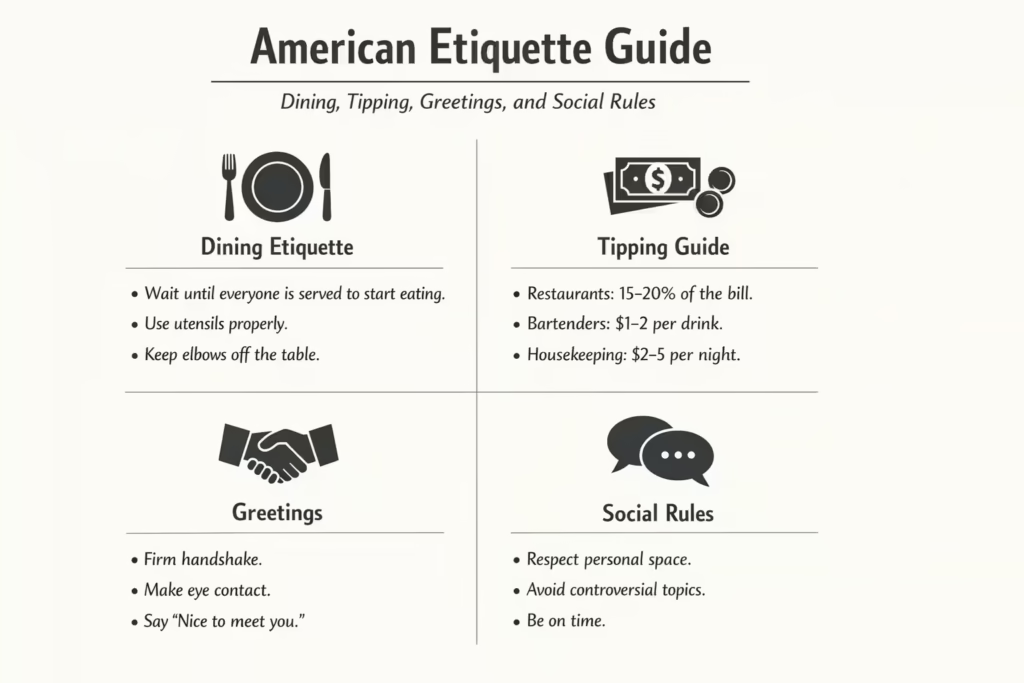
Using utensils: Americans typically hold the fork in their right hand (or left hand for left-handed people) and cut food by holding the fork in the left hand and knife in the right. After cutting, many Americans switch the fork back to their right hand to eat—this is called “zigzag style” and is perfectly normal.
Sharing food: At casual restaurants, sharing appetizers or tasting each other’s dishes is common among friends. But always ask first: “Would you like to try some?” If someone offers to share, it’s fine to say “no, thank you” without explanation.
What to Do When You Don’t Know Something
I always tell my students this story: During a business dinner, one of my adult learners encountered an artichoke for the first time. Instead of panicking, she watched others for a moment, then quietly asked her neighbor, “I’ve never eaten one of these—how does it work?” Everyone was happy to help.
When you’re unsure:
- Watch what others do for a moment
- It’s perfectly acceptable to ask, “I’m not familiar with this—could you show me?”
- If you make a mistake, a simple smile or “Oops!” is enough—Americans are usually understanding
The Tipping System: A Practical Guide
Tipping causes more confusion than almost any other aspect of American culture. Unlike many countries where service charges are included, tipping is expected in America because many service workers earn very low base wages.
Who to Tip and How Much
Restaurants: 15-20% of the bill before tax. For good service, 20% is now standard in most cities. For exceptional service, 25% shows extra appreciation. For poor service, 15% is acceptable, but consider speaking to a manager if service was truly bad rather than leaving no tip.
I teach students this simple math trick: “Double the tax to estimate 20%. In most states, sales tax is 8-10%, so if you double it, you’re close to 20%.”
Coffee shops and casual counters: $1-2 per drink, or 15-20% for larger orders. The tip jar is optional for simple transactions.
Delivery drivers: 15-20% of the order, minimum $3-5 even for small orders. In bad weather, tip more.
Taxis and rideshares: 15-20% of the fare.
Hair stylists and barbers: 15-20% of the service cost. If someone washes your hair, give them $3-5 separately.
Hotel housekeeping: $2-5 per night, left daily because staff changes. Place it on the pillow or desk with a note saying “Thank you.”
Bartenders: $1-2 per drink, or 20% of the tab if you’re ordering multiple rounds.
When NOT to Tip
Students are relieved to learn you don’t tip everywhere:
- Fast-food restaurants (McDonald’s, Subway, etc.)
- Retail stores
- Gas stations (when you pump your own gas)
- Flight attendants
- Most government service workers
Handling the Bill
Splitting the bill is extremely common in America, especially among friends, coworkers, or casual acquaintances. Don’t feel obligated to pay for everyone unless you specifically invited them as your guests.
If you say “Let me treat you” or “Dinner’s on me,” you’re offering to pay. Otherwise, expect to split.
Most servers will split the bill if asked: “Could we have separate checks, please?” It’s easiest to ask this when ordering.
Apps like Venmo, Zelle, or PayPal are commonly used to split bills. One person pays the full amount, then others send their share digitally.
Social Interactions and Conversation
Greetings and Small Talk
Americans greet acquaintances with “Hi, how are you?” or “How’s it going?” This is called a “phatic expression”—it’s a social ritual, not usually a real question about your health.
The expected response is brief and positive: “Good, thanks! How about you?” or “Pretty good, you?” Even if you’re having a bad day, most situations call for a simple positive response unless you’re talking with a close friend.
I role-play this with students constantly because it feels strange to them at first. One student asked, “So I’m supposed to lie?” I explained, “No, you’re participating in a friendly ritual. It’s like saying ‘bless you’ when someone sneezes—it’s about being polite, not having a deep conversation.”
Topics to Embrace and Avoid
Safe conversation topics for small talk:
- Weather (Americans talk about weather constantly!)
- Sports, especially local teams
- Weekend plans or recent activities
- Food, restaurants, and recipes
- Movies, TV shows, and entertainment
- Pets
- Traffic and commuting
Topics to generally avoid, especially with new acquaintances:
- Personal income or how much things cost
- Age (especially for women)
- Weight or appearance
- Religion and politics (unless you know the person shares your views)
- Relationship problems
- Health issues (beyond “I have a cold”)
One important lesson I share: Americans usually keep conversations light and positive in professional or casual social settings. Deep personal topics are reserved for close friends and appropriate moments.
Explore more interesting topics:
- English in Daily American Life: Coffee Shops, Small Talk & More
- Everyday North American English Phrases You Need to Know
- Master Everyday American Idioms Like a Pro
- How to Master the Art of Communication 2026
- Mastering English Restaurant Phrases Like a Pro
The Art of Polite Declining
Many of my students come from cultures where saying “no” directly is rude. They’ve learned to hint or make excuses. This causes confusion in America.
Americans prefer direct but polite refusals:
- “No, thank you” (This complete sentence is perfectly polite!)
- “I appreciate the offer, but I can’t”
- “That’s kind of you, but I’ll pass”
- “Thanks, but that doesn’t work for me”
You don’t need to give detailed explanations or excuses. In fact, lengthy explanations can seem insincere.
Practice exercise I use in class: I offer students various things (food, invitations, help) and have them practice saying “no, thank you” with a smile until it feels natural.
Guest Etiquette: Visiting American Homes
Invitations and Timing
When invited to someone’s home, punctuality matters but varies by situation. For dinner parties, arrive within 10-15 minutes of the stated time. For casual parties, arriving 15-30 minutes late is often expected—this gives hosts time to finish preparing.
RSVP (respond if you please) means you must reply to say whether you’re coming. Respond within a few days. “Yes” commits you to attend; “no” is perfectly acceptable and not rude. Not responding is very rude.
If you say yes and later can’t go, inform the host as soon as possible. Emergencies happen and people understand, but simply not showing up is considered very disrespectful.
Bringing Something
Should you bring a gift? For dinner at someone’s home, bringing a small gift is polite but not required. Common choices include:
- Wine or beer (if you know the host drinks)
- Flowers (avoid roses, which suggest romance)
- Dessert or appetizers (ask first: “Can I bring anything?”)
- Specialty food from your culture
When hosting says “Don’t bring anything,” you can still bring a small gift if you wish, or simply arrive empty-handed. Both are fine.
During the Visit
Shoes: Some American homes have a no-shoes policy, others don’t care. Look for cues—are there shoes by the door? Is the host wearing shoes inside? When in doubt, ask: “Should I take off my shoes?”
Offering to help: It’s polite to offer to help with setup, serving, or cleanup: “Can I help with anything?” The host might say no, and that’s fine—you’ve been polite by offering.
Duration: Unless it’s a party with a specific end time, plan to leave within 2-3 hours for a dinner invitation. Watch for cues that the gathering is winding down (host cleaning up, conversation slowing, people yawning).
Workplace and Professional Etiquette
Office Interactions
First names are used in most American workplaces, even with bosses. If unsure, follow what others do or ask: “What would you like me to call you?”
Email etiquette is more casual than in many countries. Start with “Hi [Name]” rather than formal greetings. Get to the point quickly. Sign with just your first name in most cases.
Meetings start on time. Arrive a few minutes early. Silence your phone. Being late without notice is unprofessional.
Office Kitchen and Break Room
Clean up after yourself immediately. Don’t leave dishes in the sink. If you use the last of the coffee, make more or let others know it’s empty.
Food in the shared fridge should be labeled with your name and date. Eating someone else’s food is a serious breach of etiquette.
Smelly foods at your desk can bother coworkers. Strong-smelling lunches should be eaten in the break room or outside.
Gift-Giving Occasions
Americans give gifts for certain occasions but not others. Understanding when gifts are expected helps avoid awkward moments.
When gifts are expected:
- Birthdays (close friends and family)
- Weddings (guests bring gifts, usually from a registry)
- Baby showers (for expecting mothers)
- Holidays like Christmas or Hanukkah (for close friends and family)
- Housewarmings (when someone moves to a new home)
When gifts are NOT expected:
- Casual dinner invitations
- Most professional relationships
- First meetings
- Most holidays like Thanksgiving or the 4th of July
Opening gifts: In America, gifts are typically opened immediately in front of the giver, with thanks and appreciation shown. This differs from cultures where gifts are opened privately later.
Teaching These Concepts to Students
Creating Real Scenarios
The best way to teach etiquette is through realistic practice. In my classes, I set up situations students will actually encounter.
Restaurant role-play: I divide the class into servers and customers. We practice ordering, asking questions, handling problems politely, and calculating tips. Students rotate roles so everyone experiences both perspectives.
Tipping calculator practice: We use real menus with prices and practice the math. I give them various scenarios: “Service was slow because the restaurant was very busy—how much should you tip?” This builds both math skills and cultural judgment.
Conversation practice: I create “conversation cards” with different social situations: meeting a neighbor, making small talk at a bus stop, politely declining an invitation. Students practice appropriate responses.
Addressing Cultural Differences Respectfully
I always emphasize that different isn’t wrong. I tell students: “In your culture, these rules might be different, and that’s perfectly valid. We’re learning American customs so you feel comfortable here, not because they’re better.”
One powerful exercise: Have students share etiquette from their cultures. This builds respect and helps everyone understand that all cultures have rules—they’re just different rules.
Common Student Mistakes and How to Address Them
Mistake 1: Not tipping or tipping too little
- Real example: A student tipped $2 on a $40 meal (5%) because he was used to service charges being included.
- How I address it: Show the math clearly and explain that servers often earn just $2-3 per hour base pay. I emphasize that in America, tipping isn’t optional unless service is truly terrible.
Mistake 2: Sharing too much personal information too quickly
- Real example: A student asked her coworker how much she earns during their first conversation.
- How I address it: We practice the “layers of friendship” concept—casual acquaintances get light topics, close friends get deeper topics. I create circles showing what’s appropriate at each level.
Mistake 3: Being too indirect when declining
- Real example: A student said “maybe” to every invitation, then didn’t show up because he thought “maybe” meant “probably no.”
- How I address it: Practice saying “no, thank you” with a smile in low-stakes situations until it feels natural. Role-play various scenarios where declining is appropriate and necessary.
Mistake 4: Waiting too long to speak in social situations
- Real example: International students sometimes wait to be invited into conversations or wait for pauses that never come.
- How I address it: Teach American conversation rhythm—brief overlaps are normal, Americans often show engagement by jumping in. Practice “finding the gap” and using phrases like “Oh, that reminds me…” or “Can I add something?”
Practical Tips for Teachers and Learners
For classroom use:
- Keep a “menu” from a local restaurant in class for regular tipping practice
- Create an “etiquette of the week” where you focus on one specific situation
- Record student role-plays so they can see themselves and improve
- Invite American guest speakers to share their perspectives on etiquette
For self-learners:
- Observe Americans in public places—restaurants, stores, buses—and notice patterns
- Watch American TV shows and movies with a focus on social interactions, not just language
- Practice tipping math until it becomes automatic
- Start with one new etiquette rule per week and focus on mastering it before adding more
For parents teaching children:
- Model good manners consistently—children learn by watching
- Explain the “why” behind rules: “We say ‘please’ and ‘thank you’ to show we appreciate others”
- Practice polite greetings and goodbyes in real situations
- Let children practice tipping when you’re at restaurants
For online teaching:
- Use virtual backgrounds showing restaurant or social settings
- Share your screen to show real menus and practice calculations together
- Create breakout rooms for role-play practice
- Use polls to quiz students on appropriate responses to common situations
Building Confidence Over Time
Learning etiquette is like learning vocabulary—it takes time, practice, and real-world exposure. Students won’t remember everything at once, and that’s okay.
I tell my students, “Americans understand you’re learning. Most people will be patient and helpful if you make a mistake. A friendly attitude and willingness to learn go further than perfect knowledge of every rule.”
Signs of progress to celebrate:
- A student tips correctly without calculating
- Someone declines an invitation politely without anxiety
- A learner makes appropriate small talk naturally
- Students catch and correct their own etiquette mistakes
One of my proudest teaching moments was when Mei, a shy student from China, told me she’d successfully ordered at a restaurant, made small talk with the server, and tipped 20%—all without anxiety. “I felt like a real American,” she said, beaming. That confidence is the ultimate goal.
Conclusion
American manners and etiquette are really about making social interactions smoother and showing respect for others. While some rules might seem strange at first—why tip so much? why talk about the weather so often? why say “how are you?” without expecting a real answer?—each custom serves a purpose in American culture.
For teachers, teaching etiquette alongside English gives students the complete toolkit they need for success. Language skills alone aren’t enough if students don’t know how to navigate real social situations with confidence.
For learners, remember that everyone makes etiquette mistakes sometimes—even native-born Americans. The goal isn’t perfection; it’s progress. Each polite interaction, each properly calculated tip, each successful small-talk exchange builds your confidence and helps you feel more at home in American culture.
Start with the basics: tipping correctly at restaurants, greeting people warmly, and being direct but polite. As these become natural, you’ll find yourself navigating more complex social situations with ease.
Most importantly, bring your authentic self to every interaction. Americans appreciate friendliness, respect, and genuine effort far more than perfect adherence to every unwritten rule. Your unique perspective and cultural background add richness to American society—don’t lose that while learning American customs.
Keep practicing, stay curious, and don’t be afraid to ask questions when you’re unsure. That’s not a weakness—it’s a strength that shows you care about getting it right.