“I can read and write English well, but when someone speaks to me, my mind goes blank.”
I’ve heard this from hundreds of students over my years of teaching. Many people spend years studying English grammar and vocabulary, but when it’s time to have a real conversation, they freeze. This happens because speaking English is a different skill from reading or writing it.
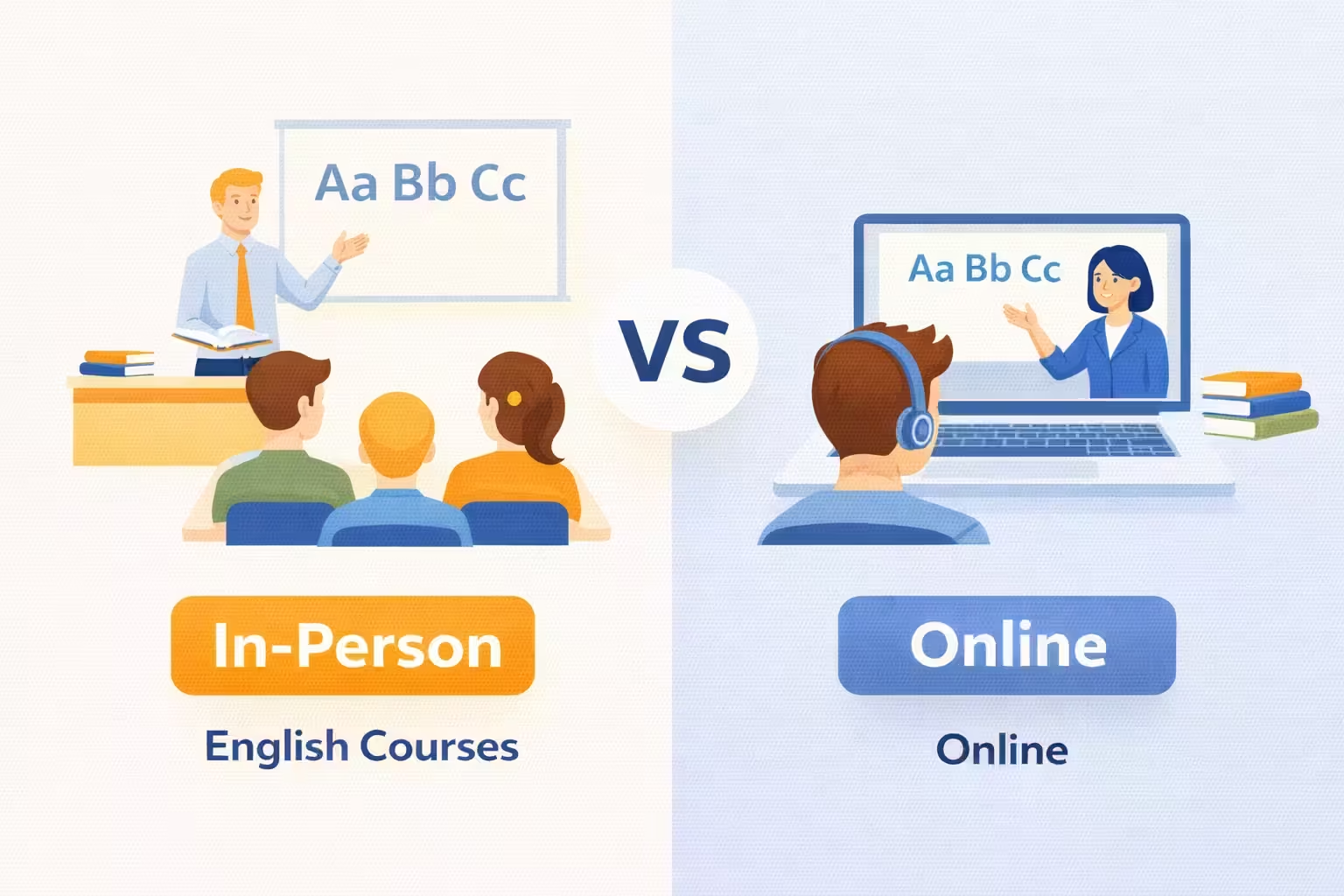
Choosing the right learning environment—whether in-person or online—can make a huge difference in how quickly and confidently you develop your spoken English. Both methods work, but they work differently. Understanding these differences will help you make the best choice for your learning style, schedule, and goals.
Let me share what I’ve learned from teaching in both traditional classrooms and online platforms, so you can decide which path suits you best.
Understanding How Spoken English is Really Learned
Before we compare the two formats, let’s talk about something important: spoken English isn’t learned the same way as grammar rules.
In my classroom, I once had a student named Maria who could perfectly explain the past perfect tense on paper but couldn’t order coffee in English. Why? Because speaking requires your brain to work fast—choosing words, forming sentences, pronouncing correctly, and listening to responses, all at the same time.
Spoken English develops through:
- Regular practice with real people (not just exercises in a book)
- Listening to natural speech (with pauses, emotions, and different accents)
- Making mistakes in a safe environment (where correction helps, not embarrass)
- Using the language for real purposes (like asking questions, sharing opinions, or solving problems)
Both in-person and online courses can provide these opportunities, but they do it in different ways.
In-Person English Courses: The Traditional Classroom Experience
What Makes In-Person Learning Special?
Face-to-face energy and connection
When you’re physically in a room with your teacher and classmates, there’s an energy that’s hard to replicate online. I can see when a student’s eyes light up with understanding, or when someone looks confused but is too shy to speak up. This immediate feedback helps me adjust my teaching on the spot.
In my physical classroom, I once noticed a quiet student named Ahmed silently mouthing words during a pronunciation exercise. I walked over, knelt beside his desk, and we practiced together for just two minutes. That personal moment built his confidence in a way that changed his participation for the rest of the course.
Body language and non-verbal communication
In person, students learn to read gestures, facial expressions, and tone—all essential parts of real English communication. When teaching “Can you help me?” I can show the difference between a polite request (with a smile and open hands) and an urgent demand (with worried eyes and quick gestures).
Immediate, spontaneous interaction
Real classrooms create unexpected learning moments. Someone asks an unplanned question, another student offers their perspective, and suddenly we’re having a genuine conversation that teaches more than any textbook example could.
Practical Activities That Work Best In Person
Group conversations and role plays
Divide the class into small groups and have them plan a birthday party in English. They must decide on location, food, budget, and guest list—all while speaking English. I walk around, listening and gently correcting. The natural chaos and laughter make learning feel less like work.
Pronunciation practice with physical presence
Stand in front of students and show them how your mouth moves when saying “think” versus “sink.” Let them watch your lips, tongue, and even put a hand in front of your mouth to feel the breath for “h” sounds. These physical demonstrations are powerful.
Board work and visual learning
Writing on a whiteboard as you explain, drawing quick diagrams, or having students come up to write their answers creates a shared visual space that helps many learners understand better.
Explore more English topics here:
- Best English Conversation Topics for Daily Use
- Learn English Through Media: Fun and Effective Methods
- 150 Basic English Sentences Every Kid Should Learn
- Top 10 Reasons to Learn English and Improve Your Life
- English Conversation at the Coffee Shop
The Challenges of In-Person Classes
Let me be honest about the downsides:
Time and travel
Students spend time commuting. In cities with traffic, a one-hour class can require three hours of total time commitment. This stops many busy adults from attending regularly.
Fixed schedules
Classes happen at set times. If you work irregular hours, travel frequently, or have family responsibilities, you might miss sessions. I’ve seen motivated students drop out simply because they couldn’t make the 6 PM time slot work consistently.
Limited speaking time in large groups
In a class of 15 students with a one-hour lesson, each student might only speak for 3-4 minutes total. That’s not enough practice for real fluency development.
One pace for everyone
Some students grasp concepts quickly; others need more time. In a physical classroom, I have to choose a middle pace, which sometimes means fast learners get bored and slower learners feel rushed.
Online English Courses: The Digital Learning Revolution
What Makes Online Learning Powerful?
Flexibility and convenience
Your classroom is wherever you are. I’ve taught students who were in their kitchen during lunch breaks, in their car during their child’s music lesson, or traveling in different countries. This flexibility means students rarely miss lessons due to schedule conflicts.
More speaking time in one-on-one or small groups
Online platforms often allow for private lessons or very small groups. In a 30-minute one-on-one session, a student might speak for 20-25 minutes—far more practice than they’d get in a traditional classroom.
Access to diverse accents and teaching styles
Students can take classes with teachers from the UK, US, Australia, or India—exposing them to different English accents and cultural perspectives. This prepares them for real-world English, which comes in many varieties.
Recording and review options
Many online platforms let students record lessons. One of my online students rewatches our pronunciation sessions before important work presentations. This review opportunity accelerates learning.
Practical Activities That Work Well Online
Screen sharing for focused learning
I can share articles, images, or videos and discuss them in real time. When teaching job interview English, I display common interview questions on screen, and we practice responses together.
Chat box for vocabulary and spelling
While speaking, I type new words or corrections in the chat. Students can copy them instantly. This written record helps visual learners and creates study material for later review.
Breakout rooms for conversation practice
In larger online classes, teachers can send students to virtual breakout rooms for pair work. Give them a topic like “Describe your perfect weekend” and let them talk for five minutes while you move between rooms, listening and helping.
Global conversation partners
Online learning connects students with practice partners from other countries. My student in Japan regularly practices with someone in Brazil—they both improve while learning about each other’s cultures.
The Challenges of Online Classes
Again, I’ll be honest about what doesn’t always work:
Technology problems
Internet connections fail. Audio cuts out. Video freezes. I once had a student whose dog knocked over the computer during class. These interruptions disrupt learning flow and can be frustrating.
Reduced personal connection
Some students feel isolated learning through a screen. The casual pre-class chats and coffee break conversations that build community in physical classrooms don’t happen as naturally online.
Harder to read subtle body language
On video, I can’t always see if a student is truly understanding or just nodding politely. Small facial expressions that signal confusion are easier to miss.
Self-discipline required
Without the commitment of traveling to a physical location, some students find it easier to skip online classes or not fully engage. Learning in pajamas at home takes more personal motivation than getting dressed and going to a school.
Screen fatigue
After a full day of Zoom meetings for work, many adults don’t want another hour looking at a screen for English class. This mental tiredness can reduce learning effectiveness.
Creating a Safe and Supportive Speaking Environment (In Both Settings)
Whether online or in person, the most important factor in learning spoken English is feeling safe to make mistakes.
I’ll never forget David, a student who barely spoke for the first three weeks of class. Later he told me he was terrified of sounding stupid. Once I explained that mistakes are proof of learning, not failure, he slowly started participating.
How Teachers Build This Safety
Celebrate attempts, not just correctness
When a shy student tries to speak, I respond with genuine enthusiasm: “Great job trying that difficult word!” This encourages them to keep attempting.
Share your own language learning struggles
I tell students about my terrible attempts to learn Spanish—mixing up words, confusing genders, saying embarrassing things by accident. This shows that even teachers make mistakes when learning languages.
Establish a ‘no laughing at mistakes’ rule
On the first day, I make it clear: we can laugh with each other, but never at each other. Mistakes are learning opportunities for everyone.
In online classes: Use private chat to give corrections without public embarrassment. In person, pull students aside during group work for gentle correction.
The Critical Role of Listening Before Speaking
Many students want to jump straight into speaking, but here’s what I’ve learned: good speakers are first good listeners.
Think about babies learning their first language—they listen for months before speaking their first words. They’re absorbing sounds, patterns, and meanings.
How to Develop Listening Skills
In-person advantage: Natural conversation speed and multiple speakers
In my classroom, students hear me, their classmates (with different accents and mistakes), and sometimes guest speakers. This variety trains their ears for real-world English.
Online advantage: Access to endless listening resources
Online students can easily watch English YouTube videos, listen to podcasts, or stream English TV shows between classes. I assign specific listening homework—like watching a 5-minute news clip and noting three new words.
Practical Listening Activities
Listen and respond exercises
I tell a short story: “Yesterday, I went to the supermarket and forgot my wallet at home.” Then I ask: “What was my problem?” Students must listen carefully to answer.
Dictation practice
Read a sentence at natural speed. Students write what they hear. This trains their ears to catch individual words in flowing speech and shows them where their listening gaps are.
Different accent exposure
Play audio clips of English speakers from Scotland, India, Australia, and Texas. Discuss how the same language sounds different. This prepares students for real global communication.
Teaching Pronunciation in Simple, Practical Ways
Pronunciation scares many students, but it shouldn’t. You don’t need perfect pronunciation—you need clear pronunciation that people can understand.
The Sounds That Matter Most
Focus on sounds that change meaning. The difference between “ship” and “sheep” matters. The difference between a perfect American “r” and a softer “r” doesn’t matter much for understanding.
In-person advantage for pronunciation:
I can physically demonstrate mouth positions. For the “th” sound in “think,” I show students to put their tongue between their teeth and blow air. They can see exactly how my mouth moves.
Online advantage for pronunciation:
Screen sharing allows me to show YouTube videos of mouth movements in slow motion, which can actually be clearer than watching me in person from across a classroom.
Practical Pronunciation Techniques
Mirror practice
Tell students to hold a small mirror while practicing difficult sounds. They can watch their own mouth and compare it to yours.
Minimal pairs practice
Practice word pairs that sound similar but have different meanings:
- “They think” vs. “They sink”
- “I feel” vs. “I fill”
- “Where’s the sheet?” vs. “Where’s the seat?”
Students say both words, and you point to which one you heard. This sharpens both their speaking and listening.
Sentence stress, not just word pronunciation
English speakers stress important words in sentences. Compare:
- “I LOVE pizza” (emphasizing your strong feeling)
- “I love PIZZA” (emphasizing the specific food)
Same words, different meanings based on stress. Practice this through natural conversations, not lists.
Record and compare
Online or in person, have students record themselves saying a sentence, then listen to a native speaker say it, then record themselves again. The improvement between recordings builds confidence.
Using Daily-Life Conversations and Real Situations
Grammar exercises have their place, but spoken fluency comes from practicing real-life situations.
Scenarios That Build Practical Skills
In a physical classroom:
Set up the room like different locations. One corner is a restaurant, another is a doctor’s office, another is a job interview. Students rotate through, practicing appropriate conversations for each setting.
In an online class:
Use virtual backgrounds. Change your background to a coffee shop, then role-play ordering coffee. Change it to an airport, then practice asking for directions to your gate.
Examples of Practical Conversation Practice
Teacher plays shopkeeper: “Can I help you?” Student: “Yes, I’m looking for a birthday gift for my sister.” Teacher: “What does she like?”
This natural back-and-forth teaches questions, polite phrases, and thinking in English—not translating from your native language.
Problem-solving scenarios
“You ordered a pizza 90 minutes ago, but it hasn’t arrived. Call the restaurant and politely ask about your order.”
This teaches how to complain professionally, ask questions, and express frustration in appropriate English.
“You need to ask your boss if you can leave work early on Friday for a family event.”
Students practice professional tone, formal requests, and negotiating—all critical real-world skills.
Encouraging Fluency Over Perfection
Here’s a truth many students don’t realize: native English speakers make grammar mistakes all the time.
We say “Me and my friend went shopping” instead of the grammatically correct “My friend and I went shopping.” We end sentences with prepositions. We use slang and shortcuts.
The goal of spoken English is communication, not perfection.
How to Build Fluency
Timed speaking activities
Give students a topic: “Talk about your favorite food for two minutes without stopping.” They must keep speaking even if they make mistakes. This trains the brain to think in English, not translate.
At first, students struggle to fill even one minute. Within weeks, they’re comfortably speaking for two or three minutes. The improvement is remarkable.
No translation allowed
Create an English-only zone in your class (whether physical or virtual). Students must find ways to express ideas using the English they know, even if it’s not perfect.
If a student doesn’t know the word “oven,” they might say “the kitchen box that makes food hot.” That’s creative communication! Later, you teach them “oven,” but you’ve also taught them to work around vocabulary gaps.
Fluency versus accuracy balance
In early stages, prioritize fluency. Let students speak without constant interruption. Take notes on errors and address them after they finish speaking.
As students advance, gradually increase accuracy expectations, but never at the cost of killing their confidence to speak.
Correcting Mistakes Without Discouraging Learners
This is an art that takes experience to master.
I once had a student, Lin, who would stop speaking entirely if I corrected her mid-sentence. I learned to let her finish her complete thought, then gently rephrase with the correct version: “Yes, you went to the store yesterday—great!” (emphasizing the correct past tense naturally).
Correction Strategies That Work
The echo technique
Student says: “Yesterday I go to market.” Teacher responds naturally: “Oh, you went to the market yesterday? What did you buy?”
You’ve modeled the correct form without explicitly saying “That’s wrong.” Students often self-correct when they hear the right version immediately after.
Error collection for group learning
Take notes on common mistakes during group work. Later, write these sentences on the board (without names) and ask the class to identify and correct them together. This makes errors a learning opportunity for everyone, not personal embarrassment.
Praise-correct-encourage sandwich
“That was a clear explanation! Just watch the verb tense—’I have saw’ becomes ‘I have seen.’ But your pronunciation was excellent!”
Always start and end with something positive.
Different correction for different goals
During fluency practice, don’t interrupt. Take notes and address patterns later.
During pronunciation practice, correct immediately and have students repeat.
During grammar-focused exercises, correct each error for learning.
Students need to know which type of practice they’re doing, so they know whether to expect immediate correction.
Building Confidence Through Real-World Success
Ultimately, students need to feel successful using English outside the classroom.
In-Person Opportunities
Field trips and real practice
Take your class to an English-speaking environment: a cafe, a museum, a local business. Students must use English to order, ask questions, or request information. The nervousness before and pride after are powerful confidence builders.
I once took my class to a local market. They had to find specific items and ask the shopkeepers about prices—all in English. The shopkeepers were kind and patient. That one morning built more confidence than a month of classroom drills.
Community connections
Connect your students with English speakers in the community for casual conversation meetups. Even 20 minutes of real conversation per week makes a huge difference.
Online Opportunities
Virtual language exchanges
Connect your students with practice partners from other countries through platforms like conversation exchange websites. They practice English with someone learning their language—both benefit.
Real-world assignments
Tell students to email an English-speaking company with a product question, comment on an English YouTube video, or write a review in English. These small real-world uses build confidence that “I can actually use this language.”
Online communities
Encourage students to join English-speaking online communities about their hobbies—gardening forums, cooking groups, gaming communities. They’ll use English for real purposes, not just study.
Which Format is Right for You?
After years of teaching both ways, here’s my honest assessment:
Choose In-Person Classes If You:
- Value face-to-face interaction and personal connection
- Learn better in a structured environment outside your home
- Want to build friendships with classmates through shared experiences
- Need the accountability of physically showing up somewhere
- Prefer hands-on demonstrations and visual learning from a teacher in the room
- Have a stable schedule that allows regular attendance
- Learn better without technology distractions
Choose Online Classes If You:
- Need flexibility due to work, family, or travel commitments
- Want more individual speaking time and personalized attention
- Live in an area without quality English courses nearby
- Prefer learning from the comfort of your home
- Want exposure to teachers and students from different countries
- Enjoy the ability to record lessons for review
- Learn well independently with less structure
- Are comfortable with technology
The Hybrid Option
Many successful students combine both! They might take:
- A weekly in-person class for community and structure
- Plus additional online sessions for extra speaking practice and flexibility
Or they might:
- Start with online classes to build basic confidence privately
- Then join in-person classes to practice in more challenging social situations
There’s no single right answer. The best choice depends on your learning style, life situation, goals, and preferences.
Practical Tips for Success in Either Format
Regardless of which type of course you choose, these strategies will maximize your progress:
For In-Person Students:
- Arrive early to chat informally with classmates in English before class starts
- Sit in front if you’re shy—it forces engagement and helps you hear better
- Record audio notes on your phone after class about what you learned
- Practice between classes using your textbook or apps—once a week isn’t enough
- Form study groups with classmates to practice outside scheduled class time
For Online Students:
- Create a dedicated learning space free from distractions
- Test your technology before each class to avoid wasting learning time
- Use headphones for better audio quality and concentration
- Keep a notebook beside you for writing new words during class
- Engage actively on camera with full attention—don’t multitask
- Schedule classes at consistent times to build a learning routine
For All Students:
- Speak English outside class every day, even if just for 5 minutes
- Don’t aim for perfection—aim for communication and gradual improvement
- Celebrate small victories: the first time you successfully order food in English, the first phone call you complete, the first meeting where you contribute ideas
- Be patient with yourself—language learning is a marathon, not a sprint
- Focus on topics you care about—you’ll learn faster when discussing your interests
Conclusion
After teaching hundreds of students in both traditional classrooms and online platforms, I can confidently say: both methods work. I’ve seen remarkable progress in both settings.
The in-person student who finally ordered their own food at a restaurant after weeks of role-playing. The online student who landed their dream job after practicing interview English from their bedroom. The hybrid student who combined both approaches and became confident enough to travel independently.
What matters most isn’t the format you choose—it’s consistency, practice, and courage to speak even when you’re uncertain.
Remember: every fluent English speaker you admire once struggled with the same fears and mistakes you’re experiencing now. The difference is they kept going.
Choose the learning environment that fits your life, commit to regular practice, find a supportive teacher who makes you feel safe making mistakes, and most importantly—use your English, even imperfectly, as often as possible.
Language learning isn’t about becoming perfect. It’s about becoming capable, confident, and connected to a wider world of people and opportunities.
Start wherever you are, with whatever format works for you. Your English-speaking future is waiting.