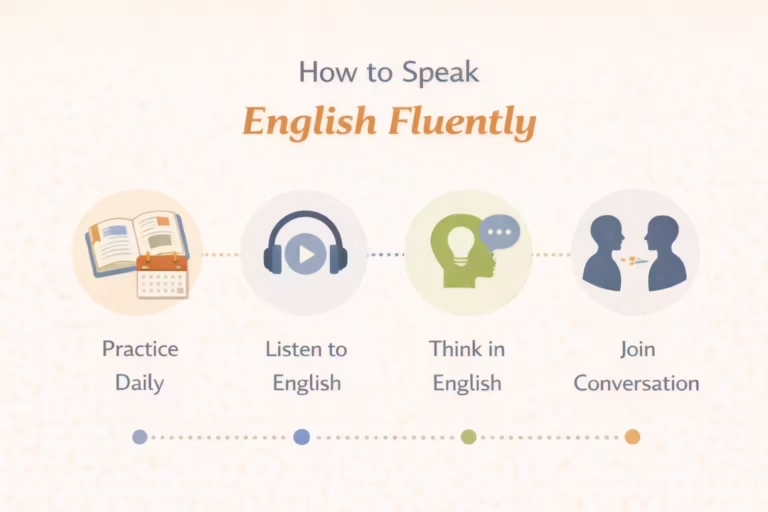
You’ve moved past the basics. You know how to introduce yourself, order food, and hold a short conversation. But somewhere between beginner and advanced, progress starts to feel slow. You study hard, but fluency still feels far away. Sound familiar?
This is one of the most common experiences among study skills for intermediate level language learners — and it even has a name. Language teachers call it the “intermediate plateau.” You’re not alone, and more importantly, you’re not stuck. You just need smarter strategies, not harder work.
In this guide, you’ll find practical, proven study skills that actually work for intermediate learners. These are methods I’ve used with hundreds of students over more than ten years of teaching English in classrooms, private sessions, and online courses. Whether you’re a student, a working professional, or someone learning English to connect with the world, this guide is for you.
Let’s get started.
What Makes Intermediate Learning Different?
When you were a beginner, everything was new. Every word, every sentence felt like a win. Progress was easy to see.
At the intermediate level, things change. You understand a lot, but you still make mistakes. You can speak, but you hesitate. You can read, but academic or professional texts still feel hard.
This stage requires a different approach. You can’t just memorize word lists anymore. You need to start thinking in the language, building real fluency, and developing confidence in real situations.
The good news? The right study habits can move you forward faster than you think.
Study Skill #1: Stop Studying Everything. Start Focusing.
One of the biggest mistakes I see intermediate learners make is trying to improve everything at once. Grammar, vocabulary, pronunciation, listening, writing — all at the same time. The result? Progress in nothing.
Instead, pick one focus area per week or even per month. This is called targeted learning, and it works because your brain builds stronger connections when it practices one skill deeply rather than many skills loosely.
How to apply this:
- Week 1: Focus only on listening. Watch English videos, podcasts, or TV shows every day.
- Week 2: Focus on speaking. Have short daily conversations, even with yourself.
- Week 3: Focus on vocabulary in context. Read short articles and notice new words in sentences.
- Week 4: Focus on writing. Write a short paragraph every day about your day or a topic you like.
I used this method with a group of adult learners in an evening class. Within four weeks, they reported feeling more confident in their weak areas — simply because they gave those areas dedicated attention.
Study Skill #2: Use the Language, Don’t Just Study It
Here’s a hard truth: reading grammar books will not make you fluent. Using the language will.
At the intermediate level, active language use is one of the most important study skills you can develop. This means speaking, writing, and responding in real situations — not just doing exercises in a workbook.
Practical ways to use English actively:
- Keep a daily journal in English. Write 5–10 sentences about your day. Don’t worry about being perfect.
- Join an online language exchange. Websites like Tandem or HelloTalk connect you with native speakers who want to learn your language.
- Think in English. When you’re cooking, commuting, or waiting in line, describe what you see or do in English inside your head.
- Record yourself speaking for 60 seconds on any topic. Listen back and notice where you hesitate or make repeated errors.
One of my students — a software engineer learning English for work — started recording two-minute voice notes every evening instead of studying grammar rules. Within three months, his spoken fluency improved dramatically, and he gave his first presentation in English at work. He didn’t learn a single new grammar rule that month. He just practiced using what he already knew.
Study Skill #3: Build Your Vocabulary the Smart Way
At the intermediate level, vocabulary is often the biggest barrier to fluency. You understand simple words but struggle with more natural, everyday expressions.
The mistake many learners make is learning vocabulary as isolated words — writing “apple” and its translation in a notebook. This doesn’t work well for intermediate learners because words get their meaning from context.
Better vocabulary strategies:
Learn words in phrases, not alone. Instead of learning “make,” learn “make a decision,” “make a mistake,” “make progress.” These chunks of language help you speak more naturally.
Use spaced repetition. Apps like Anki or even the Duolingo review feature use a system that shows you words just before you forget them. This is backed by memory research and is far more effective than reviewing a word list every day.
Learn 10 new words per week, not 50. I’ve seen learners try to memorize 50 words over a weekend. A week later, they remember three. Learning 10 words deeply — with examples, pronunciation, and practice sentences — is far more effective.
Read at your level plus one. This means reading materials that are slightly harder than your current level. If you find a word you don’t know, try to guess its meaning from context before looking it up. This builds your “reading intelligence.”
More interesting topics to explore:
- English for International Students in US Universities
- The Ultimate Guide to Reading Apps: Best Apps for Readers and Students
- How to Use the Shadowing Technique to Speak English Fluently
- Business English: Vocabulary for Professional Communication
- How Reading Can Improve Your Writing Skills
Study Skill #4: Improve Your Listening Skills with Active Listening
Many intermediate learners feel frustrated with listening. “I understand the teacher, but I can’t understand movies or real conversations.” This is extremely common, and it has a clear reason: classroom English and real English sound different.
In real conversations, people speak fast, connect words together, swallow sounds, and use informal expressions. This is called connected speech, and it’s something most textbooks don’t teach you enough of.
How to train your ears:
Shadow native speakers. Choose a short audio clip (30–60 seconds). Listen once. Then play it again and try to speak along at the same time — copying the rhythm, speed, and sounds. This is called shadowing, and it’s one of the most powerful tools for both listening and pronunciation.
Use subtitles strategically. Watch a short clip with English subtitles. Then watch it again without subtitles. Notice what you missed the first time. Over time, your ear will adjust to natural speech.
Listen to the same content multiple times. Don’t always skip to new content. Listening to the same podcast episode or video 3–4 times gives your brain time to absorb the patterns of natural speech.
Choose content you actually enjoy. I cannot stress this enough. Students who listen to boring content give up. Students who listen to things they love — cooking shows, sports commentary, comedy podcasts — keep going. Enjoyment creates consistency, and consistency creates progress.
Study Skill #5: Build Spoken English Confidence
Speaking is where most intermediate learners feel the most anxious. Many of my students tell me: “I know the grammar, but when I open my mouth, everything disappears.” This is not a grammar problem. It’s a confidence and fluency problem.
Practical techniques to build speaking confidence:
Talk to yourself — out loud. This sounds odd, but it works. Narrate what you’re doing as you do it. “I’m making coffee. I’m going to add some sugar. Now I’ll sit down and check my messages.” This builds fluency without the pressure of a real conversation.
Use the 5-sentence challenge. Every day, choose a topic and speak about it for 5 sentences without stopping. Topics can be simple: your morning routine, your favorite food, what you did yesterday. The goal is not perfect grammar — it’s forward momentum.
Practice common conversational phrases. At the intermediate level, many students overthink grammar and forget that real conversations rely on common phrases. Practice expressions like: “That’s a good point,” “I see what you mean,” “Could you repeat that?” and “What do you think about…?” These phrases keep conversations flowing naturally.
Find a speaking partner. Even one 20-minute conversation per week with a real person makes a significant difference. Use language exchange apps, join a local English conversation club, or ask a teacher for a practice session.
Common Mistakes Intermediate Learners Make
After more than a decade in the classroom, I’ve seen the same patterns come up again and again. Here are the mistakes to avoid:
Waiting until you’re “ready” to speak. Intermediate learners often say, “I’ll start speaking when my grammar is better.” But your grammar won’t improve without speaking. Start now, imperfectly.
Translating in your head. Many learners think in their native language and translate into English. This creates slow, unnatural speech. Practice thinking directly in English, even in simple sentences.
Ignoring pronunciation. Grammar and vocabulary get all the attention, but poor pronunciation can make even correct sentences hard to understand. Spend 5–10 minutes per week on pronunciation — focus on sounds that don’t exist in your native language.
Studying without a plan. Sitting down with a textbook and “doing some English” for an hour is less effective than a focused 20-minute session with a clear goal. Always know what you’re practicing before you start.
Giving up after a bad day. Progress in language learning is not linear. You will have days when you feel fluent and days when you can’t find a single word. This is normal. Consistency over months matters far more than performance on any single day.
A Simple Weekly Study Plan for Intermediate Learners
Here’s a practical routine you can start this week. You don’t need hours every day. You need consistency.
Monday: 20 minutes of listening practice (podcast or YouTube video). Write down 3 new words you heard.
Tuesday: 15 minutes of vocabulary review using flashcard app. Practice your words in example sentences.
Wednesday: 10 minutes of speaking practice. Use the 5-sentence challenge on a new topic.
Thursday: 20 minutes of reading. Choose an article slightly above your current level. Look up 2–3 key words.
Friday: 15 minutes of writing. Write a short paragraph about something that happened this week.
Weekend: Watch a TV show, film, or YouTube content in English for fun. No studying required — just enjoy it.
That’s under 2 hours per week. But done consistently for 3 months, the difference is remarkable.
Practical Classroom Application: What Teachers Can Do
If you’re a teacher working with intermediate students, here are a few strategies that work extremely well in real classrooms:
Use communicative activities, not just grammar drills. At this level, students need to practice language in context. Role plays, discussions, and problem-solving tasks are far more effective than fill-in-the-blank grammar exercises.
Record students speaking and let them self-correct. When students hear themselves, they identify their own errors more clearly than when a teacher corrects them. This builds self-awareness and independence.
Teach vocabulary in themes. Instead of random word lists, group vocabulary around topics students will actually use: job interviews, giving opinions, describing problems, making plans. Contextual vocabulary sticks better.
Create low-pressure speaking environments. Fear of making mistakes is the #1 barrier to speaking practice. Celebrate effort over accuracy. Make your classroom a safe space to be wrong.
Conclusion: Study Smarter, Not Harder
Improving your English at the intermediate level takes time — but it doesn’t have to feel like a struggle. The key is using the right study skills for intermediate level language learners: focused practice, active language use, smart vocabulary building, real listening exposure, and consistent speaking practice.
You don’t need to be perfect. You need to be consistent. You don’t need to study for hours. You need to study with purpose.
Start with one strategy from this guide this week. Just one. Build from there. Over months, these small, smart habits create real, lasting fluency.
You’ve already come further than you think.
Frequently Asked Questions (FAQs)
Q1: How long does it take to move from intermediate to advanced English?
It depends on how much you practice and how targeted your learning is. With consistent daily practice of 30–60 minutes, most learners can see significant improvement within 6–12 months. Setting specific goals and using active learning strategies speeds up the process considerably.
Q2: What are the best apps for intermediate English learners?
Anki is excellent for vocabulary with spaced repetition. HelloTalk and Tandem are great for speaking practice with native speakers. Podcasts like “BBC Learning English” and “6 Minute English” are well-suited to the intermediate level. For grammar review, apps like English Grammar in Use (the mobile version) are highly practical.
Q3: I understand English but I can’t speak well. What should I do?
This is called a “passive-active gap” — your receptive skills are stronger than your productive skills. The solution is deliberate speaking practice. Start with low-pressure methods: talking to yourself, recording voice notes, or using language exchange apps. Focus on fluency, not accuracy, in your early speaking practice.
Q4: Should I focus on American English or British English?
Choose one and be consistent. Both are widely understood globally. More importantly, choose the variety that matches your goals — if you’re applying for a job in the UK, focus on British English; if you’re connecting with American media or business, go with American English. Don’t mix the two heavily in formal writing.
Q5: How do I stay motivated when progress feels slow?
Track your progress concretely. Keep a language journal and look back at entries from 2–3 months ago. You’ll often be surprised by how far you’ve come. Also, connect your learning to a real goal — a trip, a job, a relationship, a qualification. Purpose is the strongest motivator.