What Is a Run-On Sentence?
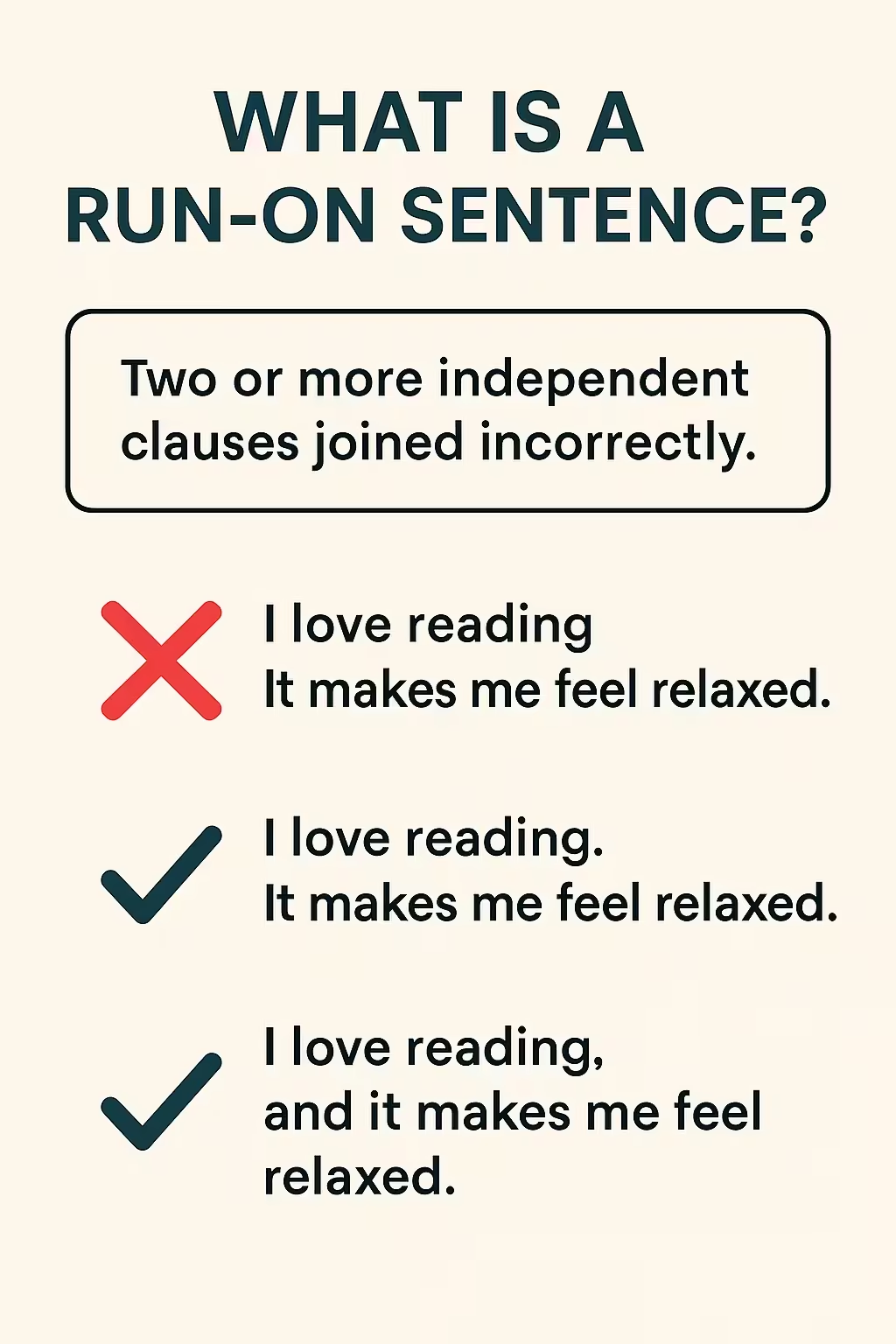
A run-on sentence is a sentence that joins two or more independent clauses (complete thoughts) without proper punctuation or connecting words. In simple terms, it’s when you combine two sentences that should be separated but aren’t.
Here’s a simple example:
Run-on sentence: I love reading books they help me relax.
Corrected: I love reading books. They help me relax.
The problem with the first sentence is that “I love reading books” and “they help me relax” are both complete thoughts. They need to be separated properly, or they create confusion for your reader.
Why Are Run-On Sentences a Problem?
Run-on sentences make your writing hard to read and understand. They can confuse your readers because they don’t know where one idea ends and another begins.
In my teaching experience, students often create run-on sentences when they’re excited about a topic and want to share all their ideas at once.
I remember one student who wrote about her favorite vacation: “I went to Paris it was beautiful I saw the Eiffel Tower I ate delicious food I want to go back.” She had so many wonderful memories, but the run-on sentence made it difficult to follow her story.
Understanding Independent Clauses
Before we go deeper into run-on sentences, you need to understand independent clauses. This is a key term in grammar.
An independent clause is a group of words that contains a subject and a verb and expresses a complete thought. It can stand alone as a sentence.
Examples of independent clauses:
- The sun is shining.
- Maria studies every morning.
- I enjoy cooking Italian food.
Each of these can be a complete sentence on its own. When you put two independent clauses together without proper connection, you create a run-on sentence.
Two Types of Run-On Sentences
There are actually two main types of run-on sentences you should know about:
1. Fused Sentences
A fused sentence (also called a comma splice without the comma) happens when two independent clauses are joined with no punctuation at all.
Example: The weather was cold we stayed inside all day.
This sentence “fuses” two complete thoughts together without any separation. Your reader has to pause and reread to understand where one idea ends and the next begins.
2. Comma Splices
A comma splice occurs when two independent clauses are joined with only a comma.
Many of my students think a comma is enough to connect two sentences, but it’s not.
Example: The weather was cold, we stayed inside all day.
While this is slightly better than a fused sentence because it has some punctuation, a comma alone is not strong enough to connect two complete thoughts. You need something more.
How to Fix Run-On Sentences: 5 Easy Methods
Now for the practical part—how do you fix run-on sentences? I teach my students five reliable methods, and I encourage you to practice all of them.
Method 1: Use a Period
The simplest solution is to separate the two independent clauses with a period and create two sentences.
Run-on: My sister loves to paint she creates beautiful artwork.
Fixed: My sister loves to paint. She creates beautiful artwork.
This is the easiest fix and works well when both ideas are equally important.
Method 2: Use a Semicolon
A semicolon (;) can connect two closely related independent clauses. Use this when the two ideas are connected and you want to show their relationship.
Run-on: The concert was amazing the band played all my favorite songs.
Fixed: The concert was amazing; the band played all my favorite songs.
The semicolon tells your reader, “These two thoughts are closely related, so I’m keeping them together.”
Method 3: Use a Comma with a Coordinating Conjunction
Coordinating conjunctions are small connecting words: for, and, nor, but, or, yet, so. You can remember them with the acronym FANBOYS.
When you use a coordinating conjunction, you must also use a comma before it.
Run-on: I wanted to go to the beach it was raining.
Fixed: I wanted to go to the beach, but it was raining.
This method works great when you want to show the relationship between two ideas (contrast, addition, cause and effect, etc.).
Method 4: Use a Subordinating Conjunction
Subordinating conjunctions (like because, although, when, if, since, while) create a dependent clause. This method changes the structure of your sentence by making one idea dependent on the other.
Run-on: I didn’t go to the party I was feeling sick.
Fixed: I didn’t go to the party because I was feeling sick.
Now “because I was feeling sick” cannot stand alone—it depends on the first part of the sentence. This creates a smooth, clear sentence.
Method 5: Use a Semicolon with a Conjunctive Adverb
Conjunctive adverbs (however, therefore, moreover, furthermore, consequently, etc.) can also connect independent clauses. When you use them, you need a semicolon before and a comma after.
Run-on: The exam was difficult I studied hard and passed.
Fixed: The exam was difficult; however, I studied hard and passed.
This method is more formal and works well in academic writing.
Common Mistakes My Students Make
In my years of teaching, I’ve noticed several patterns in how students create run-on sentences:
Mistake 1: Using “and” too much Some students connect every thought with “and,” creating extremely long sentences. Remember, even with “and,” your sentence can become too long and confusing.
Mistake 2: Thinking longer sentences sound smarter I once had a student who believed that long, complex sentences made him sound more intelligent. Actually, clear and concise writing is much more impressive than confusing run-ons.
Mistake 3: Writing like they speak When we speak, we often run sentences together naturally with pauses. In writing, you need proper punctuation to create those pauses.
Practice Tips for Beginners
If you’re new to identifying run-on sentences, here are some strategies that have worked well for my beginner students:
- Read your writing out loud. If you run out of breath or feel confused about where to pause, you might have a run-on sentence.
- Look for two subjects and two verbs. If you see two subjects doing two different actions, check if they’re connected properly.
- Check every comma. Ask yourself: “Am I connecting two complete thoughts with just this comma?” If yes, you need to fix it.
- Start small. When in doubt, use shorter sentences. There’s nothing wrong with simple, clear sentences.
Advanced Tips for Better Writing
For more advanced learners who want to take their writing to the next level:
Tip 1: Vary your sentence length Good writing includes a mix of short, medium, and long sentences. This creates rhythm and keeps readers engaged. Just make sure your longer sentences are grammatically correct.
Tip 2: Use transitional phrases Words like “in addition,” “for example,” and “on the other hand” help connect ideas between sentences without creating run-ons.
Tip 3: Consider your audience and purpose In creative writing, you might occasionally use longer, flowing sentences. In academic or business writing, shorter and clearer sentences are usually better.
Tip 4: Revise and edit carefully Many run-on sentences appear in first drafts when you’re focused on getting your ideas down. That’s okay! Just make sure to review and fix them during the editing process.
Quick Reference Guide
Here’s a summary you can bookmark and return to:
- Run-on sentence: Two or more independent clauses incorrectly joined
- Independent clause: A complete thought with a subject and verb
- Five ways to fix run-ons:
- Period (make two sentences)
- Semicolon
- Comma + coordinating conjunction (FANBOYS)
- Subordinating conjunction
- Semicolon + conjunctive adverb + comma
Final Thoughts
Learning to identify and fix run-on sentences is an essential skill for anyone learning English. While it might seem challenging at first, with practice, it becomes second nature.
Remember, even native English speakers make this mistake sometimes—the important thing is to review your writing and fix errors when you find them.
Start by practicing with the methods I’ve shared. Read your writing carefully, check your punctuation, and don’t be afraid to break long sentences into shorter ones. Your readers will thank you for writing clearly and effectively.
Keep practicing, stay patient with yourself, and celebrate your progress. Every time you correct a run-on sentence, you’re becoming a better writer. You’ve got this!
You may also like these English learning articles:
📚 Continue Learning English
Choose your next lesson and keep improving your English skills with our free English learning resources.