As an English teacher who has graded thousands of essays over the years, I know the Sunday evening panic all too well. You’re staring at a stack of 30 student essays, your red pen is running low, and you’re wondering if you’ll ever see the bottom of that pile. I’ve been there countless times, both in my traditional classroom and while teaching online students from around the world.
The truth is, grading essays faster isn’t about cutting corners or being less thorough. It’s about working smarter, not harder. After years of trial and error, I’ve developed strategies that help me grade essays more efficiently while still giving my students the detailed feedback they need to improve their writing. Whether you’re a new teacher drowning in papers, an experienced educator looking to reclaim your weekends, or even a parent helping your child with writing assignments, these eight practical tips will transform how you approach essay grading.
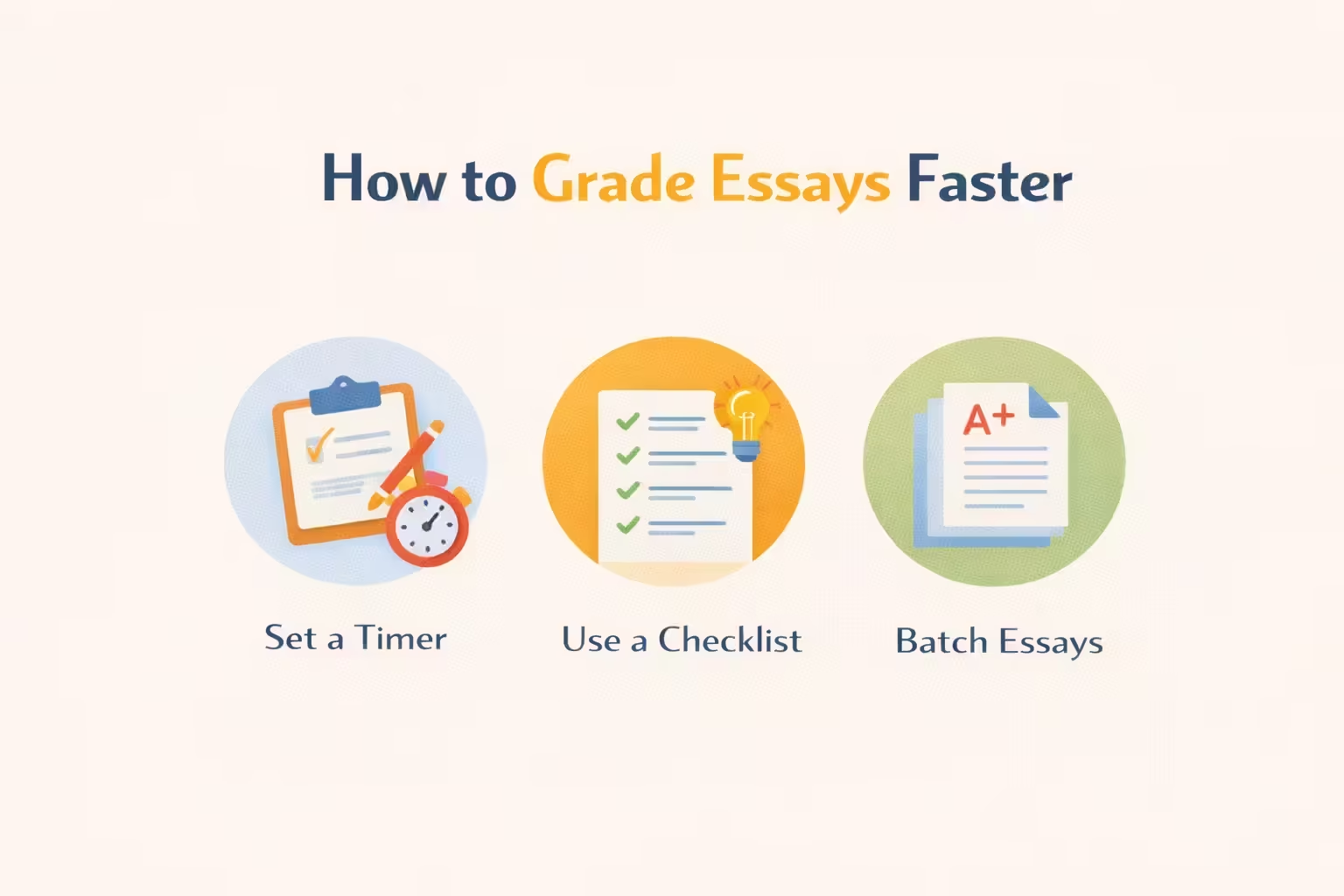
1. Create a Rubric Before You Start Grading Essays
This might seem like extra work upfront, but trust me—a well-designed rubric is your secret weapon for grading essays faster. When I first started teaching, I would read each essay from start to finish, then try to figure out what grade it deserved. This approach took forever and resulted in inconsistent grading.
Now, I create a detailed rubric before my students even start writing. My rubric typically includes four or five categories: thesis statement, organization, evidence and examples, grammar and mechanics, and conclusion. Each category has clear criteria for different grade levels.
Here’s why this works: When you have a rubric, you’re not making decisions from scratch for each essay. You’re simply checking boxes and matching the writing to your predetermined standards. Instead of spending 20 minutes wondering if an essay is a B+ or an A-, you can quickly assess which criteria it meets and assign a grade in 10 minutes or less.
I also share the rubric with students before they write. This has an amazing side effect—their essays improve because they know exactly what I’m looking for. Better essays mean faster grading because I spend less time correcting the same mistakes repeatedly.
2. Grade in Batches by Section, Not Essay by Essay
This tip completely changed my grading life. Instead of reading one complete essay, then moving to the next complete essay, I grade all the introductions first, then all the body paragraphs, then all the conclusions.
Why does this work so well? Your brain gets faster at spotting patterns when you’re focused on one specific task. When I’m in “introduction mode,” I quickly recognize strong thesis statements versus weak ones. I can immediately spot missing hooks or unclear main ideas. By the time I’m reading the 15th introduction, I’m much faster than when I read the first one.
This batch grading method also helps maintain consistency. You’ll remember exactly what an excellent introduction looks like because you just read five of them. You won’t accidentally grade harder or easier as you get tired because you’re constantly comparing similar elements.
I discovered this technique by accident during an especially busy semester when I could only grade for 30 minutes at a time. I started grading just the introductions during my lunch break, then tackled body paragraphs after school. I finished the entire stack faster than ever before, and my students said my feedback was more consistent.
3. Use Efficient Comment Codes and Symbols
Writing the same feedback over and over is exhausting and time-consuming. Early in my teaching career, I would write “This sentence is unclear and needs to be revised” on 20 different papers. Then I realized I was wasting precious time repeating myself.
Now I use a simple coding system. I mark “UC” for unclear sentences, “SP” for spelling errors, “WC” for word choice issues, and “¶” when a new paragraph is needed. At the beginning of the semester, I give my students a handout explaining all my codes and symbols.
This system lets me mark papers incredibly fast. Instead of writing a full sentence explaining every error, I simply write the code. A comment that would have taken me 30 seconds to write now takes three seconds. Multiply that time savings across 100 comments, and you’ve saved yourself nearly an hour.
The key is keeping your coding system simple and consistent. Don’t create 50 different codes—your students (and you) will forget what they mean. I stick to about 15 core codes for the most common issues I see. For comments that need more explanation, I write them out fully, but these are much less frequent.
Explore more interesting topics here:
- Learn English Through Media: Fun and Effective Methods
- Top 10 Reasons to Learn English and Improve Your Life
- English Conversation at the Coffee Shop
- 150 Basic English Sentences Every Kid Should Learn
- Best English Conversation Topics for Daily Use
4. Focus on Patterns, Not Every Single Error
This was a hard lesson for me to learn because I’m naturally a perfectionist. When I first started grading essays, I felt obligated to mark every single grammar mistake, every awkward phrase, and every misplaced comma. Not only did this take forever, but my students felt overwhelmed when they received papers covered in red ink.
Now I focus on patterns. If a student makes the same mistake five times, I mark it once or twice and write a note: “Watch out for subject-verb agreement throughout this essay. See highlighted examples.” This approach is faster for me and more helpful for students. They can focus on fixing one major issue instead of feeling paralyzed by 30 individual corrections.
In my experience teaching both native English speakers and ESL learners, I’ve found that students make the most progress when they tackle one or two writing problems at a time. A student who fixes their run-on sentence problem will write better essays in the future. A student who receives 47 different corrections might not know where to start.
I prioritize higher-order concerns (thesis, organization, evidence) over lower-order concerns (punctuation, spelling). If an essay has a weak argument, fixing the comma splices won’t make it a good essay. I address the big issues first.
5. Set a Timer for Each Essay When Grading
This tip sounds simple, but it’s surprisingly effective. I set a timer for 12 minutes per essay (adjust based on length and level). When the timer goes off, I finish my current thought and move to the next paper.
Before I used a timer, I would spend 30 minutes on an excellent essay writing detailed praise, then rush through a struggling student’s paper in 8 minutes because I was behind schedule. This wasn’t fair to anyone.
The timer creates accountability. It reminds me that my goal is to give useful feedback efficiently, not to rewrite the essay for the student. It also prevents me from going down rabbit holes—you know those moments when you spend 10 minutes trying to fix one confusing paragraph that the student really needs to rewrite themselves.
I learned this technique from a colleague who graded Advanced Placement exams. She told me that AP graders evaluate essays in just a few minutes because they’re trained to assess quickly and move on. While I give my students more detailed feedback than an AP exam, the principle holds: effective feedback doesn’t require endless time.
When the timer goes off and I’m not finished, it usually means the essay needs significant revision. In these cases, I write a summary comment identifying the main issues and schedule a quick conference with the student. This is faster than writing a novel in the margins, and students learn more from a five-minute conversation than from reading my lengthy comments anyway.
6. Grade During Your Peak Energy Hours
I used to grade essays late at night after my family went to bed. I thought I was being productive by using that “extra” time. In reality, I was exhausted, unfocused, and spending twice as long on each paper as I would have during the day.
Now I grade during my peak energy hours. For me, that’s between 9 AM and noon. I’m alert, I can think clearly, and I power through essays much faster. What used to take me three hours at night now takes 90 minutes in the morning.
Everyone’s peak hours are different. Maybe you’re a night owl who focuses best after 8 PM. That’s fine—the point is to identify when your brain works best and protect that time for grading essays.
I also discovered that changing my environment helps. Instead of grading at my desk where I teach all day, I sometimes grade at a coffee shop or in my backyard. The change of scenery keeps my mind fresh. When I’m grading online submissions, I’ll sometimes work from a library with better lighting and fewer distractions.
Taking short breaks is crucial too. I use the Pomodoro Technique: grade for 25 minutes, then take a 5-minute break to stretch, grab water, or walk around. This keeps my focus sharp and prevents the mental fatigue that slows down grading.
7. Use Technology Tools to Speed Up Feedback
Technology has been a game-changer for grading essays faster, especially since I started teaching online classes alongside my traditional classroom. I’m not suggesting that computers should grade essays for you, but there are smart ways to use technology as a helpful assistant.
For digital submissions, I use the comment feature in Google Docs or Microsoft Word. I’ve created a library of saved comments for common issues. When I see a weak thesis statement, I click my saved comment that says, “Your thesis should make a clear argument that can be supported with evidence. Try stating your position more directly.” Instead of typing this feedback from scratch each time, I insert the saved comment in two seconds.
I also use text expansion tools. When I type “tsf” it automatically expands to “This sentence is unclear. Try breaking it into two shorter sentences.” These small shortcuts add up to significant time savings across multiple essays.
Grammar checkers like Grammarly can be helpful for identifying basic errors, but I don’t rely on them completely. I tell my students to run their essays through these tools before submitting, which means I spend less time marking simple spelling and punctuation errors. This lets me focus my grading time on higher-level feedback about their arguments and ideas.
For speaking and pronunciation practice (which I incorporate into many writing assignments), I use voice recording tools. Instead of writing lengthy comments, I sometimes record 2-3 minute audio feedback. I can speak much faster than I can type, and students tell me they appreciate hearing my tone and emphasis. This works especially well for my ESL learners who benefit from listening practice.
8. Create Grading Sessions and Stick to Your Schedule
The biggest mistake I made early in my teaching career was letting essays pile up. I’d assign an essay on Monday, collect it on Friday, then let it sit for two weeks before grading. By the time students got feedback, they’d forgotten what they wrote and didn’t care anymore.
Now I create specific grading sessions in my schedule and treat them like unmissable appointments. When I assign an essay, I immediately block out time to grade it. If I collect 30 essays on Friday, I schedule three grading sessions: Saturday morning (10 essays), Sunday afternoon (10 essays), and Monday evening (10 essays). I stick to this schedule no matter what.
This approach has multiple benefits. First, I never face an overwhelming pile of 90 essays because I’m consistently grading in manageable chunks. Second, students get faster feedback when it’s still fresh in their minds. Third, I can identify class-wide issues and address them in my next lesson before students make the same mistakes again.
I’ve found that grading in shorter, focused sessions is more efficient than marathon grading marathons. Three 90-minute sessions are more productive than one exhausting 5-hour session where my focus deteriorates with each essay.
I also return essays within one week of submission—no exceptions. This deadline keeps me accountable. My students know when to expect their graded work, which builds trust and shows them I respect their efforts.
Conclusion: Grading Essays Faster Means Better Teaching
Learning how to grade essays faster has made me a better, more effective teacher. I have more energy for lesson planning, more time for one-on-one student conferences, and more balance in my personal life. My students receive timely, consistent feedback that actually helps them improve their writing.
These eight strategies—using rubrics, batch grading, creating comment codes, focusing on patterns, setting timers, working during peak hours, leveraging technology, and scheduling regular grading sessions—have transformed my approach to evaluating student work.
Remember, grading essays faster doesn’t mean grading carelessly. It means grading smartly. You’re providing the same quality feedback in less time by eliminating inefficiencies and focusing your energy where it matters most.
Start with one or two of these tips and gradually incorporate more as they become habits. You’ll be amazed at how much time you reclaim while still helping your students grow as writers. After all, the goal isn’t to spend endless hours grading—it’s to help students become confident, skilled communicators. These strategies let you do exactly that without sacrificing your evenings and weekends.
Your students need you at your best, and you can’t be your best when you’re burned out from spending every spare moment grading papers. Take back your time, improve your efficiency, and watch both your students and your teaching thrive.
📚 Continue Learning English
Choose your next lesson and keep improving your English skills with our free English learning resources.