Introduction: Why Vocabulary Teaching Matters More Than You Think
If you have ever watched a middle school student stare blankly at a reading passage, struggling to understand even a single paragraph, you already know the problem. The issue is rarely intelligence. The issue is vocabulary.
Teaching vocabulary effectively in middle school is one of the most powerful things a teacher can do. When students know more words, they read better, write better, speak more confidently, and understand the world more clearly. But here is the honest truth: most vocabulary instruction in middle school does not work. Writing down definitions from a dictionary and memorizing a word list on Friday does not help students actually use words in real life.
After more than 10 years of teaching English in classrooms and online, I have seen what works and what fails. I will walk you through practical, proven strategies to teach vocabulary in a way that actually sticks. Whether you are a classroom teacher, a parent helping at home, or an ESL educator working with language learners, these methods are ready to use starting tomorrow.
What Is Effective Vocabulary Instruction?
Effective vocabulary instruction means teaching words in a way that helps students understand them deeply, remember them long-term, and use them naturally in speaking and writing.
It is not about memorizing lists. It is about building a real relationship with words.
Research in language education consistently shows that students need to encounter a new word at least 10 to 15 times in different contexts before they truly own it. That means one Friday quiz is never enough. Vocabulary learning needs to be woven into daily classroom life.
There are two types of vocabulary every middle school teacher should focus on:
Tier 2 words — These are academic words that appear across many subjects. Words like analyze, contrast, significant, and interpret fall into this category. These are the words that show up on standardized tests and in textbooks across science, social studies, and English class.
Tier 3 words — These are subject-specific terms. In science class, you might teach photosynthesis or ecosystem. In history class, it might be democracy or revolution.
Both matter. But Tier 2 words often get ignored, and that is a mistake.
Why Traditional Vocabulary Teaching Does Not Work
Let me be direct. The “copy the definition, use it in a sentence, take a quiz Friday” method does not build real vocabulary knowledge. It builds short-term memorization.
Here is what I have seen in real classrooms. A student writes the definition of perseverance on Monday. On Friday, they spell it correctly on the quiz. By the following Monday, they cannot tell you what it means. And they would never use it in a conversation.
This happens because the brain needs repetition, context, and connection to store new vocabulary permanently. A single definition in a notebook does not create that.
Common problems with traditional methods include shallow understanding, no speaking practice, no connection to real life, and no repeated exposure over time.
Strategy 1: Teach Words in Context, Not in Isolation
One of the most effective vocabulary strategies for middle school is teaching words inside a rich context. Instead of handing students a list of 20 random words, introduce vocabulary through stories, articles, short videos, or real-world scenarios.
Here is a simple classroom example. Before reading a short article about climate change, I pre-teach three key words: impact, sustain, and reduce. I show each word in a sentence from the article. We talk about what the sentence means. Then students read the article. After reading, we revisit those three words again. By the end of class, students have seen each word at least four or five times in meaningful context.
How to apply this immediately:
- Choose 3 to 5 words from a reading passage before you teach it
- Show the word in its original sentence first
- Ask students what they think it means based on context clues
- Confirm or correct the meaning together
- Use the word again in discussion after reading
This approach respects students’ intelligence. It teaches them to figure out meaning from context, which is a lifelong reading skill.
Strategy 2: Use Word Maps and Vocabulary Notebooks
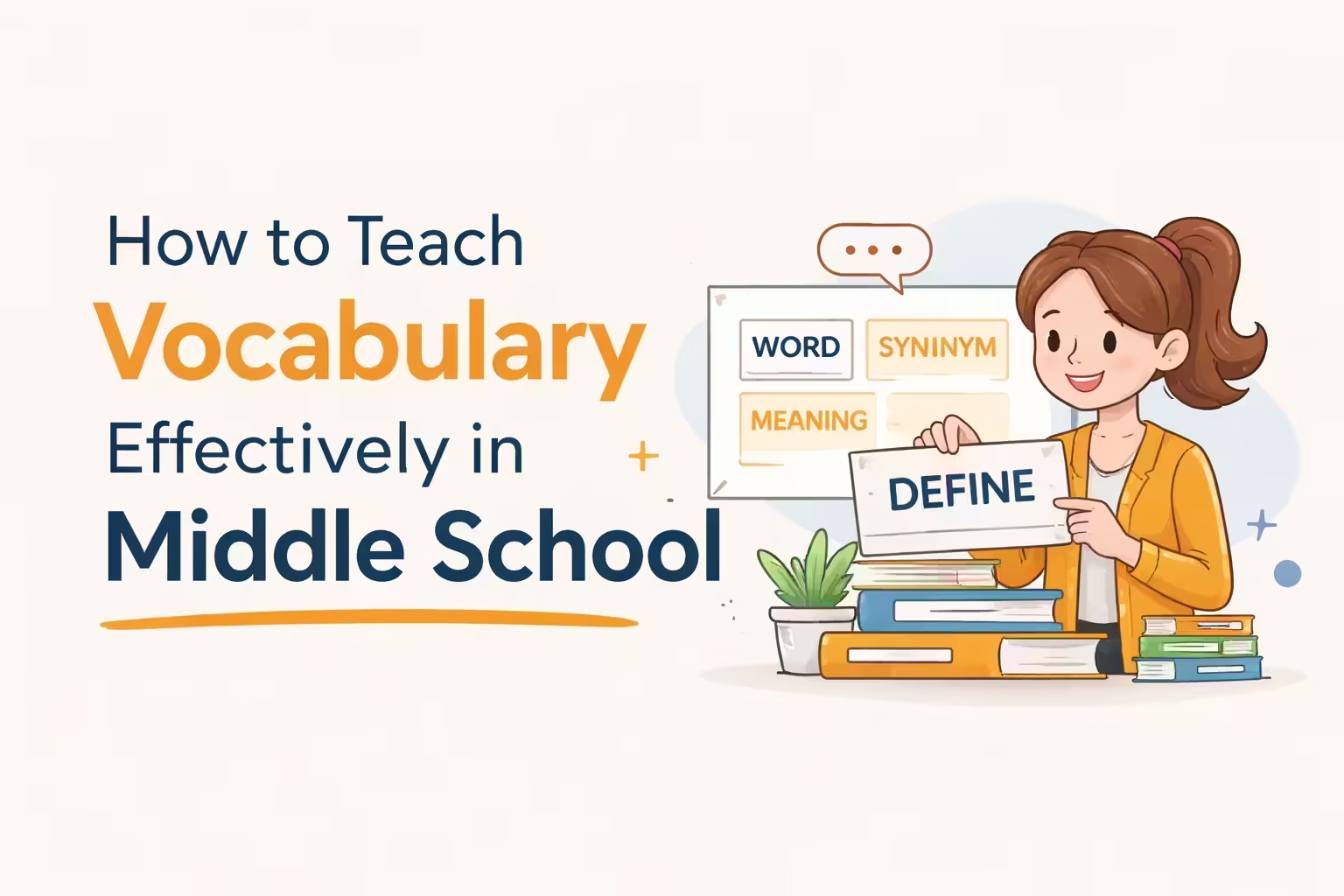
A word map is a simple graphic organizer that helps students explore a word from four angles: the definition in their own words, a picture or symbol, an example sentence they write themselves, and a non-example or antonym.
This technique works because it forces deep processing. When a student has to draw a picture of resilience or write a sentence using consequence, they are not just memorizing. They are thinking.
Try this activity this week:
Give each student a blank word map template. Choose one powerful Tier 2 word, such as perspective. Ask students to fill in all four sections individually. Then pair them up to compare. Finally, share with the whole class. The whole process takes about 10 minutes and builds real word ownership.
Vocabulary notebooks are another excellent tool. Instead of a disconnected word list, students keep a running notebook where each new word gets its own small section: the word, a simple definition, a personal example sentence, and a drawing or emoji. Students who use vocabulary notebooks consistently show stronger retention after 30 days compared to students using standard vocabulary worksheets.
Strategy 3: Build Vocabulary Through Speaking Practice
This is where many teachers miss a huge opportunity. Vocabulary is not just a reading and writing skill. Students need to say new words out loud, use them in conversation, and hear them spoken naturally.
In my online classes, I noticed that ESL middle school students who only practiced vocabulary through writing struggled to use those words when speaking. But students who practiced speaking the words in real conversations began using them naturally within two weeks.
Spoken vocabulary activities that work:
Vocabulary Hot Seat — One student sits at the front. You show the class a vocabulary word on the board behind the student. Classmates give clues using the word in sentences, without saying the word itself. The student in the hot seat guesses. This is fun, fast, and highly effective.
Word of the Day Routine — Start every class with a Word of the Day. Write it on the board, say it out loud together, use it in a silly or relatable sentence, and challenge students to use it naturally before class ends. Simple but powerful.
Think-Pair-Share with Vocabulary — Ask a question that requires students to use a target word in their answer. For example, “Tell your partner about a time you showed perseverance.” Then share with the class. Students hear the word pronounced correctly and used in real sentences.
Pronunciation matters here too. Many middle school students avoid using new words in conversation because they are not sure how to say them. Always model pronunciation clearly. Clap syllables together. Break words into parts. Make it low-pressure and even a little fun.
Strategy 4: Use Repetition That Does Not Feel Like Repetition
Students need to encounter a word many times, but repeating the same boring drill kills motivation. The secret is to repeat words through variety.
Here are ways to repeat vocabulary without students realizing they are drilling:
Word Walls — Post current vocabulary words on a classroom wall. Refer to them during lessons. Ask students to point to the word that fits a sentence you read aloud. A word wall that is actively used every day is far more valuable than one that just hangs on the wall collecting dust.
Vocabulary Games — Simple games like Vocabulary Bingo, Kahoot word quizzes, Taboo, or Pictionary with target words turn repetition into play. Games lower anxiety and increase engagement. I have used Vocabulary Bingo successfully with students from sixth grade all the way through high school ESL classes.
Sentence Starters — Give students sentence starters that require them to use the target word. For example: “I think empathy is important because…” or “An example of conflict in real life is…” Students complete the sentence in writing or share verbally. This forces them to use the word meaningfully, not just copy it.
Strategy 5: Connect New Words to Personal Experience
Words that connect to a student’s own life are words that stick. Abstract definitions float away. Personal connections anchor words in memory.
When I taught the word perseverance to a group of seventh graders, I asked them to share something difficult they had not given up on. One student talked about learning to skateboard after falling dozens of times. Another talked about practicing a video game for months. Suddenly, perseverance was not a vocabulary word. It was their word.
Practical classroom application:
After introducing a new word, ask students: “Has this word ever been part of your life? Can you think of a real example?” Give them 60 seconds to write. Then share. This takes very little time but creates strong memory connections.
For ESL learners especially, connecting vocabulary to personal experience bridges the gap between language learning and real communication.
Common Mistakes Teachers Make With Vocabulary Instruction
Even experienced teachers fall into these traps. Knowing about them is the first step to avoiding them.
Teaching too many words at once — Ten or fifteen new words in one week is too many for most middle schoolers. Research suggests that five to eight words taught deeply is far more effective than twenty words taught superficially. Quality over quantity every time.
Skipping the speaking practice — Students need to say new words, not just write them. If your vocabulary lessons never include speaking, you are leaving a huge part of language learning on the table.
Using only one activity — Doing word maps every single day gets boring fast. Vary your approach. Mix visual, verbal, written, and game-based activities across the week.
Testing instead of practicing — If the only time students engage with vocabulary is during a test, they will memorize just enough to pass and forget everything afterward. Practice should happen every day. Tests should happen occasionally.
Ignoring pronunciation — Especially with ESL students, if they cannot pronounce a word confidently, they will avoid using it. Teach pronunciation as part of every vocabulary lesson.
Building Vocabulary Confidence in Middle School Students
Middle school is a sensitive time. Students are acutely aware of how they sound in front of their peers. Many students stay silent in class not because they do not know the word, but because they are afraid of mispronouncing it or sounding wrong.
Your job as a teacher is to make word learning feel safe.
Use humor. Celebrate mistakes. Say things like, “Mispronouncing a word just means you are trying. That is a good thing.” Create a classroom culture where using a new word, even imperfectly, is celebrated. I have seen this single mindset shift transform quiet, reluctant learners into students who eagerly try new vocabulary in class discussions.
Confidence with vocabulary builds confidence in reading, writing, and speaking. These skills compound over time. A student who builds a strong vocabulary in sixth grade will carry that advantage all the way through high school, college, and their career.
A Simple Weekly Vocabulary Routine for Middle School Teachers
Here is a practical, ready-to-use weekly framework:
Monday — Introduce 5 to 8 new words using context from a reading or video. Do a quick Word Map activity for two or three key words.
Tuesday — Word Wall update and a speaking activity such as Think-Pair-Share or Vocabulary Hot Seat.
Wednesday — Reading or writing activity that naturally incorporates the week’s words. Ask students to identify or use the target words in their work.
Thursday — Vocabulary game day. Bingo, Kahoot, or Pictionary using the week’s words.
Friday — Short written reflection or exit ticket where students use at least three target words in meaningful sentences. This replaces the traditional Friday quiz and gives you much better insight into real comprehension.
Conclusion: Effective Vocabulary Teaching Changes Everything
Teaching vocabulary effectively in middle school is not about making students memorize definitions. It is about helping them fall in love with words. It is about giving them the tools to read harder texts, write stronger essays, speak more clearly, and engage with the world more fully.
The strategies in this guide are not complicated. They do not require expensive materials or technology. They require commitment, consistency, and a genuine belief that your students can grow.
Start small. Pick one strategy from this article and try it this week. Notice what happens. Then add another. Over time, these small changes build into a vocabulary-rich classroom culture where students are excited about words, not afraid of them.
Progress takes time. Real vocabulary growth happens over months, not weeks. But when it happens, it is one of the most rewarding things you will ever see as a teacher.
Keep showing up. Keep making words come alive. Your students will carry those words with them for the rest of their lives.
Frequently Asked Questions (FAQs)
Q1: How many vocabulary words should I teach per week in middle school?
Research suggests that 5 to 8 words taught deeply and repeatedly is more effective than teaching 15 to 20 words superficially. Focus on quality over quantity for lasting results.
Q2: What are the best vocabulary activities for middle school ESL students?
Word maps, vocabulary notebooks, speaking games like Hot Seat, and Think-Pair-Share activities work especially well for ESL learners because they combine reading, writing, speaking, and listening in every lesson.
Q3: How long does it take for students to truly learn a new vocabulary word?
Students typically need to encounter a word 10 to 15 times in meaningful contexts before they genuinely own it. Consistent daily exposure over several weeks is the key to permanent vocabulary retention.
Q4: How can I make vocabulary learning fun for middle schoolers?
Games like Vocabulary Bingo, Kahoot, Pictionary, and Taboo make repetition feel like play. Personal connections, group discussion, and low-stakes speaking activities also increase engagement significantly.
Q5: Should I teach vocabulary before or after reading?
Both. Pre-teaching 3 to 5 key words before reading helps students access the text more easily. Revisiting those words after reading deepens understanding and reinforces retention. The combination is far more powerful than either approach alone.
Explore more interesting topics here:
- Responsive Teaching Strategies for ELA Teachers
- The Basics of English Teaching: A Complete Guide for Beginners
- Positive Feedback Examples: 400 Inspiring Ideas
- Limerick Examples: 410 Funny & Creative Poems
- Active Voice Examples: 5,00 English Sentences + Guide
- Soft Skills in English: Complete Guide for Students & Professionals (Improve Communication & Career Growth)
Want to learn more? Check out similar topics on English Teaching Resources.