Introduction
Have you ever wished you could speak English fluently — without feeling nervous, confused, or lost for words? You are not alone. Millions of people around the world are searching for the best guide to learning English fast, and you have just found it.
English is spoken by more than 1.5 billion people worldwide. It is the global language of business, travel, technology, and culture. Whether you are a complete beginner or an intermediate learner who wants to reach an advanced level, this guide is for you.
In this article, you will find practical tips, real-life examples, and easy-to-follow strategies to improve your English speaking skills quickly. No confusing jargon. No boring grammar rules. Just clear, simple, and actionable advice that actually works.
Let’s begin your journey to fluent English — starting right now.
What Is a “Guide to Learning English Fast”?
A guide to learning English fast is a structured plan that helps you improve your English skills in the shortest time possible. It covers all the key areas of language — speaking, listening, reading, writing, vocabulary, and pronunciation.
Unlike traditional classroom learning (which can take years), a fast-learning guide focuses on what matters most: practical, everyday English that you can use immediately in real life.
Simple Definition: Learning English fast means using smart, focused methods to build your English skills quickly — instead of spending years memorising textbooks. It is about learning the right things, in the right order, using the right practice habits.
Think of it like learning to ride a bicycle. You do not start by reading a 500-page book about physics. You just get on the bike, balance, pedal, and practice every day. Learning to speak English fluently works the same way.
Why Is Learning English Fast So Important?
You might be wondering: “Why do I need to learn English quickly? Can’t I take my time?” Of course you can. But here is why faster progress makes a huge difference in your life.
Benefits in Daily Life
- You can watch English movies and TV shows without subtitles.
- You can read English articles, books, and websites with ease.
- You can travel to any country and communicate confidently.
Benefits for Your Career
- English speakers earn significantly more in many countries.
- Most international companies require English for jobs and promotions.
- Job interviews, emails, and presentations all need strong English.
Benefits for Confidence and Communication
- Speaking English well removes the fear of embarrassment.
- You can make friends from different countries and cultures.
- Your overall communication skills — even in your native language — improve.
“To have another language is to possess a second soul.” — Charlemagne
The faster you improve your English, the sooner you can enjoy all of these benefits in your real life.
Types / Categories of English Speaking Skills
To use this guide to learning English fast effectively, you need to understand the different skills involved. English is not just one skill — it is a combination of several important areas.
Fluency
The ability to speak smoothly and naturally, without long pauses or hesitation.
Pronunciation
Saying words correctly so that native speakers easily understand you.
Vocabulary
Knowing enough words to express your ideas clearly in different situations.
Grammar
Understanding the basic rules of how English sentences are structured.
Confidence
Feeling comfortable enough to speak without fear of making mistakes.
Listening Skills
Understanding English when others speak — in person, in films, or in podcasts.
Pro Tip: Most learners focus only on grammar and vocabulary. But fluency and listening skills are equally important. The best English speakers practice all six areas together.
Detailed Explanation with Real-Life Examples
Now let us explore each skill area in depth — with real-life situations and short dialogues to help you understand.
1. Building Fluency: Think in English
Fluency does not mean speaking perfectly. It means speaking naturally and continuously, even if you make small mistakes.
One of the best spoken English tips is to stop translating in your head. When you think in your native language and then translate to English, you speak slowly and awkwardly. Instead, try to think directly in English.
Real-Life Scenario: Ordering at a café
Riya: Hi! Can I get a medium latte, please?
Barista: Sure! Would you like that hot or iced?
Riya: Hot, please. And can I also have a blueberry muffin?
Barista: Of course! That’ll be $6.50.
Notice how Riya does not use difficult vocabulary. She uses simple, polite phrases. That is real-life fluency.
2. Improving Pronunciation: Sound Like a Native
Poor pronunciation can make it hard for people to understand you, even if your grammar is perfect. To improve your English pronunciation, focus on:
- Word stress: In the word “photograph,” the stress is on the first syllable — PHO-to-graph.
- Difficult sounds: The English “th” sound (as in think or this) is tricky for many learners.
- Connected speech: Native speakers link words together. “What are you doing?” sounds like “Whaddaya doin’?”
3. Expanding Vocabulary: Learn the Right Words
You do not need to know 50,000 words to speak English fluently. Studies show that just 2,000–3,000 common words cover about 95% of everyday conversation.
Start by learning high-frequency words in context — not isolated word lists. For example, instead of just learning the word “run,” learn these phrases:
- “Can you run me through the plan?” (meaning: explain)
- “We are running out of time.” (meaning: almost finished)
- “She runs a small bakery.” (meaning: manages)
This way, one word teaches you many uses at once.
4. Understanding Grammar: Rules Made Simple
Grammar is important, but it should not stop you from speaking. Focus on these three essential areas first:
- Tenses: Present simple (“I work”), past simple (“I worked”), and present perfect (“I have worked”).
- Sentence structure: Subject + Verb + Object (e.g., “She reads books every day”).
- Common prepositions: in, on, at, for, with, from, to.
5. Building Confidence: Speak Without Fear
Fear is the biggest barrier to speaking English fluently. Many learners know grammar and vocabulary but freeze when they need to speak.
Remember: Every fluent English speaker once made the same mistakes you are making right now. Mistakes are not failures — they are how your brain learns and gets better. Speak more, fear less.
6. Listening Skills: The Forgotten Superpower
Listening is the skill that most English learners ignore — and it is one of the most powerful.
Research in second language acquisition shows that we learn most of our language through comprehensible input — content we can mostly understand, with a little challenge. Watch English content that is slightly above your current level.
Common Mistakes to Avoid When Learning English
Many learners make the same mistakes that slow down their progress. Here are the most common ones — and how to fix them.
- Studying grammar too much, speaking too little. Grammar is a tool, not the goal. If you only study and never practice speaking, you will never become fluent.
- Translating every word in your head. This slows you down badly. Practice thinking in English, even for simple thoughts like “I am hungry” or “It is a beautiful day.”
- Avoiding difficult conversations. Real fluency comes from speaking even when you are NOT ready. Push yourself into uncomfortable situations.
- Learning vocabulary in isolation. Memorising 50 random words each day does not work well. Learn words in sentences and phrases so your brain remembers how to use them.
- Only using one resource. Relying only on textbooks or one app limits your progress. Mix it up: podcasts, movies, conversations, reading, and writing.
- Giving up after making mistakes. Mistakes are a normal part of learning. Every mistake is your brain building new neural pathways.
- Not practising every day. 30 minutes of English practice every day is far better than 4 hours once a week. Consistency is everything.
Tips, Strategies & Best Practices to Learn English Fast
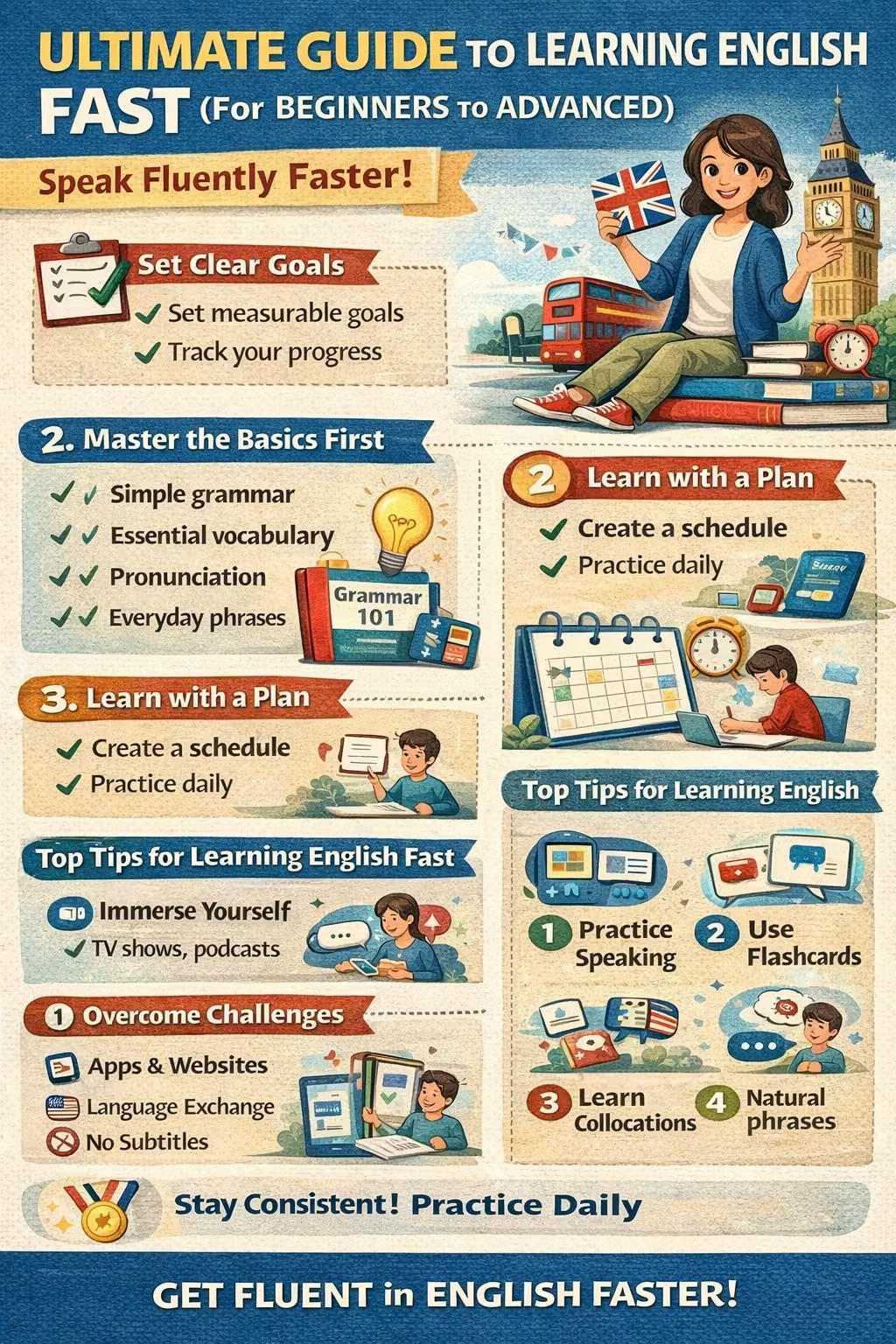
This is the heart of your guide to learning English fast. Use these proven strategies every day and watch your English improve faster than you ever imagined.
Daily Habits That Make a Big Difference
- Start your day in English. Set your phone language to English. Think of five simple English sentences when you wake up. This trains your brain to think in English from the very beginning of your day.
- Learn 5 new words every day. Do not try to learn 50 words. Learn 5 deeply — in context, in sentences, with pronunciation. Use them in conversation during that day. This equals 1,825 words per year.
- Watch one English video each day. YouTube channels like BBC Learning English, English with Lucy, or TED-Ed are excellent. Watch with subtitles first, then without.
- Speak to yourself. Narrate your actions in English: “I am making tea. I will put the kettle on. The water is boiling.” It builds fluency without needing a partner.
- Read something in English every day. Start with simple articles — BBC Simple English or Newsela are great options. Reading builds vocabulary and grammar naturally.
- Write in English for 10 minutes. Keep a simple diary in English. Write about your day, your plans, or your opinions. Writing reinforces everything you learn.
Proven Study Techniques
- Spaced Repetition: Use apps like Anki or Quizlet to review vocabulary at perfect intervals. Your brain remembers things much longer this way.
- Shadowing Method: Listen to a native English speaker, then immediately repeat what they say, copying their rhythm, tone, and pronunciation. This is one of the best ways to improve your pronunciation and fluency together.
- Extensive Listening: Listen to English podcasts even while doing other things — cooking, walking, or travelling. Your ear gets used to the natural speed of English.
- Speaking with Native Speakers: Use platforms like iTalki, Tandem, or HelloTalk to find language partners. Even 20 minutes of real conversation per week makes a significant difference.
- The “Chunks” Method: Learn English in set phrases, not individual words. Instead of learning “good,” “morning,” and “how” separately — learn “Good morning! How are you doing?” as one chunk.
How to Practise English When You Are Busy
- Listen to English podcasts during your commute.
- Change your social media feeds to English.
- Watch English news for 10 minutes with your morning coffee.
- Use your lunch break to review 5 vocabulary words.
- Write a quick English journal entry before bed.
Even 30 minutes of focused practice per day adds up to over 180 hours per year. That is significant progress.
Real-Life Applications of English Skills
Here are the key real-life situations where your improved English speaking skills will make a real difference.
At School or University
- Participate more confidently in class discussions.
- Write better essays and assignments.
- Understand English-language textbooks and research papers.
- Score higher in IELTS, TOEFL, or Cambridge English exams.
At Job Interviews
More and more job interviews are conducted in English — even in non-English-speaking countries. Strong English shows employers that you are professional, internationally minded, and confident.
Job Interview Scenario:
Interviewer: Can you tell me a little about yourself? Candidate: Of course! I have three years of experience in digital marketing. I enjoy working in fast-paced environments and I am very comfortable using data to make decisions. I am excited about this opportunity because your company’s focus on innovation matches my own values.
While Travelling
- Ask for directions, book hotels, and order food confidently.
- Make friends with people from all over the world.
- Handle emergencies or unexpected situations without panic.
- Enjoy guided tours, museums, and cultural experiences more deeply.
In Social Conversations
- Join English-speaking communities online and offline.
- Understand humour, sarcasm, and cultural references.
- Express your personality, not just basic information.
- Build genuine friendships across cultures and countries.
Frequently Asked Questions (FAQs)
Q1. How long does it take to learn English fluently?
It depends on your current level and how much you practice. On average, a beginner can reach conversational fluency in 6–12 months with daily practice of 30–60 minutes. Reaching an advanced level typically takes 2–3 years of consistent effort.
Q2. What is the best way to improve English speaking skills at home?
The best methods at home include watching English movies and TV shows, practising the shadowing technique with podcasts, talking to yourself in English daily, using language exchange apps like Tandem or HelloTalk, and keeping a daily English journal. Consistency beats intensity — a little every day is more powerful than a lot once a week.
Q3. Can I learn English fast without a teacher?
Absolutely, yes. Many people have become fluent through self-study using online resources, apps, podcasts, and language exchange partners. A teacher can accelerate your progress, but it is not essential. What matters most is consistent daily practice.
Q4. Which English skills should I focus on first — speaking or grammar?
Focus on speaking and listening first, especially if your goal is to communicate in real life. A basic understanding of grammar is enough to start speaking. As you speak more, your grammar will naturally improve. Do not let fear of grammar mistakes stop you from practising conversation.
Q5. What are the best free resources to learn English fast?
Some of the best free resources include: BBC Learning English, Duolingo, YouTube channels like English with Lucy or Rachel’s English, Cambridge English free online tests, and language exchange apps like Tandem and HelloTalk.
Q6. How do I stop being afraid to speak English?
Start small and practice regularly. Begin by speaking to yourself at home. Then move to low-pressure situations — ordering food, asking for directions, or chatting in online language communities. The fear only disappears with practice, not with more study.
Q7. Is it possible to speak English fluently in 3 months?
Reaching full fluency in 3 months is difficult, but remarkable progress is possible. With intensive daily practice of 2–3 hours and regular conversation practice, you can go from beginner to comfortable conversational speaker in 3–4 months using immersive methods.
Conclusion
Learning English does not have to be slow, boring, or overwhelming. With the right guide to learning English fast, the right daily habits, and the right mindset, you can make real, visible progress every single week.
Quick recap of what we covered:
- English fluency involves six key skills: fluency, pronunciation, vocabulary, grammar, confidence, and listening.
- Common mistakes like over-studying grammar, avoiding conversation, and being inconsistent will slow you down.
- Daily habits — even 30 minutes a day — build powerful momentum over time.
- Proven strategies like shadowing, spaced repetition, and speaking with natives accelerate your learning dramatically.
- Strong English opens doors in school, career, travel, and social life.
There is no magic shortcut to fluency. But there is a smarter path — and this guide has shown it to you. The only thing left is to start.
“The secret of getting ahead is getting started.” — Mark Twain
Start today. Practise for just 20 minutes. Say one English sentence out loud right now. Share this guide with a friend who is also learning English. Every journey begins with a single step — and yours starts here.
Explore more interesting topics here:
- English for Public Speaking: Build Confidence and Clarity
- How to Become Fluent in English in 30 Days: A Complete Step-by-Step Guide
- Study Skills for Intermediate Level Language Learners: Your Complete Guide to Learning Smarter
Interested in more? Browse similar posts in our English Speaking Practice category.
📚 Continue Learning English
Choose your next lesson and keep improving your English skills with our free English learning resources.