Introduction
Do you feel nervous when writing a professional email? Do you struggle to speak confidently in meetings or on business calls? You are not alone.
Business English Communication is one of the most important skills in today’s workplace. Whether you work in an office, from home, or run your own business, knowing how to communicate professionally in English can open doors you never imagined.
This complete guide will walk you through everything — from writing clear emails to speaking confidently in meetings and handling business calls like a pro. You will find simple explanations, real examples, and practical tips you can start using today.
Let’s begin.
What Is Business English Communication?
Business English Communication is the use of the English language in a professional or workplace setting. It includes the way you write emails, speak in meetings, answer phone calls, give presentations, and interact with colleagues, clients, and managers.
It is different from casual, everyday English. When you chat with a friend, you can use slang, abbreviations, and informal language. But in a business setting, you need to be clear, polite, and professional.
Think of it this way: Business English is the “formal dress code” of language. Just as you wear formal clothes for a job interview, you use formal, well-structured language in professional situations.
Business English Communication covers three main areas:
- Written communication — emails, reports, memos, messages
- Verbal communication — meetings, presentations, phone calls, video calls
- Non-verbal communication — tone, body language, listening skills
Even if English is not your first language, you can absolutely master Business English. It simply takes practice, the right strategies, and a little confidence.
Why Is Business English Communication Important?
Good Business English skills can completely change your career. Here is why it matters so much.
1. It Helps You Get Better Jobs
Employers everywhere value people who can communicate clearly and professionally. When you write a strong cover letter, speak well in an interview, and express your ideas clearly, you stand out from the competition.
Many job descriptions list “excellent communication skills” as a requirement. Business English is exactly what they mean.
2. It Builds Your Confidence
When you know how to express yourself properly, you feel more confident. You stop second-guessing every email you send. You stop dreading phone calls. Confidence grows naturally when you have the right language tools.
3. It Improves Your Relationships at Work
Misunderstandings at work often happen because of poor communication. When you communicate clearly, people understand your ideas, respect your opinions, and trust your judgment.
4. It Opens Global Opportunities
English is the global language of business. When you improve your English speaking skills and writing skills, you become capable of working with international clients, multinational companies, and global teams.
5. It Makes You More Productive
Clear communication saves time. A well-written email avoids back-and-forth confusion. A well-structured meeting ends on time with clear next steps. Good communication makes everything run smoother.
Types and Categories of Business English Communication Skills
Before we dive into the details, let’s look at the key skills that make up strong Business English Communication.
1. Fluency
Fluency means speaking smoothly and naturally, without stopping too often to think of words. In business, fluency helps you sound confident during meetings and calls. You do not need to be perfect — you need to be clear and easy to understand.
Tip: Fluency improves when you practice speaking regularly, even for 10 minutes a day.
2. Pronunciation
Pronunciation means saying words correctly so others can understand you. In a business call or meeting, poor pronunciation can cause confusion. You do not need a perfect accent, but you should aim to be understood clearly.
Tip: Listen to native speakers on podcasts, YouTube, or TED Talks. Repeat what they say. This is one of the best spoken English tips for improving pronunciation.
3. Professional Vocabulary
Business English has its own vocabulary. Words like “agenda,” “deadline,” “follow up,” “proposal,” “KPI,” and “stakeholder” are common in professional settings.
Learning this vocabulary helps you sound more professional and understand what others are saying.
Tip: Learn five new business vocabulary words every week. Use them in sentences to remember them better.
4. Grammar
You do not need to be a grammar expert. But knowing the basics — correct tenses, sentence structure, and punctuation — makes your writing and speaking much clearer.
A simple grammar mistake in a professional email can make a bad impression. A clear, grammatically correct message shows that you take your work seriously.
5. Confidence
Confidence is not a language skill — but it affects how you communicate. Many ESL learners know English well but feel too nervous to use it.
Remember: Making mistakes is part of learning. Every expert was once a beginner. Speak up, even if you are not 100% sure. Confidence grows with practice.
6. Listening Skills
Business English is not just about speaking and writing. Listening is equally important. In meetings and on calls, you need to understand what others are saying and respond appropriately.
Active listening means paying full attention, not interrupting, and asking for clarification when needed.
Detailed Explanation with Real-Life Examples
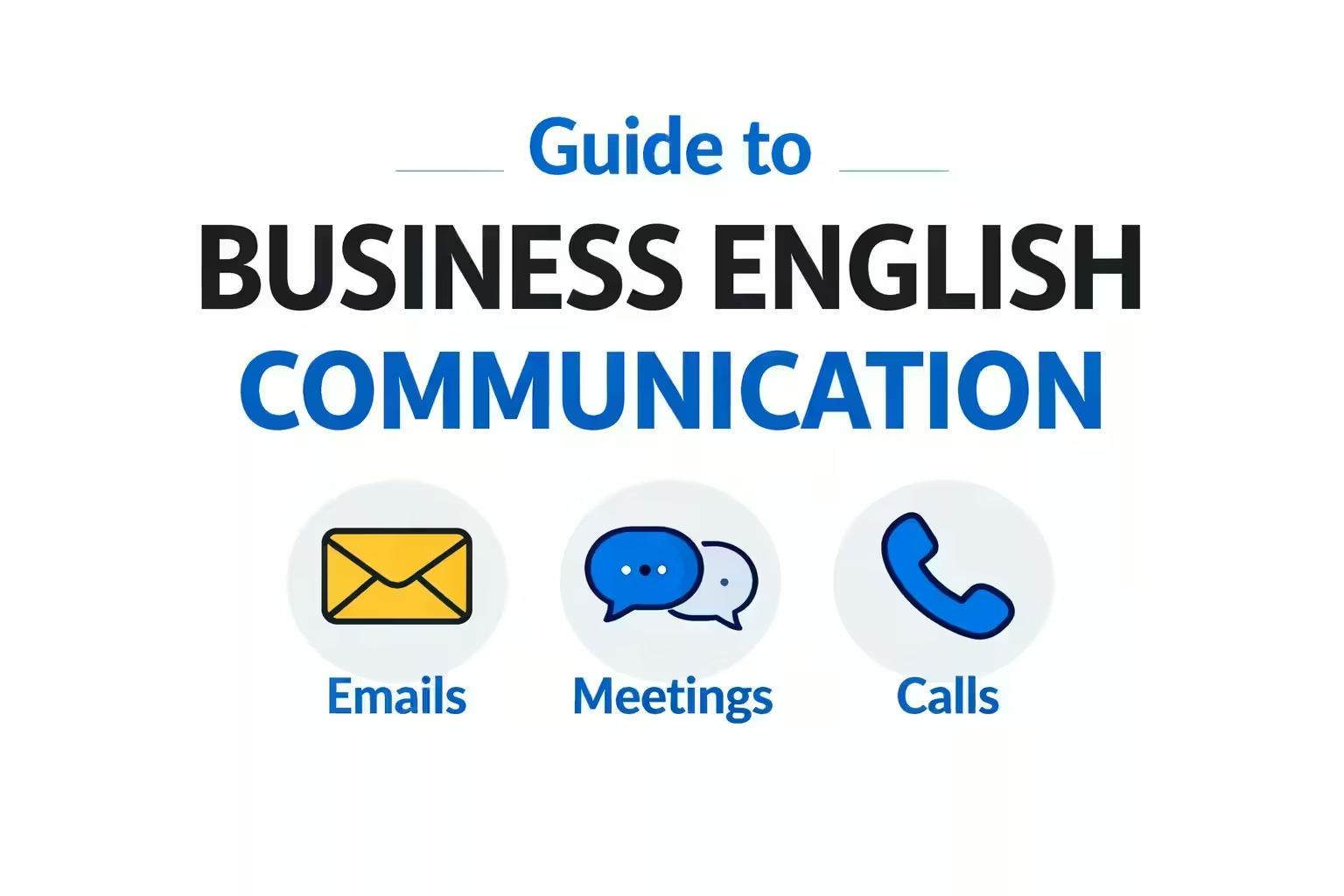
Now let’s break down the three pillars of Business English Communication: emails, meetings, and calls.
Part 1: Writing Professional Business Emails
Email is still one of the most common forms of Business English Communication. A good business email is clear, concise, and professional.
The Structure of a Professional Email
Every professional email has five key parts:
- Subject line — tells the reader what the email is about
- Greeting — a polite opening
- Body — the main message
- Closing — a polite ending
- Signature — your name and contact details
Example: Requesting a Meeting
Subject: Request for a Brief Meeting — Project Update
Dear Ms. Johnson,
I hope this email finds you well.
I am writing to request a short meeting to discuss the progress of the XYZ project. I believe a 30-minute call this week would be very helpful.
Please let me know your availability, and I will be happy to adjust to your schedule.
Thank you for your time. I look forward to hearing from you.
Best regards, Ravi Sharma Marketing Executive | ABC Company
Notice how this email is:
- Short and to the point
- Polite and professional
- Easy to understand
- Free of slang or casual language
Useful Email Phrases to Remember
Opening phrases:
- I hope this email finds you well.
- I am writing to inform you about…
- Thank you for your prompt response.
- Further to our conversation…
Closing phrases:
- Please feel free to reach out if you have any questions.
- I look forward to hearing from you.
- Thank you for your time and consideration.
- Kind regards / Best regards / Warm regards
Email Dos and Don’ts
Do:
- Use a clear subject line
- Keep paragraphs short
- Proofread before sending
- Use a professional email address
Don’t:
- Use all capital letters (it looks like SHOUTING)
- Write very long, complicated sentences
- Use casual words like “gonna,” “wanna,” or “hey”
- Forget to include a greeting and closing
Part 2: Speaking in Business Meetings
Meetings are a regular part of professional life. Whether in person or on video call, knowing how to speak English fluently and confidently in meetings is a game-changer.
Before the Meeting
Good meeting communication starts before the meeting begins.
- Review the agenda — know what topics will be discussed
- Prepare your ideas — think about what you want to say
- Learn key phrases — know how to agree, disagree, and ask questions politely
During the Meeting
Here are the most useful phrases for business meetings:
Starting the meeting:
- “Let’s get started.”
- “Thank you all for joining today.”
- “The purpose of today’s meeting is…”
Sharing your opinion:
- “In my opinion…”
- “I think we should consider…”
- “From my perspective…”
Agreeing:
- “That’s a great point.”
- “I completely agree.”
- “Absolutely, I think that works well.”
Disagreeing politely:
- “I see your point, but I feel that…”
- “That’s interesting. However, I think…”
- “With respect, I would like to suggest an alternative.”
Asking for clarification:
- “Could you please clarify what you mean by…?”
- “I’m sorry, could you repeat that?”
- “Just to confirm, are you saying that…?”
Ending the meeting:
- “Let’s summarize what we’ve discussed.”
- “The next steps are…”
- “Thank you everyone. I’ll send a follow-up email.”
Real-Life Meeting Scenario
Imagine this situation: Your team is discussing a new marketing campaign. Your manager asks: “What do you think about using social media for this campaign?”
Instead of just saying “Yes,” try this:
“In my opinion, social media would be a great channel for this campaign. Based on our target audience’s age group, platforms like Instagram and LinkedIn could give us strong results. I would recommend starting with a small test campaign and reviewing the data after two weeks.”
This response is confident, structured, and professional. It shows that you have thought about the topic and you can communicate your ideas clearly.
Part 3: Handling Business Phone and Video Calls
Phone and video calls can feel stressful, especially in English. But with the right phrases and preparation, you can handle them smoothly.
How to Start a Business Call
Introducing yourself:
- “Hello, this is [Your Name] calling from [Company].”
- “Good morning. May I speak with [Name], please?”
- “Hi, this is [Name]. I’m calling regarding…”
Answering a call:
- “Good morning, [Company Name]. How can I help you?”
- “Hello, [Your Name] speaking.”
- “Thank you for calling [Company]. How may I assist you?”
During the Call
When you don’t understand:
- “I’m sorry, could you please repeat that?”
- “Could you speak a little more slowly, please?”
- “I didn’t quite catch that. Could you say it again?”
Taking notes or confirming information:
- “Let me make a note of that.”
- “Just to confirm, you said…”
- “Could you spell that for me, please?”
Putting someone on hold:
- “Could you please hold for a moment?”
- “I’ll just check that for you. Please hold the line.”
Ending the call:
- “Thank you for calling. Have a great day.”
- “I’ll send you an email with the details shortly.”
- “It was great speaking with you. Goodbye.”
Video Call Tips
Video calls (on Zoom, Teams, or Google Meet) have become very common. Here are some extra tips:
- Test your audio and video before the call starts
- Choose a quiet, professional background
- Mute yourself when you are not speaking
- Look at the camera, not the screen, when talking
- Dress professionally, even at home
Common Mistakes to Avoid in Business English Communication
Even advanced English speakers make mistakes. Here are the most common ones — and how to avoid them.
1. Using Overly Casual Language
Mistake: “Hey! Just wanted to check in real quick about the report, you know?” Better: “Good afternoon. I am writing to follow up on the status of the report.”
Casual language is fine with close friends, but not in professional settings. It can make you seem unprofessional or disrespectful.
2. Writing Very Long Emails
Mistake: Writing a 500-word email when 100 words would do. Better: Be concise. State your purpose clearly and quickly.
Long emails often go unread or cause confusion. Keep it short and clear.
3. Saying “No Problem” Instead of “You’re Welcome”
Mistake: “No problem!” (after someone thanks you) Better: “You’re welcome.” / “My pleasure.” / “Happy to help.”
“No problem” can sound dismissive in formal settings. Use a more professional response.
4. Not Proofreading Emails
Mistake: Sending an email with spelling errors or wrong names. Better: Always re-read your email before hitting send.
A typo in a professional email can damage your credibility. Take 60 seconds to check it.
5. Interrupting During Meetings
Mistake: Cutting someone off mid-sentence to share your idea. Better: Wait for a pause, then say: “May I add something here?”
Interrupting is considered rude in most business cultures. Practice patience and active listening.
6. Speaking Too Fast on Calls
Mistake: Rushing through your words because you are nervous. Better: Speak slowly, pause between sentences, and breathe.
Speaking too fast makes it hard for the other person to understand you. Slow, clear speech sounds more professional.
7. Using Vague Language
Mistake: “I’ll get it done soon.” Better: “I will complete the report by Friday at 5 PM.”
Vague language causes confusion. Be specific about dates, times, and details.
Tips, Strategies, and Best Practices to Improve Business English Communication
Here are the most practical and effective strategies to help you improve English speaking skills and written communication for the workplace.
Daily Habits
- Read one business article every day. Try BBC Business, Forbes, or Harvard Business Review. Notice how professionals write.
- Listen to business podcasts. Shows like “HBR IdeaCast” or “The Tim Ferriss Show” expose you to natural professional English.
- Keep a vocabulary notebook. Write new business words, their meanings, and example sentences.
- Practice speaking out loud. Even if alone, speak your thoughts in English for 10 minutes a day. This builds fluency.
- Record yourself. Record a mock meeting or call. Listen back and note areas to improve.
Study Techniques
- Shadow native speakers. Listen to a sentence, then repeat it exactly — the same words, tone, and rhythm. This is one of the best spoken English tips for improving both pronunciation and fluency.
- Use flashcards for business vocabulary. Apps like Anki or Quizlet make it fun and effective.
- Write one professional email a day. Even if it is fictional, practice the format and language.
- Join English-speaking communities. Online platforms like Toastmasters or language exchange apps connect you with real speakers.
Communication Best Practices
- Always have an agenda for meetings. Send it before the meeting so everyone is prepared.
- Follow up after calls and meetings. Send a short email summarizing what was discussed and the next steps.
- Use the BLUF method for emails: Bottom Line Up Front. State your main point in the first sentence.
- Be direct but polite. Business English values clarity. Do not bury your main message at the end.
- Adapt your tone. Emails to your manager should be more formal than emails to a teammate you know well.
Real-Life Applications of Business English Communication
Business English is not just useful inside the office. Here is where you will use it in real life.
Job Interviews
Your ability to speak English fluently and professionally during an interview can be the deciding factor. Practice answering common questions like:
- “Tell me about yourself.”
- “What are your strengths and weaknesses?”
- “Why do you want to work here?”
Speak in clear, structured sentences. Use examples from your experience.
Client Meetings and Presentations
When presenting to clients, Business English helps you explain your ideas clearly, handle questions confidently, and build trust.
Structure your presentations with: an introduction, main points, and a conclusion. Use simple language and avoid jargon the client may not understand.
Networking Events
When meeting new professionals, Business English helps you introduce yourself, explain what you do, and build connections.
Practice a short “elevator pitch” — a 30-second introduction of who you are and what you do.
Example: “Hi, I’m Priya. I work as a digital marketing manager at TechStar. We help small businesses grow their online presence. It’s great to meet you.”
International Travel for Business
If you travel for work, Business English is essential — for checking in at hotels, attending conferences, making restaurant reservations, or meeting foreign clients.
Knowing how to communicate politely and professionally in English makes every business trip smoother.
Remote and Hybrid Work
Today, millions of professionals work remotely. Email, Slack messages, video calls, and written reports are the main ways they communicate. Strong Business English Communication skills are more important than ever in remote work environments.
Frequently Asked Questions (FAQs)
1. What is Business English Communication, and why do I need it?
Business English Communication is the use of English in a professional workplace setting — including emails, meetings, reports, and calls. You need it because it helps you get jobs, advance your career, work with international teams, and communicate more confidently and clearly.
2. How can I improve my Business English Communication quickly?
The fastest way to improve is through daily practice. Read business content, listen to professional podcasts, write emails regularly, and speak English out loud every day. Focus on vocabulary, grammar basics, and useful professional phrases.
3. Can I learn Business English if I am a beginner?
Absolutely. Business English is a skill that anyone can learn. Start with the basics: professional email phrases, common meeting vocabulary, and simple call etiquette. Build from there step by step. Many successful professionals learned Business English as a second language.
4. What are the most important Business English phrases I should know?
Some of the most essential phrases include:
- “I am writing to inform you…”
- “Please find attached…”
- “Could you please clarify…?”
- “I look forward to hearing from you.”
- “Let’s schedule a follow-up meeting.”
- “Could you please repeat that?”
5. How do I sound more professional on business calls?
To sound more professional on calls: speak slowly and clearly, use formal greetings and closings, avoid slang, confirm information by repeating it back, and always be polite. Prepare before the call by knowing what you want to say and what questions you might be asked.
6. What is the difference between formal and informal Business English?
Formal Business English is used with senior managers, clients, and official documents. It uses complete sentences, professional vocabulary, and polite tone. Informal Business English is used with close colleagues in everyday workplace chat — it is friendly but still appropriate. Always match your language to the situation and audience.
7. How long does it take to become fluent in Business English?
It depends on your current level and how much you practice. With consistent daily effort — reading, listening, speaking, and writing — most learners see significant improvement within three to six months. Fluency is a journey, not a destination. The key is to keep practicing every day.
Conclusion
Business English Communication is one of the most valuable skills you can develop in your career. Whether you are writing a professional email, presenting in a meeting, or handling an important business call, the right language skills can make all the difference.
Let’s quickly recap what we covered:
- Business English is professional English used in workplace settings
- It includes written communication (emails), verbal communication (meetings, calls), and listening skills
- Key skills include fluency, vocabulary, pronunciation, grammar, and confidence
- You can improve through daily reading, listening, speaking, and writing practice
- Common mistakes include casual language, vague messages, and not proofreading
- Real-life applications include job interviews, client meetings, networking, and remote work
The most important thing to remember is this: You do not have to be perfect. You just have to keep practicing.
Start small. Write one professional email today. Prepare two or three phrases for your next meeting. Practice introducing yourself in English. Every small step adds up to big progress over time.
If you found this guide helpful, share it with a colleague, friend, or fellow learner who wants to improve their Business English Communication. And keep coming back — the more you practice, the more confident you will become.
Your professional success story starts with the next English sentence you speak, write, or type. Make it count.
Explore more interesting topics here:
- American Work Culture and Business Etiquette Guide
- MBA English: Business School Vocabulary and Essays
- Business English Phrases Used in American Offices (Examples and Practice)
- How to Improve English Grammar for Business Communication
- English Business Collocations: Words for Professional English
Want to learn more? Find similar topics on Business & Workplace English and improve your business communications.