Introduction
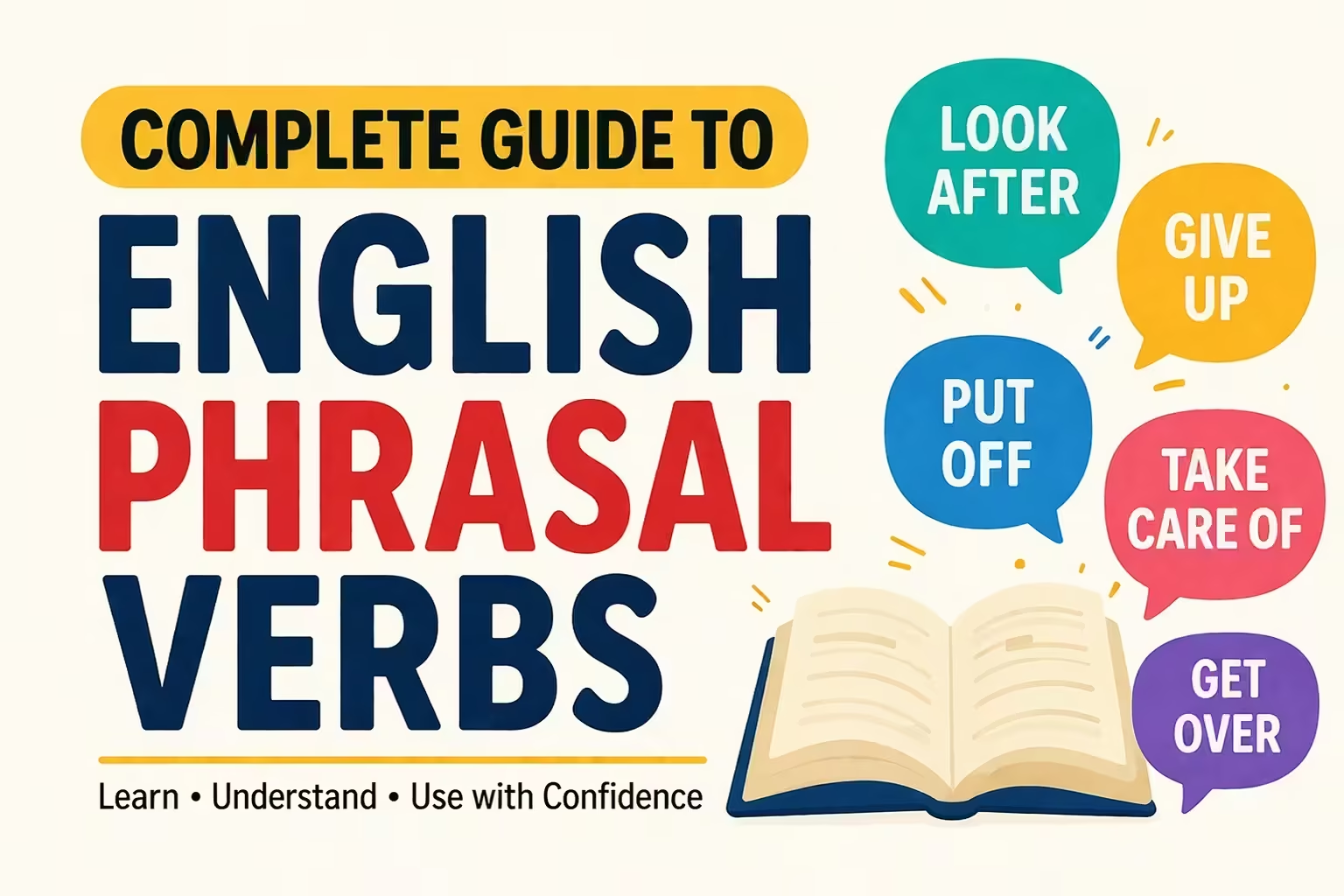
Have you ever heard a native English speaker say something like “give up,” “look after,” or “run into” and felt completely confused? You understood every single word separately, but together they meant something totally different. If this sounds familiar, you are not alone. Millions of English learners face this exact problem every single day. The secret to solving this problem lies in understanding English phrasal verbs. These powerful two- or three-word combinations are everywhere in spoken and written English. They appear in movies, books, conversations, job interviews, and social media.
If you want to speak English fluently and naturally, mastering English phrasal verbs is not optional — it is absolutely essential. This complete guide will teach you everything you need to know, from basic definitions to real-life examples and expert tips. Let us get started.
What Are English Phrasal Verbs?
A Simple, Clear Definition
English phrasal verbs are combinations of a verb and one or more other words — usually a preposition or an adverb — that together create a completely new meaning. This new meaning is often very different from what the individual words mean on their own.
For example:
- The word “give” means to hand something to someone.
- The word “up” usually refers to direction.
- But “give up” means to stop trying or to quit something entirely.
That is the magic — and the challenge — of English phrasal verbs. The individual words lose their original meanings, and together they create something brand new.
Breaking It Down Further
A phrasal verb is made up of:
- A base verb — like go, take, look, come, get, run, break, turn, put, or call.
- A particle — which can be a preposition (like “at,” “in,” “on,” “for”) or an adverb (like “up,” “out,” “away,” “back,” “down”).
Sometimes a phrasal verb can have two particles. For example, “put up with” means to tolerate something. Here, “put,” “up,” and “with” all work together.
Two Main Types
There are two main categories of phrasal verbs you need to know:
1. Separable Phrasal Verbs
These can be split apart with an object placed in the middle. Example: “Turn off the light” or “Turn the light off.” Both are correct.
2. Inseparable Phrasal Verbs
These cannot be split apart. The object must come after the complete phrasal verb. Example: “Look after the children.” You cannot say “Look the children after.” That is wrong.
Understanding this difference is one of the most important steps in learning to use English phrasal verbs correctly.
Why Are English Phrasal Verbs Important?
They Are Everywhere in Real English
If you want to improve your English speaking skills and communicate like a native speaker, you simply cannot avoid phrasal verbs. They are used constantly in:
- Casual conversations with friends and family
- Professional emails and business meetings
- Academic writing and classroom discussions
- Movies, TV shows, songs, and podcasts
- Job interviews and workplace communication
- Travel, shopping, and everyday social situations
Native English speakers use phrasal verbs dozens of times in a single conversation — often without even realizing it. So if you do not understand them, you will miss a huge part of what people are actually saying.
Benefits of Mastering English Phrasal Verbs
Learning English phrasal verbs brings incredible benefits to your everyday life, your career, and your overall confidence as an English speaker. Here is why they matter so much:
Improved Communication Skills
When you know phrasal verbs, you can express your thoughts more naturally. Instead of saying “I cannot continue,” you simply say “I give up.” It sounds more fluent and native-like, which makes communication smoother and faster.
Greater Confidence in Speaking
Many ESL learners feel nervous when speaking English because they are not sure how to sound natural. Knowing phrasal verbs removes that awkward gap between formal textbook English and real conversational English. When you speak the way native speakers speak, you feel more confident and less afraid of making mistakes.
Better Understanding of Movies and Media
Have you ever watched an English movie with subtitles and still felt confused? Phrasal verbs are often the reason. Once you know them, you will understand movies, songs, and TV shows much more clearly and enjoy them on a completely different level.
Career and Professional Growth
In job interviews and the workplace, using phrasal verbs correctly shows that your English is advanced and natural. Phrases like “follow up on a task,” “carry out a project,” or “come up with a solution” are used every day in professional settings. Knowing them makes you sound more competent and fluent to employers and colleagues.
Academic and Exam Success
Phrasal verbs appear regularly in English exams like IELTS, TOEFL, and Cambridge English tests. Having a strong knowledge of them can genuinely boost your score and improve your performance in all four language skills — reading, writing, listening, and speaking.
Categories of English Phrasal Verbs
1. Phrasal Verbs Related to Daily Routines
Some of the most common English phrasal verbs are the ones you use every single day without even thinking about it. These are great for beginners to start with because you can practice them immediately in your daily life.
Common examples:
- Wake up — to stop sleeping (I wake up at 7 every morning.)
- Get up — to rise from bed (She got up late on Sunday.)
- Put on — to wear clothes (He put on his jacket before leaving.)
- Take off — to remove clothing (Take off your shoes at the door.)
- Turn on / Turn off — to activate or deactivate something (Turn on the TV. Turn off the fan.)
- Pick up — to collect something or someone (I’ll pick you up from the airport.)
- Drop off — to leave someone at a place (Can you drop me off at the station?)
2. Phrasal Verbs for Communication
These phrasal verbs are essential if you want to improve your English speaking skills and sound more natural in conversations.
- Bring up — to mention a topic (She brought up an interesting point.)
- Talk over — to discuss something (Let’s talk it over before deciding.)
- Point out — to draw attention to something (He pointed out the mistake.)
- Speak up — to talk louder or express an opinion (Please speak up, I can’t hear you.)
- Go over — to review something (Let’s go over the plan again.)
- Call off — to cancel something (They called off the meeting.)
- Follow up — to check on progress (I’ll follow up with an email.)
3. Phrasal Verbs for Emotions and Feelings
These help you talk about your emotional state in a natural, expressive way.
- Cheer up — to become happier (Cheer up! Things will get better.)
- Break down — to lose emotional control or cry (She broke down when she heard the news.)
- Get over — to recover from something emotional (It took him a long time to get over the breakup.)
- Calm down — to become less upset (Just calm down and breathe.)
- Look up to — to admire someone (She looks up to her teacher.)
- Fall out — to have an argument and end a friendship (They fell out over money.)
4. Phrasal Verbs for Work and Study
These are especially important if you want to improve your professional English communication skills or speak English fluently in academic settings.
- Carry out — to perform a task (The team carried out the research successfully.)
- Come up with — to think of an idea (She came up with a brilliant solution.)
- Hand in — to submit work (Please hand in your assignment by Friday.)
- Look into — to investigate something (The manager said she would look into the complaint.)
- Keep up with — to maintain the same pace (It’s hard to keep up with all the new technology.)
- Set up — to organize or establish something (He set up a new company last year.)
- Run out of — to have no more of something (We ran out of time during the exam.)
5. Phrasal Verbs for Travel and Movement
If you travel frequently or plan to visit an English-speaking country, these phrasal verbs will be extremely useful.
- Check in — to register at a hotel or airport (We need to check in before 3 PM.)
- Check out — to leave a hotel (What time do we check out?)
- Get on / Get off — to board or leave transport (Get on the bus at Stop 4.)
- Set off — to begin a journey (We set off early to avoid traffic.)
- Pull over — to move a vehicle to the side of the road (The police asked the driver to pull over.)
Detailed Explanation With Real-Life Examples
Situation 1 — A Job Interview
Imagine you are in a job interview. The interviewer asks:
“Can you tell me about a time when you had to deal with a difficult situation?”
You reply: “Sure. In my last job, a major project was falling behind. I had to come up with a new plan quickly. I reached out to the team, went over the tasks carefully, and we pulled through together. In the end, we handed in the project on time.”
Notice how naturally the phrasal verbs fit into the conversation. This is exactly how spoken English tips work in practice — using natural language makes you sound far more fluent and impressive.
Situation 2 — Making Plans With a Friend
Friend: “Hey, are you free on Saturday? Do you want to hang out?”
You: “I’d love to, but I have to look after my younger sister. Can we put it off until Sunday?”
Friend: “Sure! I’ll get back to you in the evening.”
This short dialogue shows how phrasal verbs make everyday conversations flow naturally. Without them, the same conversation would sound very stiff and unnatural.
Situation 3 — A Classroom Setting
Teacher: “Let’s go over the homework from last night. Who would like to bring up any questions?”
Student: “I couldn’t figure out question five. Could you walk us through it?”
Teacher: “Of course! Let me break it down step by step.”
In educational settings, these phrasal verbs are used constantly. If you are a student trying to improve your English speaking skills, learning these expressions will make you feel much more comfortable in class.
Common Mistakes to Avoid With English Phrasal Verbs
Even advanced learners make mistakes with phrasal verbs. Here are the most common errors and how to avoid them:
Mistake 1 — Translating Directly From Your Native Language
Phrasal verbs rarely translate directly. If you try to translate “look after” word by word into your native language, it will not make sense. Always learn the meaning of the phrasal verb as a whole unit, not word by word.
Mistake 2 — Using the Wrong Particle
Particles matter enormously. “Call off” means to cancel. “Call up” means to telephone someone. “Call out” means to challenge or expose someone. Using the wrong particle changes the meaning completely or makes the sentence incorrect.
Mistake 3 — Separating Inseparable Phrasal Verbs
Remember that inseparable phrasal verbs must stay together. Never say “Look the children after.” Always say “Look after the children.” This is a very common mistake among ESL learners.
Mistake 4 — Overusing Formal Alternatives
Many learners stick to formal vocabulary because they are afraid of sounding wrong. But in spoken English, saying “I cannot tolerate this” sounds extremely unnatural. A native speaker would simply say “I can’t put up with this.” Using phrasal verbs makes your English sound real and fluent.
Mistake 5 — Learning Phrasal Verbs Without Context
Memorizing long lists of phrasal verbs without using them in sentences or conversations is one of the least effective methods of learning. Always learn each phrasal verb in a real sentence or dialogue so your brain connects it to a real situation.
Mistake 6 — Ignoring the Tone
Some phrasal verbs are informal and should not be used in formal writing or professional emails. For example, “bail out” or “freak out” are casual expressions. Always pay attention to whether a phrasal verb is formal, informal, or neutral.
Tips and Strategies to Learn English Phrasal Verbs Faster
Daily Habits That Work
Tip 1 — Learn Five New Phrasal Verbs Every Day
Do not try to learn fifty at once. Instead, pick five new phrasal verbs each day. Write them down in a notebook with their meanings and example sentences. Review them before you go to sleep. This spaced repetition technique is one of the most powerful study methods for language learners.
Tip 2 — Use Them in Real Sentences Immediately
As soon as you learn a new phrasal verb, use it in at least three different sentences. The faster you use a new word or phrase, the faster it moves from your short-term memory to your long-term memory. This is one of the most effective spoken English tips you can follow.
Tip 3 — Watch English Movies and TV Shows With Subtitles
Films and TV shows are goldmines for phrasal verbs. Watch with English subtitles so you can read exactly what the characters are saying. Every time you hear a phrasal verb, pause the video, write it down, and look up its meaning. Shows like Friends, The Office, and Breaking Bad are excellent for this.
Tip 4 — Listen to English Podcasts and Songs
Songs and podcasts are perfect for learning phrasal verbs in context because you can listen to them over and over again. Pay attention to the lyrics of English songs — they are full of phrasal verbs used naturally and creatively.
Tip 5 — Use Flashcards or Vocabulary Apps
Apps like Anki, Quizlet, or Duolingo can help you review phrasal verbs through flashcards and quizzes. Digital flashcards are especially useful because you can carry them everywhere and study during free moments throughout your day.
Tip 6 — Keep a Phrasal Verb Journal
Buy a small notebook and dedicate it entirely to phrasal verbs. Each time you come across a new one — in a book, movie, conversation, or article — write it down with its meaning, an example sentence, and the context where you found it. Reviewing this journal regularly will dramatically expand your vocabulary.
Tip 7 — Practice Speaking With a Partner
Find a language exchange partner or join an English conversation group. Challenge yourself to use at least five phrasal verbs every time you speak in English. If you make mistakes, that is completely fine. Making mistakes and correcting them is how you truly learn. This is one of the most important tips for anyone who wants to improve English speaking skills.
Tip 8 — Group Phrasal Verbs by Verb or Topic
Instead of learning phrasal verbs randomly, group them together. Learn all phrasal verbs with “get” at once — get up, get over, get along, get away, get back, get on. Or group them by theme — all phrasal verbs for communication, all for travel, all for emotions. This makes them easier to remember and recall.
Tip 9 — Read English Books, Blogs, and Articles
Reading is one of the best ways to see phrasal verbs used in natural, written context. Choose topics that interest you so you stay motivated. Reading also improves your grammar, vocabulary, and overall language skills simultaneously.
Tip 10 — Be Consistent and Patient
Learning English phrasal verbs is a gradual process. You will not master all of them in one week. But if you study a little every single day and use what you learn in real conversations, you will see remarkable progress within just a few months. Consistency is far more important than intensity.
Real-Life Applications of English Phrasal Verbs
In School and Education
Students who understand English phrasal verbs perform better in English classes, score higher on standardized tests, and feel more comfortable participating in class discussions. Teachers use phrasal verbs constantly — “hand in your homework,” “go over the lesson,” “look up the definition,” “figure out the answer.” Knowing these expressions makes classroom learning much smoother and more effective.
In Job Interviews and the Workplace
The professional world is full of English phrasal verbs. During a job interview, you might say you “came up with innovative ideas,” “carried out important tasks,” “dealt with difficult clients,” or “worked out complex problems.” In the workplace, your colleagues will ask you to “follow up on emails,” “set up meetings,” “carry out projects,” or “look into problems.” Employees who can use these expressions naturally are seen as more confident, capable, and professional.
While Travelling
If you travel to any English-speaking country, phrasal verbs become part of your survival toolkit. You need to know how to “check in” at a hotel, “get on” the right bus, “look for” directions, “sort out” a problem at the airport, or “get by” with basic English in a foreign city. Without this knowledge, even simple travel situations can become unnecessarily stressful and confusing.
In Social Conversations
Whether you are meeting new people, chatting with neighbors, or attending social events, phrasal verbs help you sound friendly, approachable, and natural. Saying “I really look forward to seeing you” or “Let’s catch up soon” immediately makes your English sound warm and native-like. Social conversations rely heavily on informal, natural language — which is exactly where phrasal verbs shine the most.
Online and in Writing
Social media, emails, chat messages, and online comments are filled with phrasal verbs. If you want to write in English naturally and engagingly — whether in a professional email or a casual WhatsApp message — understanding and using phrasal verbs is absolutely essential.
Frequently Asked Questions (FAQs) About English Phrasal Verbs
Q1. How many English phrasal verbs are there?
There are thousands of English phrasal verbs — some estimates suggest over 10,000. However, you do not need to learn all of them. Focusing on the most common 200 to 300 phrasal verbs will cover the vast majority of everyday English conversations and written communication.
Q2. What is the fastest way to learn English phrasal verbs?
The fastest way is to learn them in context — always in a full sentence or real-life situation, never from a bare word list. Combine daily study with watching English movies, listening to podcasts, and speaking with native or fluent English speakers. Consistency and real-world practice will always beat isolated memorization.
Q3. Are English phrasal verbs only used in spoken English?
No. While phrasal verbs are especially common in spoken English and informal writing, many are also used in formal writing, academic texts, and professional communication. For example, “carry out research,” “set up a framework,” and “look into the matter” are all used in formal contexts regularly.
Q4. How do I know if a phrasal verb is separable or inseparable?
Unfortunately, there is no single rule that tells you whether a phrasal verb is separable or inseparable. You need to learn each one individually. A good English dictionary or phrasal verb reference book will always tell you whether the verb is separable or inseparable. Over time, it becomes natural and automatic.
Q5. Do phrasal verbs appear in IELTS and TOEFL exams?
Yes, absolutely. English phrasal verbs appear in the reading, listening, writing, and speaking sections of both IELTS and TOEFL exams. Knowing them well can significantly improve your exam score, especially in the speaking and writing sections where natural, fluent language is rewarded with higher band scores.
Q6. Can I learn English phrasal verbs on my own without a teacher?
Yes, you absolutely can. There are excellent books, websites, YouTube channels, apps, and podcasts dedicated entirely to teaching English phrasal verbs. With the right resources and a consistent daily study habit, self-study is completely effective. Of course, having a teacher or speaking partner to give you feedback will always accelerate your progress.
Q7. Why do phrasal verbs confuse English learners so much?
Phrasal verbs are confusing because the combined meaning is often completely unrelated to the individual words. For example, “kick the bucket” means to die — which has nothing to do with kicking or a bucket. Additionally, many phrasal verbs have multiple meanings depending on context. This unpredictability makes them challenging, but also fascinating and extremely rewarding to learn.
Conclusion
English phrasal verbs are one of the most important and powerful elements of the English language. They appear everywhere — in conversations, classrooms, workplaces, media, and everyday life. Understanding and using them correctly is the key difference between sounding like someone who studied English from a textbook and someone who truly speaks the language naturally and confidently.
This complete guide has given you everything you need to begin your journey with English phrasal verbs: clear definitions, organized categories, real-life examples, common mistakes to avoid, practical daily tips, and answers to the most frequently asked questions. You now have a strong foundation to build on.
The most important thing you can do right now is take action. Start small — learn five new phrasal verbs today and use them in sentences. Watch an English movie tonight and listen for phrasal verbs. Write three sentences using what you learned from this guide. Speak English with someone and challenge yourself to use at least a few of the expressions you have discovered here.
Remember: language learning is a journey, not a destination. Every phrasal verb you learn brings you one step closer to speaking English fluently, confidently, and naturally. Do not be afraid to make mistakes. Every mistake is a lesson. Every lesson is progress.
If this guide helped you, share it with a friend who is also learning English. And keep coming back for more practical tips, lessons, and guides designed to help you reach your English language goals faster than you ever thought possible.
Now go out there and speak English with confidence. You have got this.
Related Topics You Might Enjoy:
- How to Improve English Speaking Skills at Home
- Top 30 Most Common English Phrasal Verbs List
- English Grammar Tips for Beginners
- How to Speak English Fluently in 30 Days
- Common English Idioms and Their Meanings
Want to learn more? Find similar topics on Common English Phrasal Verbs with Meanings.