Introduction: Why Inference Skills Matter More Than You Think
Have you ever watched a student read a passage perfectly — every word pronounced correctly — and then look up completely lost? That moment happens in classrooms every day. The student decoded the text but missed the meaning hiding beneath it.
That is exactly where inference skills come in.
Learning how to teach inference skills is one of the most valuable things any teacher can do. Inference is the ability to read between the lines — to figure out what is not directly stated but is strongly suggested. It is a thinking skill, a reading skill, and a communication skill all rolled into one.
Whether you are a classroom teacher, an ESL trainer, a parent helping your child at home, or a student trying to improve your own reading and listening comprehension, this guide is for you.
Over my ten-plus years of teaching English in physical classrooms, online sessions, and one-on-one coaching — I have seen firsthand what works and what does not when teaching this skill.
By the end of this article, you will have clear, practical strategies you can use immediately.
What Is Inference? A Simple Definition
Before we talk about how to teach it, let us make sure we understand what inference actually is.
Inference means using clues — from a text, a conversation, or a situation — to figure out something that was not directly said.
Here is a simple example:
“Maria walked into the kitchen. The smoke alarm was beeping. She opened the window quickly and grabbed a towel.”
The text never says Maria burnt something. But you can infer it. Why? Because the clues — smoke alarm, open window, grabbing a towel — all point to that conclusion.
That mental process of connecting clues to reach a logical conclusion is inference. It happens in reading, listening, and everyday life.
For ESL learners and younger students especially, this skill does not come automatically. It must be taught, practiced, and reinforced.
Why Students Struggle With Inference
In my experience teaching both native English speakers and ESL students, inference is consistently one of the hardest skills to develop. Here is why.
Students are trained to find answers that are already written. School tests often reward students for locating facts directly in the text. When the answer is not sitting on the page in plain sight, many students feel stuck or anxious.
Background knowledge gaps affect comprehension. Inference relies on connecting new information with what you already know. If a student has limited exposure to certain cultural references, settings, or life experiences, making those connections becomes harder.
Passive reading habits. Many students read without actively questioning the text. They move their eyes across the page but are not asking: Why did the character do that? What does this detail suggest? How does the author feel about this?
Listening comprehension adds another layer. In spoken English, inference is even trickier. The speaker’s tone, pauses, and word choice all carry meaning. Many learners focus so hard on understanding individual words that they miss the implied meaning entirely.
Knowing these common obstacles helps us teach more effectively.
Explore more interesting topics here:
- Best Resources to Teach English as a Second Language
- Responsive Teaching Strategies for ELA Teachers
- The 5 Whys Approach in Education: A Practical Teaching Guide
- How to Teach Spoken English Effectively
- Getting Your Online Teaching English Certificate
How to Teach Inference Skills Step by Step
Here is the approach I use in my own classes. It works with beginners, intermediate learners, and even advanced students who need to sharpen their critical thinking.
Step 1: Start With Visuals, Not Text
Before jumping into written passages, use images.
Show students a photograph — a crowded bus, a messy desk, a person holding an umbrella and looking at the sky. Ask them: What do you think is happening? What happened just before this? How does this person feel?
This removes the pressure of decoding language and focuses purely on the thinking process. Students quickly see that they are already making inferences all the time in real life.
I once showed a class a photo of an empty swing set in the rain. Students came up with beautiful inferences: “The children went inside.” “It rained suddenly.” “No one is allowed to play today.” Not one of those answers was written anywhere. They figured it out from context. That is inference.
Step 2: Model the Thinking Process Out Loud
Students need to see inside your brain. Use the Think Aloud technique.
Read a short paragraph to the class and narrate your thinking in real time:
“Okay, it says the man checked his watch three times and tapped his foot. I’m thinking… that suggests he’s nervous or impatient. The text didn’t say that, but those actions are usually connected to those feelings. So I’m inferring he feels anxious.”
Do this several times before you ever ask students to do it alone. Show them that inferring is not guessing randomly — it is using evidence plus reasoning.
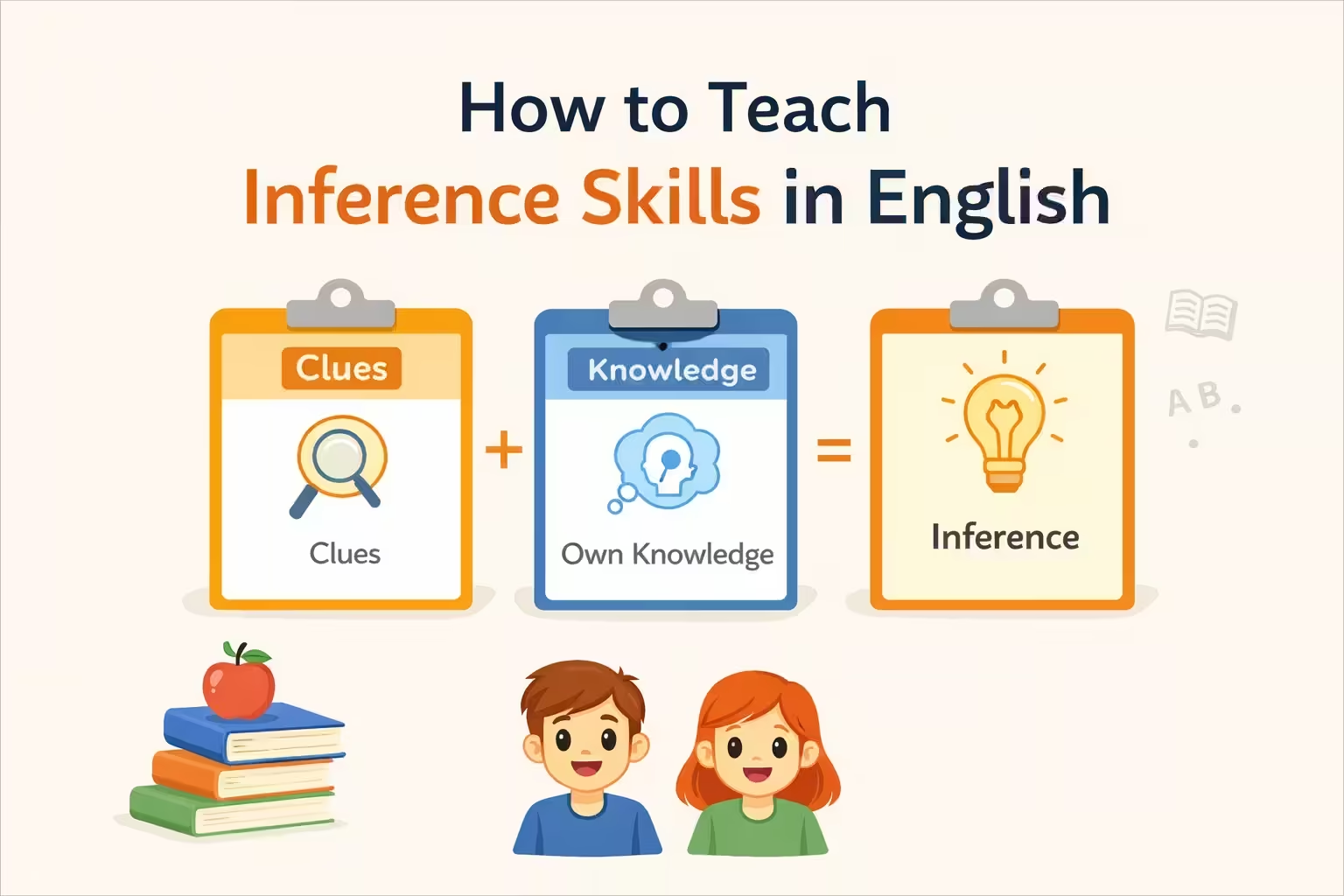
Step 3: Teach the Clue + Prior Knowledge Formula
I teach my students a simple formula:
Inference = Text Clues + What You Already Know
Write this on the board. Repeat it. Quiz them on it. When a student makes an inference, ask them: “What clue helped you? What did you already know that connected to it?”
This gives students a clear process to follow instead of feeling like they are just guessing.
Step 4: Practice With Short, High-Interest Texts
Do not start with long passages. Use short paragraphs, dialogue snippets, or even single sentences.
Examples that work well in class:
- “He slammed his laptop shut and didn’t speak for the rest of the evening.” → What can you infer about his mood?
- “The fridge was empty except for a half-eaten container of leftovers.” → What can you infer about the person’s week?
- “She scrolled past his message without replying.” → What might she be feeling?
Short texts let students practice the skill repeatedly without getting lost in a long story. And using relatable, modern situations keeps engagement high.
Step 5: Move to Longer Texts Gradually
Once students are comfortable with short exercises, introduce longer passages. Encourage them to annotate — underline clues, write notes in the margins, and mark moments where they are making an inference.
In online classes, I use shared Google Docs where students can highlight text and leave comments with their inferences. It creates a collaborative, visible thinking process that the whole class can learn from.
Practical Inference Activities for the Classroom
Here are some of my favorite activities that consistently get results.
Activity 1: The “What Happened Before?” Game
Show students the middle or end of a short story. Do not show the beginning. Ask: “What do you think happened before this scene? What evidence supports your idea?”
This builds inferential thinking by forcing students to work backwards.
Activity 2: Dialogue Detectives
Write a short dialogue between two people. Leave out all context — no names, no setting. Students must infer: Who are these people? Where are they? What is the relationship? How does each person feel?
This works especially well for practicing spoken English comprehension and reading between conversational lines.
Activity 3: Newspaper Headlines
Bring in five or six newspaper headlines. Ask students to infer the full story from only the headline. Then compare their inferences to the actual article.
This develops both inference skills and reading fluency at the same time.
Activity 4: Listen and Infer
Play an audio clip — a conversation, a short radio piece, or even a scene from a TV show. Ask students to infer things from tone of voice, word choice, and pacing.
Questions might include: Is this person confident or nervous? Do these two speakers know each other well? Is this a formal or informal situation?
This bridges inference skills with listening comprehension — a critical combination for ESL learners.
Activity 5: The Emotion Inference Chart
Read a paragraph and ask students to fill in a simple three-column chart:
| What the text says | Clue I noticed | My inference |
|---|
This structured approach helps students slow down and see their own thinking clearly.
Common Mistakes Teachers Make When Teaching Inference
Even experienced teachers can fall into these traps.
Accepting inferences without asking for evidence. When a student says, “I think she is angry,” do not just say “Good!” Ask why. “What in the text made you think that?” Accountability is part of the learning process.
Jumping to complex texts too early. I have seen teachers hand students a full-page literary passage on day one of inference practice. The students shut down. Start small. Build confidence first.
Treating all inferences as equal. Not all inferences are equally supported. Teach students the difference between a strong inference (well-supported by multiple clues) and a weak inference (based on one small detail or personal bias). This develops critical thinking skills.
Neglecting to praise the process, not just the answer. A student who reaches the wrong inference but used a clear, logical process is doing better than a student who gets the right answer by luck. Reward the thinking, not just the conclusion.
How to Teach Inference Skills for Listening and Spoken English
Reading is not the only place inference matters. In everyday conversation, implied meaning is everywhere.
When someone says, “This is certainly an interesting choice,” do they mean it positively or sarcastically? That depends on tone, context, and relationship — all things a learner must infer.
Here is how I teach inference in spoken English contexts:
Use video clips without subtitles first. Ask students to infer the emotional tone of a conversation before they understand every word. Then play it again with subtitles. This trains them to tune into tone and body language.
Role-play ambiguous situations. Create scenarios where the polite words do not match the real meaning. For example: “Do you want to come to my party?” / “I might be busy that day…” Ask students: What is the real answer? How do you know?
Teach common implied phrases in English. Phrases like “That’s one way to look at it” or “I’ll keep that in mind” often carry polite negative meaning. Make a list and discuss them openly.
Building inference skills in speaking and listening also builds confidence — because learners stop panicking when they do not understand every single word. They start trusting their ability to piece meaning together from context.
Setting Realistic Expectations
I want to be honest with you here, whether you are a teacher or a learner.
Inference skills take time to develop. You will not master this in a week. Students who practice inference regularly over several months show the most improvement. It is not about natural talent — it is about consistent, guided practice.
In my classes, I dedicate at least ten minutes per session to inference-based activities. Over a semester, the growth I see is remarkable. Students who once panicked at ambiguous questions begin approaching them with curiosity and confidence.
Set small goals. Celebrate small wins. Progress is real, even when it feels slow.
Common Mistakes Students Make With Inference
- Over-relying on one clue. Strong inferences use multiple pieces of evidence.
- Treating inference like guessing. Inference must be supported by the text or context, not personal preference.
- Ignoring tone and word choice. How something is said matters just as much as what is said.
- Giving up if they are unsure. Encourage students to attempt an inference, label it as tentative, and explain their reasoning. Uncertainty is okay.
Conclusion: Building Stronger Thinkers Through Inference
Teaching inference skills is not just about improving reading scores. It is about building sharper thinkers, more confident communicators, and more empathetic people.
When students learn how to read between the lines, they become better at understanding books, conversations, instructions, and even the people around them. That is a life skill with unlimited reach.
The good news is that how to teach inference skills does not require special equipment or expensive materials. It requires patience, structured practice, short engaging texts, and a teacher willing to model their own thinking out loud.
Start small. Use images before texts. Ask why before accepting any answer. And remind your students — and yourself — that making meaning is a skill, and all skills improve with practice.
You have got this.
Frequently Asked Questions (FAQs)
Q1: At what age can children start learning inference skills?
Children as young as five or six can begin developing inference skills through picture books and visual storytelling. Formal instruction typically begins around ages seven to eight, but the foundation starts much earlier through guided reading and conversation.
Q2: Can inference skills be taught to ESL learners with limited vocabulary?
Yes, absolutely. Start with visuals, simple sentences, and familiar real-life situations. Inference is a thinking skill, not purely a language skill. Limited vocabulary does not prevent inference — it just requires more scaffolding and context-rich materials.
Q3: How do I assess whether a student can make inferences?
Ask students to justify their inferences in writing or speech. A student who can say “I think X because the text says Y, and I know that Z usually means…” is demonstrating strong inferential thinking. The explanation matters as much as the conclusion.
Q4: What is the difference between inference and prediction?
Prediction is about what will happen next, typically made before or during reading. Inference is about figuring out what is implied but not stated, made during or after engaging with the text. Both are important comprehension skills, and both rely on clues plus background knowledge.
Q5: How often should inference skills be practiced?
Ideally, every class session. Even ten minutes of dedicated inference practice per lesson leads to measurable growth over time. Consistency matters far more than the length of any single activity.
📚 Continue Learning English
Choose your next lesson and keep improving your English skills with our free English learning resources.