Introduction
Learning English can feel difficult when you only focus on grammar rules and memorizing vocabulary.
Many learners study for months but still struggle to speak naturally or understand real conversations.
That is why more people are now choosing to improve their language skills through stories.
Learning English through stories is one of the most enjoyable and effective ways to build vocabulary, improve pronunciation, understand grammar naturally, and gain speaking confidence.
Stories create emotional connections that help learners remember words and expressions more easily.
Whether you read graded readers, novels, audiobooks, or short stories, you learn English in context instead of through isolated exercises.
This method also makes learning less stressful and more engaging because you focus on characters, emotions, and ideas instead of only grammar rules.
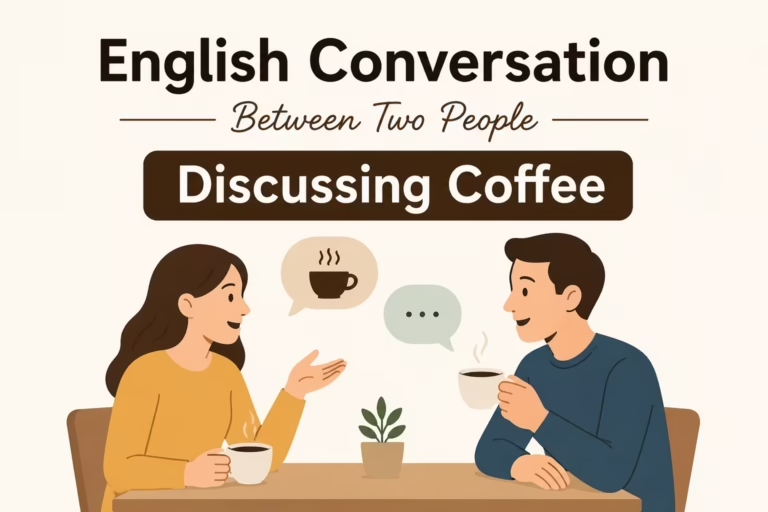
In this conversation between Emma and Priya, you will discover how stories can transform your English learning journey and help you become a more confident speaker.
Learning English Through Stories – English Conversation Between Two Friends
Emma: Hey Priya, it’s so good to catch up! I saw your post about struggling with English practice again. What’s been the latest frustration?
Priya: Oh, Emma, you have no idea. I’ve been grinding away with apps and grammar drills for months, but it still feels like I’m memorizing rules without actually using the language. My speaking is stiff, and reading the news gives me a headache. How did you get so confident so fast after moving here?
Emma: Honestly? Stories saved me. I started learning English through stories about three years ago when I was in the same boat as you. I was in Delhi too, remember? Fresh off the plane from my exchange year, and everything felt overwhelming. But once I switched to stories, it clicked. Want me to explain why it works so well?
Priya: Stories? Like children’s books? That sounds too simple. I’m an adult professional. I need real business English, not fairy tales.
Emma: Haha, not fairy tales—at least not only those. I’m talking about graded readers, short stories, novels, even audiobooks. The magic is in the context. When you read a story, new vocabulary doesn’t come as isolated flashcards. It appears naturally, surrounded by plot, emotions, and repetition. You see “serendipity” once in a sentence about a lucky coincidence, and suddenly you remember it forever because you felt the character’s surprise. Grammar patterns repeat without you noticing you’re learning them. It’s called comprehensible input—your brain absorbs the language the same way kids do.
Priya: Comprehensible input? That sounds familiar from some YouTube video. But does it actually work for speaking? I can read okay, but when I open my mouth in meetings, everything freezes.
Emma: Absolutely it helps speaking. After I finished my first full novel in English—“The Alchemist” by Paulo Coelho—I started retelling the story out loud to myself every morning while walking to work. At first it was clumsy: “The boy… he leave his home because he want… wanted to find treasure.” But by the end of the book, I was adding my own opinions: “I think the boy learned that the real treasure is inside him, you know?” That practice built fluency. Stories give you ready-made sentences you can borrow and adapt. Plus, the emotional connection makes you want to talk about them.
Priya: Okay, I’m intrigued. Tell me about your first story. What did you pick and why?
Emma: I started super easy because my level was around A2. I downloaded the Oxford Bookworms series—level 2 or 3. My very first one was “The Adventures of Tom Sawyer.” Short chapters, simple past tense everywhere, lots of dialogue that sounds like real kids talking. I read one chapter a day, then listened to the audiobook version at normal speed while following along with the text. That shadow-reading trick is gold. After a week, I could summarize the chapter without looking: “Tom tricks his friends into painting the fence for him. He is clever but lazy.” The repetition of words like “trick,” “fence,” and “adventure” made them stick.
Priya: Shadow-reading? Never heard of that.
Emma: It’s simple. You read the text silently first for understanding. Then you play the audio and read out loud at the same time, matching the speaker’s speed and intonation. Your mouth gets used to natural rhythm, pronunciation, and linking words. After a month of that, my accent improved dramatically. Indians like us sometimes stress every syllable equally, but stories teach you the music of English—where to pause, where to rise your voice for questions.
Priya: That sounds fun, actually. But what about vocabulary? English has so many words that look similar but mean totally different things—phrasal verbs drive me crazy. “Give up,” “give in,” “give out.” How do stories handle that?
Emma: Stories are the best teacher for phrasal verbs because they show usage in action. In “The Little Prince,” the fox says, “You become responsible, forever, for what you have tamed.” I saw “tame” as a verb for the first time and understood it emotionally—the prince tames the fox, meaning they build a bond. Later I read “Harry Potter and the Philosopher’s Stone.” When Harry “takes after” his father, the context of family resemblance made the phrasal verb crystal clear. I started keeping a “story journal.” After each chapter I wrote five new expressions and invented my own sentence using them. Within six months my active vocabulary doubled.
Priya: A journal? I like the idea of writing. But I worry about time. I work ten hours a day in marketing. When do I fit in story time?
Emma: That’s the beauty—stories fit anywhere. I used the Kindle app on my phone during commute. Fifteen minutes in the metro, one chapter. Or Audible while cooking dinner. The key is consistency, not marathon sessions. Start with stories that match your interests. You love Bollywood and cricket, right? Try “The White Tiger” by Aravind Adiga. It’s set in India, uses Indian English mixed with British and American styles, and the satire is sharp. You’ll recognize the world, so the language feels less foreign. Or “Life of Pi” by Yann Martel—survival story with animals. The descriptions of the ocean are poetic but not too hard.
Priya: “The White Tiger” is on my shelf actually, untouched. I started it once and stopped at all the unfamiliar slang. But if I combine it with audio…
Emma: Exactly! Listen first, then read. Or read and highlight unknown words, but only look them up after finishing the page. Guessing from context is a skill stories train. Research shows learners who guess retain words 40% better than those who check dictionaries immediately. And when you finish the book, join an online discussion. There are Reddit threads or Goodreads groups for every title. Explaining why Balram in “The White Tiger” is both hero and anti-hero forces you to use complex sentences: “Although he commits a crime, I believe he represents the frustration of the underclass in modern India.”
Priya: You’re making me excited. But what about grammar? I still mix up articles and prepositions. Does reading fix that automatically?
Emma: Not 100% automatically, but almost. Stories flood you with correct patterns. After reading twenty chapters of present perfect in real situations—“I have never seen anything like this”—your brain starts producing it naturally. I used to say “I am living in Delhi since 2015.” After stories, it became “I have been living here since 2015.” The difference is huge in job interviews. One tip: after finishing a book, pick ten sentences you loved and change them slightly to fit your life. For example, from “To Kill a Mockingbird”: “You never really understand a person until you consider things from his point of view.” I adapted it: “You never really understand a client until you consider things from their point of view.” Boom—professional English.
Priya: I love that adaptation idea. It turns passive reading into active practice. Are there stories specifically for business English?
Emma: Yes! Graded readers like “Business English Stories” or “The Business” by Macmillan. Short cases about negotiations, mergers, ethical dilemmas. Or full novels like “The Goal” by Eliyahu Goldratt—it’s about manufacturing but reads like a thriller. I read it when I was prepping for my PMP certification. The dialogue is full of idioms like “bottleneck,” “buy-in,” and “think outside the box.” I practiced by recording myself retelling the plot to my mirror: “The factory has a bottleneck in the assembly line, so they must find a way to increase throughput.” My boss later complimented my clear explanations in meetings.
Priya: Mirror practice? I feel silly doing that alone.
Emma: Everyone does at first! But it works. Or better—find a language partner on Tandem or HelloTalk and discuss the same story. Last month I paired with a guy from Brazil who was also reading “1984.” We debated: “Is Big Brother watching us through our phones today?” Two hours of speaking flew by because we cared about the ideas. Stories create genuine topics. Unlike “What did you do last weekend?” which dies after three sentences.
Priya: True. Small talk is exhausting. But deep conversations about characters feel meaningful. What if the story is too difficult and I get discouraged?
Emma: Choose the right level. Use the “five-finger rule”: while reading a page, if you find more than five unknown words, drop to an easier book. Apps like LingQ or Readlang let you tap words for instant translations without leaving the page. And celebrate milestones. When I finished my first 300-page book, I treated myself to a fancy coffee and wrote a one-paragraph review on Amazon. That review got three likes, and suddenly I felt like a real English user.
Priya: I can see the motivation snowball. Do you ever read stories just for pleasure now, or is it always study?
Emma: Both! That’s the secret. Once the habit forms, pleasure takes over. Last year I devoured “Dune” and “The Midnight Library.” I didn’t analyze every sentence; I just enjoyed the worlds. Yet my English kept improving because I was immersed. And when I watch Netflix now—English subtitles off—I understand 95%. Stories train your ear and eye together.
Priya: Subtitles off? I’m not there yet.
Emma: You will be. Start with stories that have movie adaptations. Read the book, then watch the film. Compare. “The Fault in Our Stars” is perfect—teen language, deep emotions, short chapters. Or Indian authors writing in English: “The Inheritance of Loss” by Kiran Desai. The descriptions of Kalimpong will feel like home, and the vocabulary is rich but accessible.
Priya: I’m writing all these titles down. One more question—does this method help with writing emails and reports too?
Emma: Massively. Stories teach paragraph flow, linking words, and tone. After reading “Pride and Prejudice,” my emails became more polite and structured: “I would be grateful if…” instead of blunt commands. I even started writing fan-fiction continuations of stories on Wattpad. My first short story got 200 reads. The comments helped me improve grammar in context.
Priya: Fan-fiction? That sounds creative and fun. I never thought learning could feel like play.
Emma: That’s exactly why stories win over apps. Apps gamify with points; stories gamify with emotions, suspense, and characters you care about. Your brain doesn’t feel it’s studying—it feels it’s living another life in English. Krashen’s theory says when anxiety is low and interest is high, acquisition skyrockets. I experienced it personally. From B1 to C1 in eighteen months, mostly through stories.
Priya: Eighteen months? That’s fast. I’ve been stuck at B1 for two years.
Emma: Because you were using the wrong method. Switch tonight. Download a free graded reader from the British Council website or Project Gutenberg. Pick something under 100 pages. Commit to thirty minutes daily—no excuses. In two weeks message me your first summary. I’ll give feedback.
Priya: Deal! I’m actually excited now. Maybe I’ll start with “Animal Farm.” I’ve heard it’s short and has big ideas.
Emma: Brilliant choice. The allegory will make you think, and the simple farm language is perfect for intermediate learners. Notice how Orwell repeats “Four legs good, two legs bad” and how the meaning shifts. You’ll pick up political vocabulary naturally. Then we can discuss it over coffee next weekend—like a mini book club.
Priya: Yes! I’ll even try recording a voice note summary and send it to you. That way you can correct my pronunciation too.
Emma: Perfect. And remember, if you get stuck on a word, don’t stop. Keep reading. The next paragraph often explains it. Stories reward persistence with satisfaction. The moment you realize you just read ten pages without checking a dictionary—that’s the breakthrough.
Priya: I can picture it already. Thank you, Emma. This conversation just changed my whole approach. No more boring worksheets. From now on, it’s stories all the way.
Emma: You’re going to love it. And one day soon you’ll be the one recommending your favorite book to someone else, saying, “This is how I really learned English.” Trust me.
Priya: I do trust you. Let’s make this our new weekly topic—story updates. Same time next week?
Emma: Absolutely. Can’t wait to hear what you think of the first chapter. See you then!
Priya: Bye, Emma. And seriously—thank you.
Conclusion
Learning English through stories is more than just a study method—it is a fun and natural way to become fluent.
Stories help learners improve vocabulary, speaking, listening, grammar, and writing skills while keeping motivation high.
Instead of feeling bored with endless worksheets and drills, learners can enjoy meaningful conversations, interesting characters, and real-life language use.
As Emma explains to Priya, consistency and enjoyment are the keys to success.
By reading books, listening to audiobooks, practicing summaries, and discussing stories with others, learners can gradually build confidence and fluency.
No matter your current English level, starting with simple stories and practicing every day can lead to amazing progress.
If you want to improve your English naturally and effectively, stories may become your best learning partner.
📚 Continue Learning English
Choose your next lesson and keep improving your English skills with our free English learning resources.