Introduction
Have you ever read an English paragraph and felt completely lost? Maybe you understood every single word, but still could not understand what the writer was really trying to say. You are not alone.
Learning how to analyze any English text like an expert is one of the most powerful skills you can develop. It helps you read faster, understand deeper, and communicate better — in school, at work, and in everyday life.
This guide is written for ESL learners and beginners who want to go beyond just reading words.
You will learn exactly how to break down any English text, find its meaning, and use that knowledge to improve your English speaking skills, writing, and overall communication.
Let’s get started.
What Does It Mean to Analyze an English Text?
A Simple Definition
Text analysis means carefully reading a piece of writing to understand:
- What it says — the main message or idea
- How it says it — the language, tone, and style used
- Why it says it — the purpose behind the writing
In simple words, when you analyze a text, you do not just read it. You study it. You ask questions about it. You look for clues. You think about what the writer wants you to feel, think, or do.
What Counts as “Text”?
A text can be anything written, such as:
- A news article
- A social media post
- A short story or novel
- An email or letter
- A job advertisement
- A school essay
- A product description
Every piece of writing has a purpose. Text analysis helps you discover that purpose — even when it is not clearly stated.
Why This Skill Matters for ESL Learners
For ESL learners, analyzing English text is like having a secret map. Instead of getting lost in long paragraphs, you learn to find your way quickly. You start to notice patterns in the language. You begin to understand not just what English says, but how it works.
This skill also helps you improve English speaking skills. When you understand how good writers structure their ideas, you naturally start doing the same when you speak and write.
Why Is Text Analysis Important?
Learning how to analyze any English text like an expert brings many real benefits. Here is why this skill matters so much.
1. It Builds Reading Comprehension
You stop reading word by word and start understanding ideas. Your reading speed improves because you know what to look for.
2. It Boosts Your Vocabulary
Every time you analyze a text, you discover new words. More importantly, you see those words used in real context — which is the best way to remember them.
3. It Improves Your Writing
When you study how skilled writers organize their ideas, you naturally begin to copy their style. Your own writing becomes clearer, more organized, and more effective.
4. It Strengthens Your Speaking Skills
Good speakers think in structured ideas — just like good writers. As you analyze more texts, you train your brain to think this way too. This helps you speak English more fluently and confidently.
5. It Helps in Exams and Academic Work
Whether you are preparing for IELTS, TOEFL, or a school exam, text analysis is a core skill. Most English exams test your ability to read closely and understand meaning at a deeper level.
6. It Builds Confidence
When you know how to approach any piece of English writing, you feel less afraid. Confidence is everything in language learning. Text analysis gives you the tools to face any text without panic.
Types of Skills Involved in Text Analysis
To analyze any English text like an expert, you need to develop several connected skills. Think of these as different muscles — each one needs regular practice.
1. Fluency
Fluency means reading smoothly and naturally without stopping at every word. A fluent reader moves through text quickly and picks up meaning from whole sentences, not just individual words.
How to build fluency: Read every day. Start with texts that are slightly below your level. Gradually move to harder material.
2. Vocabulary
A wide vocabulary helps you understand what you are reading. But vocabulary is not just about knowing definitions. It is about understanding how words are used in different contexts.
Key vocabulary skills for text analysis:
- Understanding word families (analyze, analysis, analytical)
- Recognizing synonyms and antonyms
- Identifying formal vs. informal language
- Learning collocations (words that go together, like “make a decision” or “take a risk”)
3. Grammar Awareness
Grammar is the structure of language. When you analyze a text, grammar helps you understand relationships between ideas.
For example:
- “Although it was raining, they continued the match.” — The word “although” tells you there is a contrast.
- “Because of poor planning, the project failed.” — “Because of” signals a cause-and-effect relationship.
Understanding these grammatical signals helps you follow the writer’s logic.
4. Comprehension at Multiple Levels
There are three levels of reading comprehension:
- Literal level: What does the text say directly?
- Inferential level: What does the text suggest or imply?
- Critical level: Do you agree? Is the information reliable? What is the writer’s bias?
Expert text analysts work at all three levels.
5. Listening Skills (Yes, Even Here!)
You might wonder — why mention listening skills in a reading article? Because reading and listening are more connected than most people think.
When you listen to English speeches, podcasts, or conversations, you train your ear to recognize tone and emotion. These same skills transfer to reading. You start to “hear” the voice behind the text.
Spoken English tips: Practice reading texts aloud after you analyze them. This connects your reading, speaking, and listening skills all at once.
6. Critical Thinking
Perhaps the most important skill. Critical thinking means you do not just accept what you read. You question it. You evaluate it. You form your own opinion.
Ask yourself:
- Does this argument make sense?
- Is the evidence strong?
- Could there be another point of view?
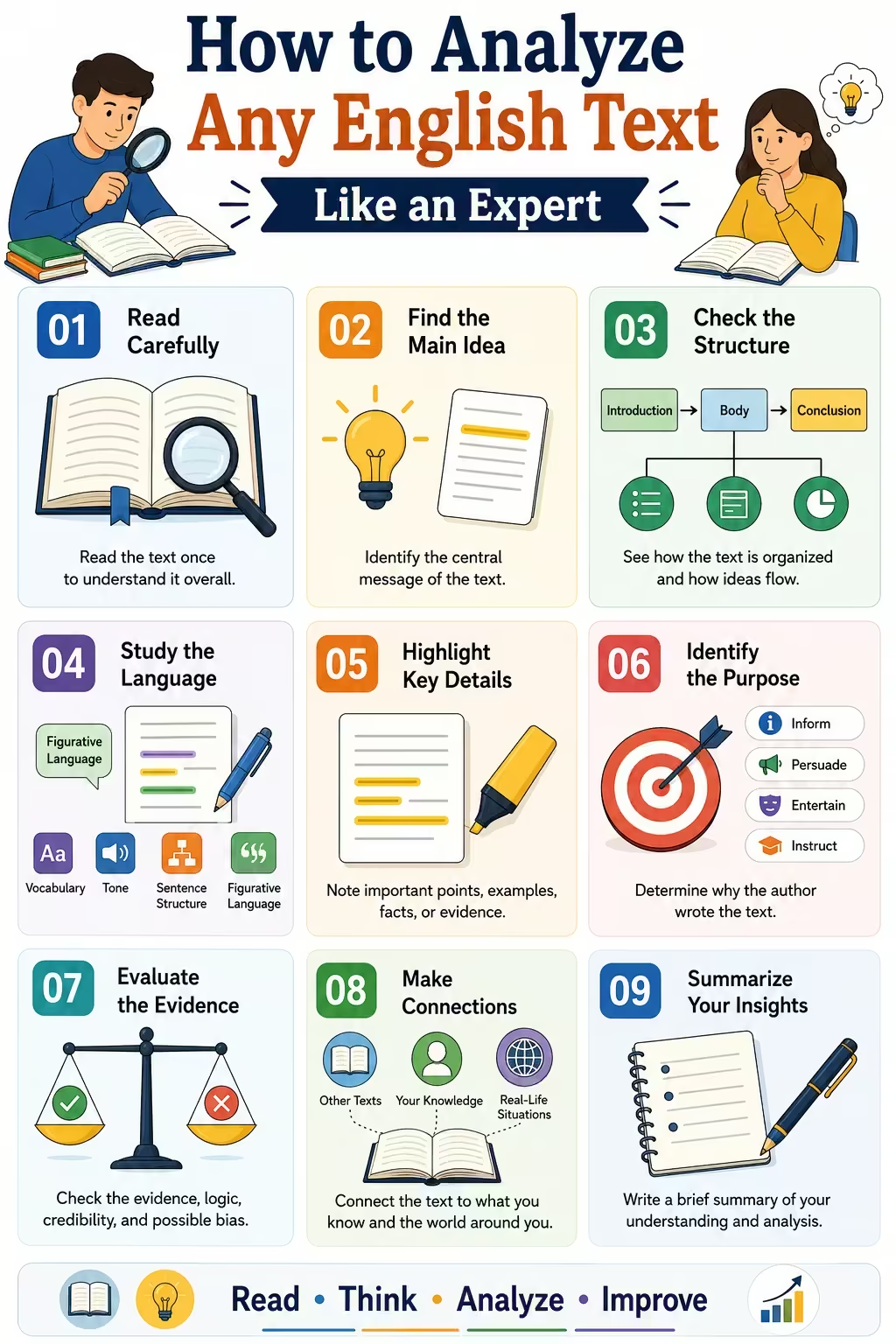
How to Analyze Any English Text: A Step-by-Step Guide
Now let us look at the actual process. Here is a simple, practical framework you can use every time you pick up an English text.
Step 1: Do a Quick Skim First
Before reading carefully, skim the whole text in 30–60 seconds. Look at:
- The title and any subheadings
- The first and last sentences of each paragraph
- Any bold, italicized, or underlined words
- Images, captions, or charts (if present)
This gives you a “big picture” before you dive into the details. You will read faster and with more focus.
Step 2: Identify the Purpose
Every text has a purpose. Ask yourself: Why was this written?
Common purposes include:
- To inform — news articles, textbooks, how-to guides
- To persuade — opinion pieces, advertisements, speeches
- To entertain — stories, humorous essays, personal blogs
- To instruct — manuals, recipes, step-by-step guides
- To describe — travel writing, product descriptions, character profiles
Knowing the purpose helps you read with the right mindset.
Step 3: Find the Main Idea
Every well-written text has one central idea. This is sometimes called the thesis statement (in essays) or the topic sentence (in paragraphs).
Ask yourself: What is the ONE thing this text is mostly about?
Example: In a paragraph about the benefits of exercise, the main idea might be: “Regular physical activity improves both mental and physical health.”
Everything else in the paragraph — the statistics, the examples, the explanations — supports this main idea.
Step 4: Identify Supporting Details
Once you find the main idea, look for the evidence the writer uses to support it. Supporting details can include:
- Facts and statistics
- Examples and stories
- Expert opinions and quotes
- Comparisons and contrasts
- Definitions and explanations
Practice tip: Underline or highlight the main idea in one color and supporting details in another. This visual technique trains your brain to separate important information from background details.
Step 5: Analyze the Tone and Style
Tone is the writer’s attitude toward the subject and the reader. It answers the question: How does the writer feel about this topic?
Common tones include:
- Formal: Academic papers, legal documents, official letters
- Informal: Blog posts, social media, text messages
- Optimistic: Motivational writing, positive news stories
- Critical: Reviews, opinion pieces, analytical essays
- Neutral: News reporting (or at least, intended to be neutral)
- Humorous: Comedy writing, lighthearted blogs
You can identify tone by paying attention to:
- Word choice (positive or negative words?)
- Sentence length (short and punchy = urgent; long and complex = thoughtful)
- Use of pronouns (Does the writer say “you” to connect with the reader?)
Step 6: Understand Vocabulary in Context
Do not stop reading every time you see an unfamiliar word. Instead, use context clues.
Context clues are hints in the surrounding text that help you guess the meaning of a new word.
Example: “The politician’s rhetoric was so persuasive that even his opponents applauded.”
Even if you don’t know the word “rhetoric,” you can guess from context that it means skillful or powerful speech.
Types of context clues:
- Definition clue: “Photosynthesis, the process by which plants make food from sunlight, is essential for life.”
- Synonym clue: “She was loquacious — in fact, nobody talked more than she did at the party.”
- Antonym clue: “Unlike his cautious brother, Marcus was reckless.”
- Example clue: “She loved legumes such as lentils, chickpeas, and black beans.”
Step 7: Look for Text Structure
Good writers organize their ideas in recognizable patterns. Learning these patterns helps you predict what is coming next.
Common text structures:
| Structure | Signal Words | Example |
|---|---|---|
| Cause and Effect | because, therefore, as a result | “Sales dropped because of poor marketing.” |
| Compare and Contrast | however, on the other hand, similarly | “Tea is calming, while coffee energizes.” |
| Problem and Solution | the problem is, one solution is | “Traffic is increasing. One solution is better public transport.” |
| Sequence/Order | first, then, finally | “First, boil the water. Then, add the pasta.” |
| Description | for example, such as, including | “There are several types of clouds, including cumulus and stratus.” |
Step 8: Ask Critical Questions
The final and most advanced step. Do not just understand the text — evaluate it.
Ask yourself:
- Is this information accurate? How do I know?
- Is the writer biased? What perspective are they coming from?
- What is NOT said? What has the writer left out?
- Do I agree with the writer’s conclusion? Why or why not?
- Who is the intended audience? Am I part of that audience?
Common Mistakes to Avoid
Many learners struggle with text analysis because of a few common errors. Here are the mistakes to watch out for:
- Reading every word equally. Not all words carry the same weight. Focus on topic sentences, key terms, and transition words. These carry the main meaning.
- Ignoring unknown words too quickly. Skipping a word you don’t know without even trying to guess its meaning can cause you to miss the main idea. Always try context clues first.
- Missing the tone. Many learners focus only on facts and ignore tone. But tone changes meaning completely. “That was interesting” said sarcastically means the exact opposite of what the words literally say.
- Reading only once. Expert readers read a challenging text two or three times. The first read gives you the general idea. The second and third reads reveal deeper details.
- Translating mentally into your native language. This slows you down and breaks your flow. Try to think in English as much as possible during analysis.
- Looking for one right answer. Especially in critical analysis, there are often multiple valid interpretations. Avoid the habit of thinking there is always one correct answer.
- Neglecting the title. Titles are carefully chosen. They almost always tell you something important about the main idea, tone, or purpose of the text.
Tips, Strategies, and Best Practices for Mastering Text Analysis
Here are proven strategies to help you improve quickly and consistently.
Daily Habits That Help
- Read something in English every single day. It does not need to be long. Even 10–15 minutes makes a difference over time.
- Keep a vocabulary notebook. Write down new words from your reading with the sentence where you found them.
- Read a variety of texts. Articles, stories, emails, social media posts — each type teaches you something different.
- Read aloud. This connects reading, speaking, and listening. It also helps you notice the rhythm and tone of the language — excellent for improving spoken English tips.
Active Reading Techniques
- Annotate as you read. Write notes in the margins (or on sticky notes). Underline key sentences. Circle words you want to look up later.
- Summarize each paragraph in one sentence. This forces you to identify the main idea and stay focused.
- Ask questions before you read. Look at the title and predict what the text will say. This activates your prior knowledge and gives you a purpose for reading.
- Use the “5W1H” framework. For any text, try to identify: Who, What, When, Where, Why, and How.
Long-Term Study Strategies
- Analyze model texts. Find well-written English texts (BBC News, The Guardian, TED Talk transcripts) and study them carefully. Why do they work? What techniques does the writer use?
- Compare different texts on the same topic. Notice how different writers approach the same subject in different ways. This builds your critical thinking and deepens your vocabulary.
- Write responses to texts you analyze. Write a short paragraph agreeing or disagreeing with the writer’s main point. This solidifies your understanding and improves your writing.
- Use graded readers. These are books written at specific difficulty levels for ESL learners. They are excellent for building fluency and confidence before tackling authentic texts.
Real-Life Applications
Knowing how to analyze any English text like an expert is not just a classroom skill. It has powerful real-world applications.
At School or University
- You can read academic texts faster and more accurately.
- You can write better essays because you understand how good arguments are built.
- You can answer comprehension exam questions more confidently.
- You improve English speaking skills for presentations and discussions.
In Job Interviews and the Workplace
- You can quickly understand company emails, reports, and instructions.
- You can read job descriptions carefully and match your answers to what employers are looking for.
- You come across as intelligent and well-prepared in meetings.
During Travel
- You can understand signs, menus, maps, and instructions in English-speaking countries.
- You can read travel reviews and make smarter decisions.
- You can understand announcements in airports and train stations.
In Social Conversations
- You can follow news stories and discuss current events confidently.
- You can understand jokes, idioms, and references — making conversations much more fun.
- You can send and receive professional emails and messages without confusion.
For Personal Growth
- You can learn anything faster by reading and analyzing books, articles, and research.
- You can protect yourself from misinformation by thinking critically about what you read online.
- You feel more confident and capable every day.
FAQs: How to Analyze Any English Text Like an Expert
Q1: Can a complete beginner learn how to analyze English text?
Absolutely. Text analysis is a skill, and like all skills, it improves with practice. Start with short, simple texts — even one paragraph at a time. Focus on finding the main idea first. As your confidence grows, move on to more advanced techniques.
Q2: How long does it take to become good at analyzing English texts?
It depends on how often you practice. With daily reading and active analysis, most learners notice a real improvement within 4–8 weeks. Consistency matters far more than the amount of time you spend in any single session.
Q3: What are the best texts to practice analyzing for ESL learners?
Start with news articles from clear, well-written sources such as BBC Learning English, VOA Learning English, or The Guardian. These texts are well-organized and use a wide range of vocabulary. You can also practice with TED Talk transcripts, short stories, and product reviews.
Q4: How does text analysis help me speak English more fluently?
When you analyze well-written English texts, you absorb the patterns of the language — sentence structures, vocabulary choices, and ways of organizing ideas. Over time, these patterns enter your own speaking and writing naturally. This is why reading and speaking are so deeply connected in how to speak English fluently.
Q5: What is the difference between reading and analyzing a text?
Reading means going through the words to get a general understanding. Analyzing means going deeper — identifying the main idea, understanding the purpose, examining the tone, evaluating the evidence, and forming a critical opinion. All good analysts read first, but not all readers analyze.
Q6: Do I need to know advanced grammar to analyze texts?
You do not need perfect grammar. A working knowledge of basic grammar — sentences, tenses, conjunctions, and clause structures — is enough to start. As you analyze more texts, your grammar awareness will grow naturally.
Q7: Is text analysis only for literary or academic texts?
Not at all. You can analyze any text — a WhatsApp message, an advertisement, a social media caption, or a product review. Every text has a purpose, a tone, and a structure worth examining. Everyday texts are actually great places to start practicing.
Conclusion
Learning how to analyze any English text like an expert is one of the most valuable investments you can make in your English language journey. It is not a talent that some people are born with. It is a skill — and skills can be learned, practiced, and mastered.
Let us quickly recap what you have learned in this guide:
- Text analysis means understanding what a text says, how it says it, and why it says it.
- It builds your vocabulary, improves your grammar awareness, strengthens your writing, and boosts your spoken English skills.
- The key skills involved are fluency, vocabulary, grammar, comprehension, listening, and critical thinking.
- The step-by-step process includes skimming, identifying purpose, finding the main idea, analyzing tone, understanding vocabulary in context, recognizing text structure, and asking critical questions.
- Common mistakes include reading too passively, ignoring tone, and translating mentally into your native language.
- Daily habits — reading every day, keeping a vocabulary notebook, and reading aloud — build your skills faster than any shortcut.
Now it is your turn to take action.
Pick any English text today — a news article, a social media post, a product description — and try the step-by-step analysis framework from this guide. Apply just one or two techniques and see what a difference it makes.
The more you practice, the more confident and capable you become. Share this article with a friend who is learning English too. And if you want to keep improving, explore more guides on how to speak English fluently, spoken English tips, and strategies to improve English speaking skills.
Your English journey is just beginning — and you are already ahead of the curve.
Found this guide helpful? Bookmark it for future reference and revisit it each time you sit down to analyze a new English text.
Explore more topics here:
- When to Use Semicolons vs. Commas in English Grammar
- English Conversation About K-Pop Culture | Learn English Speaking Practice
- In-Person vs Online English Courses: Which Is Best?
- Business English Conversation: Training / Meeting Deadline (Examples and Practice)
- How to Think in English While Reading and Writing
- Writing Rubric Examples for ELA Teachers: A Practical Guide to Better Assessment
📚 Continue Learning English
Choose your next lesson and keep improving your English skills with our free English learning resources.