Writing a strong composition in English requires more than good vocabulary and correct grammar. It involves organizing ideas clearly, developing strong paragraphs, and expressing thoughts in a logical and engaging way. Many students struggle with structure, introductions, and conclusions, which can affect their overall writing quality. That’s why learning how to write English compositions step by step is essential for academic success and exam preparation.
In this comprehensive guide, you will discover practical writing strategies, composition structure tips, and techniques to improve clarity and coherence. We will explore how to brainstorm ideas, create effective outlines, write strong thesis statements, and revise your work confidently. Whether you are preparing for school exams, competitive tests, or improving your general writing skills, this guide will help you write well-organized and impactful English compositions.
What Is an English Composition?
Before we dive into the tips, let’s clarify what we mean by “composition.” An English composition is any piece of structured writing that communicates ideas clearly and logically. This includes essays, reports, letters, articles, and even longer emails.
The word “composition” comes from the Latin word meaning “to put together,” which perfectly describes what you’re doing — putting words, sentences, and paragraphs together to create meaning.
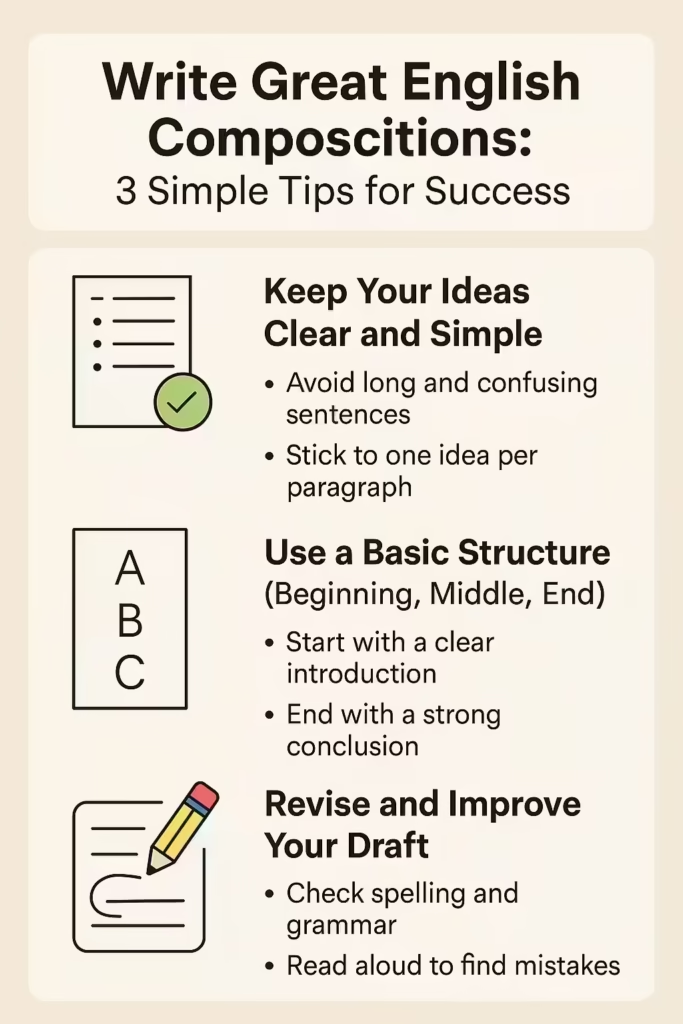
A good composition has three essential parts: an introduction that presents your topic, a body that develops your ideas with details and examples, and a conclusion that wraps up your thoughts.
Think of it like a sandwich — you need both pieces of bread (introduction and conclusion) to hold the filling (body paragraphs) together.
Tip 1: Plan Before You Write
Let’s start at the beginning; planning is an integral part of writing. I have been teaching English for many years. I noticed that the students who plan their writing produce much better work. So even if you hate the idea of planning, try experimenting with some of the ideas in this section.
I remember one student, Maria, who would spend 40 minutes writing an essay only to realize halfway through that she had strayed completely off topic. She’d end up crossing out entire paragraphs and starting over, feeling frustrated and running out of time. Once she learned to plan first, everything changed.
Why Planning Matters
Planning is like creating a roadmap before a journey. When you plan, you organize your thoughts, decide what to include, and determine the best order for your ideas. This saves time, reduces stress, and results in much better writing. It might feel like extra work at first, but you’ll soon see how much easier it makes the actual writing process.
How to Plan Effectively
Here’s a simple planning process that works:
Step 1: Understand the Question or Topic
Read the prompt carefully. Underline key words. If the question asks you to “discuss the advantages and disadvantages,” make sure you address both sides. If it says “explain,” you need to give clear reasons and details. This step sounds obvious, but many students skip it and end up answering a different question entirely.
Step 2: Brainstorm Your Ideas
Spend 3-5 minutes writing down everything that comes to mind about the topic. Don’t worry about complete sentences — just jot down words, phrases, and ideas. I teach my students to use a simple mind map: write the main topic in the center of a page and branch out with related ideas. There are no bad ideas at this stage; just get your thoughts onto paper.
Step 3: Organize Your Ideas
Look at your brainstorming notes and group similar ideas together. Decide which points are strongest and which examples best support your argument. Choose 2-3 main ideas for the body of your composition. Each main idea will become one paragraph. This is where you become selective — not every idea you brainstormed needs to make it into your final piece.
Step 4: Create a Quick Outline
Your outline doesn’t need to be fancy. Here’s a basic structure:
- Introduction: Hook + background + thesis statement
- Body Paragraph 1: First main idea + supporting details
- Body Paragraph 2: Second main idea + supporting details
- Body Paragraph 3: Third main idea + supporting details (if needed)
- Conclusion: Summary + final thought
This entire planning process should take about 10 minutes for a standard composition. It might feel like you’re wasting time at first, but you’ll write faster and better with a plan in place. Trust me on this — the students who resist planning are always the ones who struggle most with their writing.
Tip 2: Use Clear Topic Sentences and Paragraph Structure
After planning, the next crucial skill is building strong paragraphs. A paragraph is a group of sentences that focus on one main idea. Think of each paragraph as a building block — when you stack them logically, you create a solid composition. This is something many students overlook, but it makes an enormous difference to the quality of your writing.
The Power of Topic Sentences
Every body paragraph should begin with a topic sentence. A topic sentence tells the reader what that paragraph will be about. It’s like a mini-headline for each section of your writing. Without clear topic sentences, your reader can feel lost, unsure where you’re going with your ideas.
I once worked with a student named Ahmed who wrote long paragraphs that jumped from idea to idea. His writing felt confusing and hard to follow. When I taught him to start each paragraph with a clear topic sentence, his writing improved dramatically. Suddenly, readers could follow his logic and understand his points. It was like turning on a light in a dark room.
Topic Sentence Examples
Let’s say you’re writing about the benefits of learning a second language. Here are examples of weak and strong topic sentences:
- Weak: “Learning languages is good.”
- Strong: “Learning a second language significantly improves your career opportunities.”
Notice how the strong version is specific and makes a clear claim that the paragraph will then support with evidence and examples. It tells the reader exactly what to expect.
The PEEL Paragraph Method
Once you have your topic sentence, use the PEEL method to develop your paragraph. This is a technique I teach all my students, and it’s remarkably effective:
P – Point: State your main idea (topic sentence)
E – Evidence: Give facts, statistics, examples, or quotes
E – Explanation: Explain how your evidence supports your point
L – Link: Connect back to your main argument or transition to the next paragraph
Here’s how it works in practice:
“Learning a second language significantly improves your career opportunities. (Point) According to recent research, bilingual workers earn on average 10-15% more than their monolingual colleagues. (Evidence) This is because companies increasingly operate in global markets and need employees who can communicate with international clients and partners. (Explanation) Therefore, investing time in language learning is not just intellectually rewarding but also financially beneficial. (Link)”
This structure keeps your writing focused and convincing. Each paragraph feels complete rather than rushed or incomplete. When you use PEEL consistently, your compositions naturally become clearer and more persuasive.
Transition Words: The Glue Between Ideas
To make your composition flow smoothly, use transition words and phrases to connect your ideas. These are like road signs that guide your reader from one thought to the next. Without them, your writing can feel choppy and disconnected.
Common transition words include:
- To add information: furthermore, additionally, moreover, also
- To show contrast: however, on the other hand, nevertheless, despite
- To give examples: for instance, for example, such as, specifically
- To show cause and effect: therefore, consequently, as a result, thus
- To conclude: in conclusion, to sum up, ultimately, finally
In my classroom, I keep a “transition word wall” where students can quickly reference these connectors. It’s a simple tool, but it makes a huge difference in writing quality. Your compositions will sound more professional and sophisticated when you use these linking words effectively.
Tip 3: Write a Strong Introduction and Conclusion
Your introduction and conclusion are the most important parts of your composition — and this is not an exaggeration. The introduction creates the first impression, and the conclusion is the last thing your reader remembers. Both need to be clear and engaging. Many students spend all their time on the body paragraphs and rush these crucial sections, but that’s a mistake.
Crafting an Effective Introduction
A strong introduction does three things:
- Hooks the reader: Start with something interesting — a surprising fact, a thought-provoking question, a relevant quote, or a brief anecdote
- Provides context: Give necessary background information about your topic
- States your thesis: Present your main argument or purpose in one clear sentence
Here’s an example introduction about the importance of reading:
“How many books did you read last year? If the answer is zero or just one or two, you’re not alone — studies show that the average person reads fewer books each year. (Hook) However, this trend is concerning because reading regularly offers tremendous benefits for mental health, knowledge, and communication skills. (Context) Developing a consistent reading habit is one of the most valuable investments you can make in your personal growth. (Thesis)”
Notice how it flows naturally from grabbing attention to setting up the main argument. This takes practice, but it’s worth the effort.
Common Introduction Mistakes to Avoid
Many students make these errors, and I see them time and time again:
- Starting too broadly: “Since the beginning of time, people have communicated…” This is vague and wastes words. Get to the point more quickly.
- Announcing your intentions: “In this essay, I am going to write about…” Just start discussing the topic directly. Your reader knows it’s an essay.
- Being too short: A one-sentence introduction doesn’t give enough context. Aim for 3-5 sentences.
These mistakes are easy to fix once you’re aware of them. Read your introduction carefully and ask yourself: does this make me want to keep reading?
Writing a Memorable Conclusion
Your conclusion should do two things: summarize your main points and leave the reader with something to think about. It’s not just repeating what you already said — it’s showing why it matters. This is your final chance to make an impact, so make it count.
Effective conclusion strategies include:
- Summarize + Call to action: “Given the clear benefits of regular exercise for mental and physical health, start with just 15 minutes of movement each day. Your future self will thank you.”
- Summarize + Future implications: “As technology continues to advance, the ability to think critically will only become more valuable in distinguishing fact from fiction online.”
- Summarize + Broader connection: “While learning English grammar may seem tedious, it opens doors to new cultures, ideas, and opportunities that enrich every aspect of life.”
One student, Li Wei, used to end every composition with “In conclusion, I think this topic is very important.” It was generic and forgettable. After practicing more thoughtful conclusions, his final paragraphs became the strongest part of his writing. They gave his compositions a sense of completeness and purpose.
Bringing It All Together: A Practical Example
Let me show you how these three tips work together. Imagine you need to write a composition on “The Importance of Time Management for Students.” This is a common topic, and it’s a good one to practice with.
Using Tip 1 (Planning): You’d spend 5 minutes brainstorming ideas like better grades, less stress, more free time, improved sleep. Then organize these into 2-3 body paragraphs: academic benefits, health benefits, and personal life benefits. Your outline is your roadmap.
Using Tip 2 (Clear Structure): Each body paragraph gets a topic sentence. “Effective time management directly improves academic performance.” Then use PEEL to develop it with evidence and explanation. Your paragraphs become focused and convincing.
Using Tip 3 (Strong Beginning and End): Your introduction might ask, “Ever stayed up until 3 AM cramming for an exam?” Your conclusion could suggest, “Start small — plan just one day at a time, and watch how your productivity soars.” You’ve engaged your reader from start to finish.
See how these three tips work together? They’re not separate techniques — they’re interconnected parts of one effective writing process.
Final Thoughts
Writing great English compositions is a skill that improves with practice. Don’t expect perfection immediately — that’s not realistic, and it’s not necessary. I’ve seen students go from barely passing to writing excellent compositions simply by consistently applying these three tips. It takes time, but it absolutely works.
Remember: plan your ideas before writing, structure your paragraphs clearly with strong topic sentences, and bookend your composition with engaging introductions and conclusions. These strategies work whether you’re writing a 200-word paragraph or a 2000-word essay. They’re universal principles of good writing.
Start practicing today. Choose a simple topic, set a timer for 30 minutes, and write a short composition using these three tips. Review what you wrote and identify what worked well and what needs improvement. With each composition you write, you’ll become more confident and capable. That confidence is what transforms adequate writers into excellent ones.
Your writing journey is unique, and every word you write is progress. Keep practicing, stay patient with yourself, and trust the process.
And if you’re serious about improving your English writing skills quickly, consider taking a specialized English writing course where you can get personalized feedback and guidance.
You’ve got this.
You may also like these English learning articles:
- Top Online Resources for Learning English
- How to Improve Daily Communication
- Top Vocabulary Building Strategies to Boost Your English Skills”
- Master Daily Habits to Improve English
- 7 Reasons Why You are Not Fluent in English
Want to improve more? Explore our Career Skills section for practical tips and lessons.