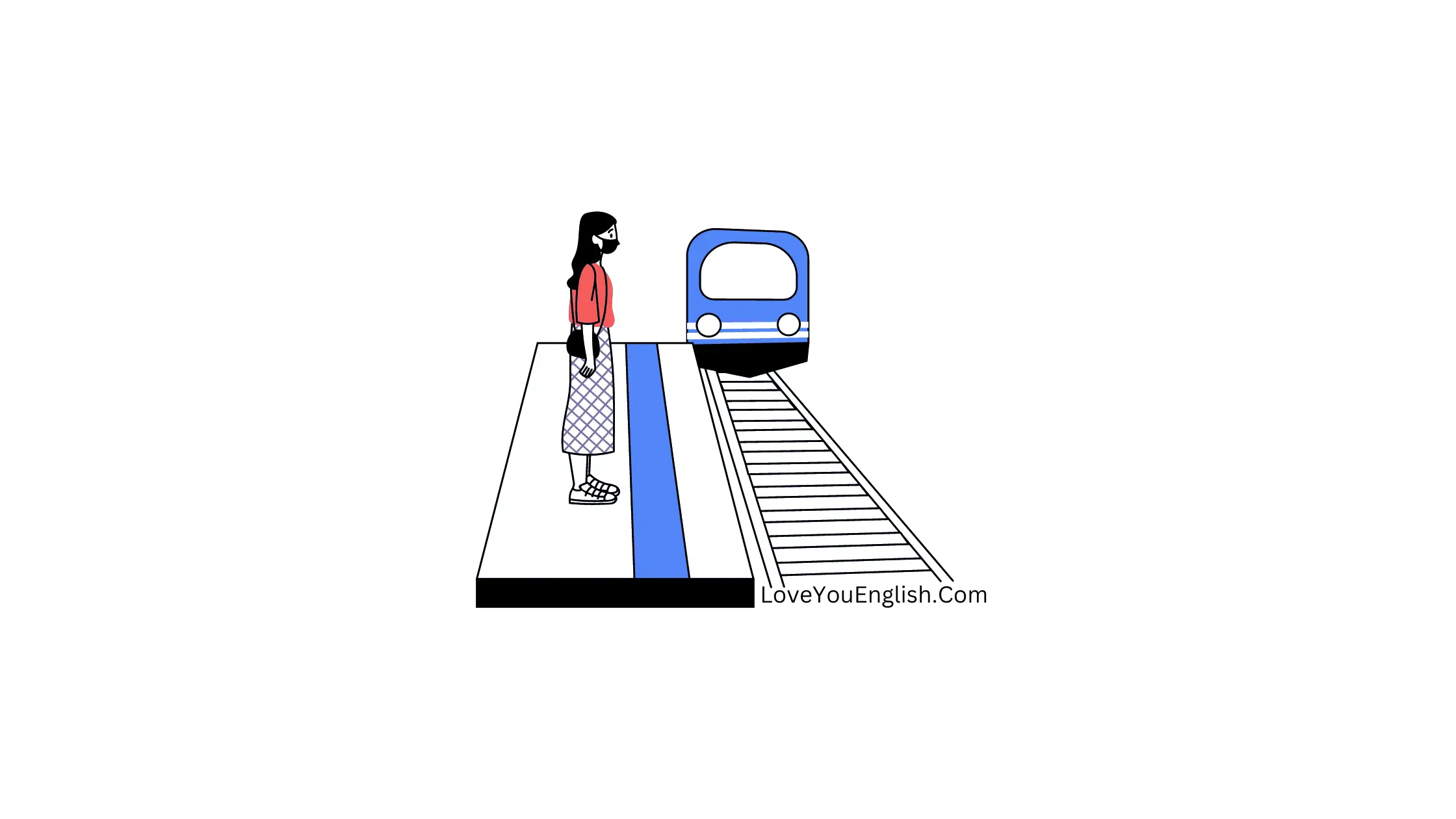
Railway stations are busy places where people ask questions, buy tickets, check schedules, and request information.
Table of Contents
ToggleFor English learners, knowing how to speak confidently in these situations is very useful—especially when traveling in English-speaking regions or communicating with tourists.
At a railway station, you may need to ask about ticket prices, departure times, platforms, delays, or seat availability.
You might hear announcements such as, “The train to Delhi is arriving on platform number three,” or questions like, “Is this the right train for Mumbai?” Learning these common expressions helps you avoid confusion and travel smoothly.
In this article, you will find practical spoken English conversations at a railway station. These dialogues are written in simple and clear language to help beginners and intermediate learners practice real-life situations.
By practicing these conversations, you will feel more confident buying tickets, asking for information, and understanding announcements at a railway station.
Spoken English Conversations at A Railway Station
Passenger: Excuse me, could you tell me which platform the train to London is on?
Station Staff: Yes, the train to London is on platform 3.
Passenger: Thank you. Do you know what time it leaves?
Station Staff: It leaves at 10:30 AM.
Passenger: Great. How long does the journey take?
Station Staff: It takes about two hours.
Passenger: Thank you very much.
Station Staff: You’re welcome. Have a safe trip!
Spoken English Conversations at A Railway Station
Passenger: Excuse me, is this the right place to buy a ticket?
Ticket Seller: Yes, you can buy your ticket here. Where are you traveling to?
Passenger: I’m going to Manchester.
Ticket Seller: Alright. Do you want a one-way ticket or a return ticket?
Passenger: A return ticket, please.
Ticket Seller: When will you be coming back?
Passenger: I’ll be back tomorrow evening.
Ticket Seller: Okay. That will be £40.
Passenger: Here you go.
Ticket Seller: Thank you. Here are your tickets. The train leaves from platform 5 at 11:15 AM.
Passenger: Thank you very much.
Ticket Seller: You’re welcome. Have a nice trip!
Spoken English Conversations at A Railway Station
Passenger: Excuse me, where is the nearest restroom?
Station Staff: The nearest restroom is just down the hall to your left.
Passenger: Thank you. Also, do you know if the 2:00 PM train to Birmingham is on time?
Station Staff: Yes, the 2:00 PM train to Birmingham is on time. It will arrive on platform 6.
Passenger: That’s good to know. Can I get something to eat around here?
Station Staff: Yes, there’s a café right next to platform 4 and a small shop near the entrance.
Passenger: Perfect. Thanks for your help!
Station Staff: You’re welcome. Have a good day!
Spoken English Conversations at A Railway Station
Passenger: Hi, can you help me find my train to Glasgow?
Station Staff: Of course! What time is your train?
Passenger: It’s at 4:45 PM.
Station Staff: Okay, your train to Glasgow will be on platform 7.
Passenger: Is it running on time?
Station Staff: Yes, it’s on time. It should be arriving in about 10 minutes.
Passenger: Great! Do I need to check in anywhere?
Station Staff: No, you don’t need to check in. Just make sure you have your ticket ready for the conductor.
Passenger: Got it. Thank you so much!
Station Staff: You’re welcome. Enjoy your trip!
Spoken English Conversations at A Railway Station
Passenger: Hi, I’m looking for the train to Edinburgh.
Station Staff: Hello! The train to Edinburgh is on platform 2.
Passenger: Do you know if it’s delayed?
Station Staff: No, it’s on time. It’s scheduled to leave at 5:30 PM.
Passenger: How long does the trip take?
Station Staff: The journey takes about one hour and 45 minutes.
Passenger: Okay, thanks. Is there a waiting area nearby?
Station Staff: Yes, there’s a waiting area right by the ticket machines and a few benches on platform 2.
Passenger: Great. Is there also a place to get some snacks?
Station Staff: Yes, there’s a small kiosk near the waiting area where you can buy snacks and drinks.
Passenger: Perfect. Thanks for your help!
Station Staff: You’re welcome! Have a nice trip to Edinburgh!
Key Vocabulary with Meanings
Railway & Travel Words
-
Passenger – a person traveling on a train
-
Platform – the place where trains stop
-
Ticket – a paper or digital pass to travel
-
One-way ticket – ticket for one trip only
-
Return ticket – ticket for going and coming back
-
Journey – the act of traveling from one place to another
-
Departure – when a train leaves
-
Arrival – when a train reaches the station
-
Delayed – late, not on time
-
On time – arriving or leaving as scheduled
-
Conductor – person who checks tickets on the train
Station Facilities
-
Restroom – toilet
-
Waiting area – place to sit and wait
-
Ticket counter / ticket seller – place/person to buy tickets
-
Café – place to buy food and drinks
-
Kiosk – small shop
-
Entrance – way to enter
Useful Spoken English Phrases
Asking for Train Information
-
Excuse me, which platform is the train on?
-
What time does the train leave?
-
Is the train on time?
-
How long does the journey take?
Buying Tickets
-
Is this the right place to buy a ticket?
-
I’d like a return ticket, please.
-
When will you be coming back?
-
Here you go.
Asking for Help
-
Can you help me find my train?
-
Where is the nearest restroom?
-
Is there a waiting area nearby?
-
Do I need to check in anywhere?
Polite Expressions
-
Thank you very much.
-
You’re welcome.
-
Have a safe trip!
-
Have a nice day!
-
Enjoy your trip!
Why These Conversations Are Useful
-
Improve spoken English
-
Build confidence while traveling
-
Learn polite and natural expressions
-
Practice real-life communication
Conclusion
Spoken English conversations at a railway station are very useful for daily life and travel.
They help learners understand how to ask for information, buy tickets, check train timings, and speak politely with station staff.
By practicing these simple dialogues, learners can become more confident and comfortable using English in real-life situations.
Regular practice of such conversations improves communication skills and makes traveling easier and stress-free.
FAQs: Spoken English Conversations at a Railway Station
1. Why should English learners practice railway station conversations?
Railway station conversations help learners communicate confidently while traveling. They teach practical English for buying tickets, asking for directions, checking train schedules, and speaking politely with station staff.
2. Who are these conversations suitable for?
These dialogues are ideal for:
- A2–B1 English learners
- ESL students
- School and college students
- Tourists
- Travelers visiting English-speaking countries
- Anyone improving spoken English
3. What vocabulary can I learn from these dialogues?
Some useful words include:
- Passenger
- Platform
- Ticket
- Departure
- Arrival
- Journey
- Delayed
- On time
- Return ticket
- One-way ticket
- Conductor
- Waiting area
- Ticket counter
- Restroom
- Café
- Kiosk
4. How do I ask which platform my train is on?
You can say:
- Excuse me, which platform is the train to London on?
- Which platform does the train leave from?
- Can you tell me where Platform 5 is?
These are polite and commonly used expressions.
5. How can I ask about train departure times?
Common questions include:
- What time does the train leave?
- When is the next train to Manchester?
- What time is the departure?
- Has the train already left?
6. How do I ask if a train is delayed?
You can ask:
- Is the train on time?
- Has the train been delayed?
- How long is the delay?
- When is the train expected to arrive?
7. How do I buy a train ticket in English?
You can use these expressions:
- I’d like a ticket to Birmingham, please.
- I’d like a return ticket.
- One-way ticket, please.
- How much is the ticket?
- Can I pay by card?
8. What is the difference between a one-way ticket and a return ticket?
- One-way ticket: Travel to your destination only.
- Return ticket: Travel to your destination and back.
Example:
“I’d like a return ticket to Manchester, please.”
9. How do I ask about the journey time?
You can say:
- How long does the journey take?
- When will the train arrive?
- What time will we reach Edinburgh?
10. How can I ask for help at a railway station?
Useful questions include:
- Can you help me?
- Where is the ticket counter?
- Where is the waiting room?
- Where is Platform 6?
- Could you please help me find my train?
11. What polite expressions are commonly used at railway stations?
Some common expressions are:
- Excuse me.
- Thank you very much.
- You’re welcome.
- Have a safe trip.
- Have a nice day.
- Enjoy your journey.
- Thanks for your help.
12. What announcements might I hear at a railway station?
Typical announcements include:
- The train is arriving on Platform 4.
- The train is delayed by 20 minutes.
- Please stand behind the yellow line.
- The train is now boarding.
- This is the final boarding call.
13. What grammar is used in these conversations?
The dialogues mainly use:
- Present Simple
- Future with will
- Polite questions with could, can, and do
- Question words (what, where, when, how)
- Common travel expressions
These structures are useful for everyday communication.
14. How can I improve my pronunciation using these dialogues?
You can:
- Read the dialogues aloud.
- Repeat after native speakers.
- Practice with a partner.
- Record your voice.
- Focus on polite intonation and clear pronunciation.
Daily practice builds fluency.
15. Can these dialogues be used for classroom role-play?
Yes. Teachers can ask students to:
- Play the passenger and station staff.
- Change destinations.
- Create new travel situations.
- Practice asking and answering questions.
- Add announcements and follow-up questions.
Role-play makes learning interactive.
16. What travel situations do these conversations cover?
The dialogues include:
- Buying tickets
- Asking about platforms
- Checking train times
- Asking about delays
- Finding station facilities
- Asking for directions
- Getting travel information
These are common situations travelers face.
17. How often should I practice travel English?
Practicing 10–15 minutes daily is enough to build confidence. Reading dialogues aloud, memorizing useful phrases, and using them in conversations will improve your speaking skills.
18. What mistakes should English learners avoid at a railway station?
Avoid:
- Forgetting polite expressions like “Excuse me” and “Please.”
- Using incorrect question word order.
- Speaking too softly or too quickly.
- Mispronouncing destination names.
- Not confirming important information like departure time or platform number.
19. How do these conversations improve spoken English?
They help learners:
- Build travel vocabulary.
- Practice asking and answering questions.
- Speak politely and naturally.
- Improve listening comprehension.
- Gain confidence in real-life travel situations.
20. What is the main benefit of learning railway station English conversations?
Learning railway station conversations prepares English learners for real-world travel. By practicing common questions, useful vocabulary, and polite expressions, learners can buy tickets, ask for information, understand announcements, and travel more confidently and comfortably in English-speaking environments.