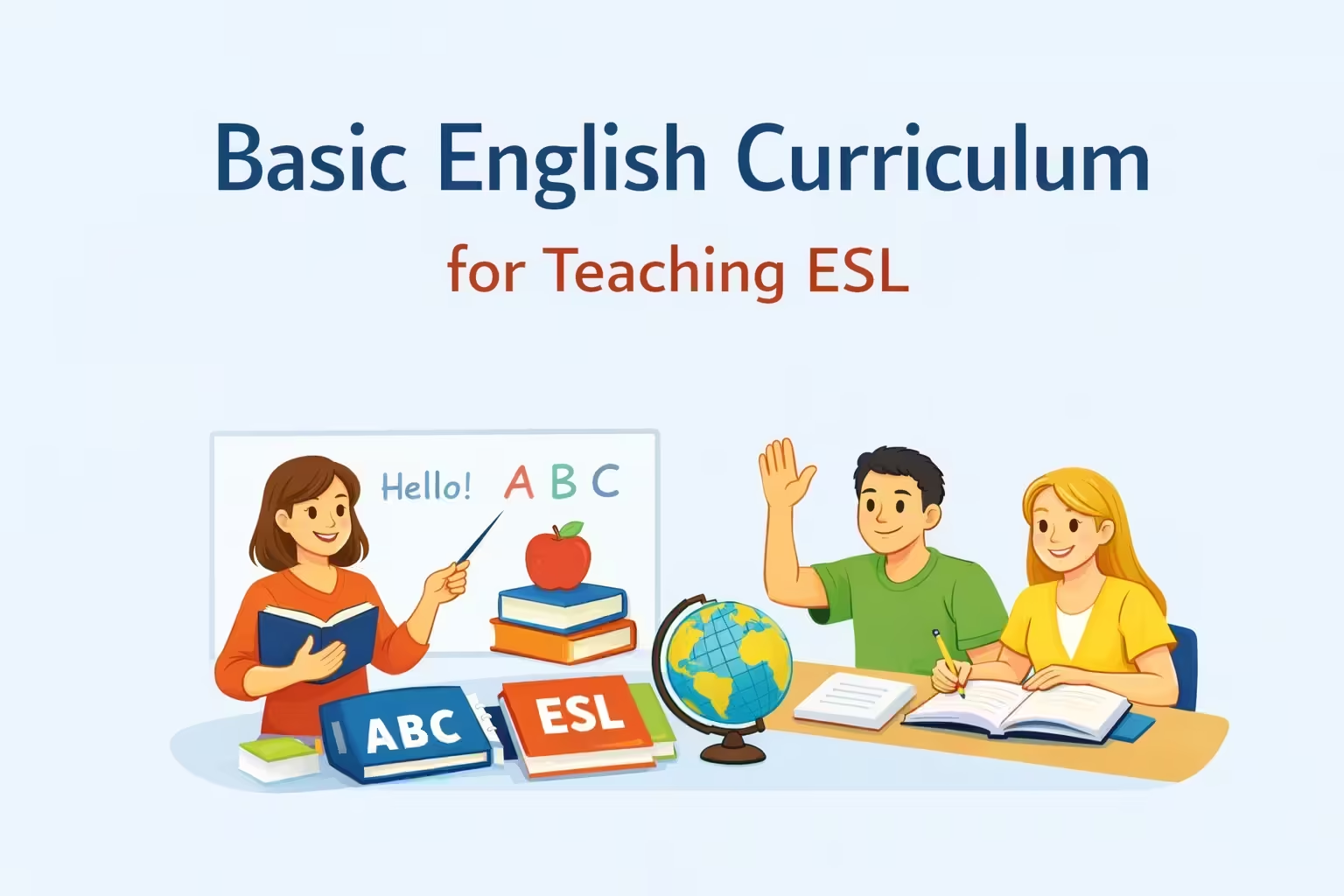
If you are a teacher looking to build a solid basic English curriculum for ESL students, you already know how important it is to start right. A well-designed basic English curriculum for teaching ESL gives students the foundation they need to communicate with confidence, understand simple conversations, and grow their language skills step by step. But where do you start? What should you teach first? And how do you keep students motivated?
I have been teaching English as a Second Language for over 10 years — in classrooms, community centers, and online. I have taught students from all walks of life: factory workers, young children, university students, elderly adults, and new immigrants. One thing I have learned is this: a clear, structured curriculum makes all the difference.
In this guide, I will walk you through exactly what to include in a basic ESL curriculum, how to structure your lessons, what activities actually work, and how to help your students build real confidence in English. Whether you teach in a classroom or online, this guide is for you.
What Is a Basic English Curriculum for ESL?
A basic English curriculum for ESL (English as a Second Language) is a structured plan that guides students from knowing little or no English to being able to communicate in everyday situations. It covers four main language skills: reading, writing, listening, and speaking.
The goal is not to make students perfect grammar experts right away. The goal is to give them practical tools they can use in real life — like introducing themselves, asking for directions, understanding simple instructions at work, or writing a short message.
A good basic ESL curriculum usually includes:
- Core vocabulary (500–1000 most common words)
- Basic grammar structures (present tense, simple questions, common verbs)
- Everyday speaking and listening practice
- Simple reading and writing tasks
- Pronunciation guidance
- Confidence-building activities
The 6 Core Areas of a Basic ESL Curriculum
After years of teaching, I have found that a strong ESL curriculum for beginners must cover six key areas. Let me explain each one and why it matters.
1. Vocabulary Building
Vocabulary is the heart of language learning. Without words, students cannot express themselves — no matter how much grammar they know. Start with the most common English words. These are words like: go, eat, help, work, home, family, time, money, day, and good.
In my classes, I use word cards, pictures, and simple sentences to introduce new vocabulary. I also group words by topic — for example, food words one week, job words the next week, family words the week after.
Quick classroom activity:
Show a picture of a kitchen. Ask students to name everything they see. Write the words on the board. Then ask them to make one sentence using two of those words. This simple activity builds vocabulary AND speaking at the same time.
2. Basic Grammar for Everyday Use
Grammar gives students the structure to build sentences. But at the beginner level, do not overwhelm students with too many rules. Focus on grammar they will actually use every day.
Key grammar topics for a basic ESL curriculum:
- Simple present tense (I work, She eats, They go)
- Yes/No questions (Do you like coffee? Is she your sister?)
- Basic negatives (I don’t know, He doesn’t work here)
- There is / There are (There is a bank near here)
- Simple past tense (I went, She called, We ate)
- Common irregular verbs (go/went, have/had, do/did)
A common mistake I see in ESL classes is teaching too much grammar too fast. Students get confused and lose confidence. Teach one grammar point at a time. Practice it through speaking and writing before moving on.
3. Spoken English Practice
Many students can read English but are afraid to speak. This is one of the biggest challenges in ESL teaching. Spoken English practice must be a central part of your curriculum — not just an extra activity at the end.
I always dedicate at least 30–40% of class time to speaking. Here is how I make it work even for very shy students.
Effective speaking activities for beginners:
- Pair practice: Students take turns asking and answering simple questions with a partner.
- Role plays: Create simple everyday scenarios — at the grocery store, at the doctor’s office, at work.
- Sentence starters: Give students a phrase like “My favorite food is…” and ask them to finish it aloud.
- Repeat after me: Model correct pronunciation, then have the whole class repeat.
- Show and tell: Students bring an object from home and say three things about it.
One of my most memorable classroom moments: A student named Maria had been in class for two months and barely spoke. One day I asked everyone to describe their hometown in two sentences. She stood up and said, “I am from Guatemala. It is very beautiful and the food is delicious.” The class clapped. She smiled for the rest of the day. Small moments like that build big confidence.
Explore more interesting topics here:
- English Vocabulary: Words Related to Teaching
- Top Tips for Teaching English in the Classroom
- The Role of Technology in English Teaching and Learning
- Active Voice Examples: 5,00 English Sentences + Guide
- How to Make Money Teaching Online: A Complete Guide
4. Listening Skills Development
Listening is the skill students use most in real life — and the one that often gets the least attention in the classroom. A good ESL curriculum includes regular, purposeful listening practice.
Types of listening practice to include:
- Teacher-led listening: Speak clearly at a moderate pace and ask comprehension questions.
- Audio dialogues: Use short, simple recorded conversations about everyday topics.
- Video clips: Show short clips (1–3 minutes) with clear English and ask students what they heard.
- Dictation: Read sentences slowly and have students write what they hear. This builds both listening and writing.
A tip from my experience: students often struggle more with natural, fast speech than with grammar or vocabulary. Train them to listen for key words and general meaning, not every single word. This is called “listening for gist” and it is a very practical, real-world skill.
5. Pronunciation Guidance
Poor pronunciation can cause real communication problems. If people cannot understand what a student is saying, it does not matter how good their grammar is. Pronunciation practice should be woven into every lesson.
Common pronunciation mistakes in beginner ESL students:
- Difficulty with the “th” sound (they say “d” instead — “de” for “the”)
- Confusing short and long vowels (“ship” vs “sheep”, “bit” vs “beat”)
- Dropping the final consonant sound (“tes” instead of “test”)
- Stress on the wrong syllable (“PHOtograph” not “phoTOgraph”)
I do not correct every mistake immediately — that can make students freeze and stop talking. Instead, I use “recast” — I repeat what the student said correctly, naturally, without making it feel like a correction. For example, if a student says “I go to store yesterday,” I respond with “Oh, you went to the store? What did you buy?” They hear the correct form without feeling embarrassed.
6. Reading and Writing for Real Life
Reading and writing in a basic ESL curriculum should focus on real-life tasks — not just textbook exercises. Think about what your students actually need to read and write in their daily lives.
Practical reading topics for beginners:
- Reading signs, labels, and simple instructions
- Short messages and text messages
- Simple job applications and forms
- Doctor’s appointment reminders and medical forms
- Simple news stories and captions
Practical writing tasks for beginners:
- Filling out a simple form (name, address, phone number)
- Writing a short thank-you message
- Writing three sentences about their day
- Composing a simple email requesting information
A Sample 12-Week Basic English Curriculum for ESL Beginners
Here is a simple 12-week plan you can adapt for your class. Each week focuses on one main theme with vocabulary, grammar, speaking, and listening tied together.
- Week 1: Introductions — names, countries, greetings, the verb “to be”
- Week 2: Family and relationships — family vocabulary, possessives (my, your, his, her)
- Week 3: Daily routines — present simple tense, time expressions (in the morning, at night)
- Week 4: Food and drink — food vocabulary, asking and ordering, “I would like…”
- Week 5: Numbers and money — counting, prices, basic shopping conversations
- Week 6: Getting around — directions, transportation, prepositions of place
- Week 7: Home and living — rooms, furniture, “there is / there are”
- Week 8: Work and jobs — job vocabulary, “What do you do?”, present simple review
- Week 9: Health and body — body parts, common illnesses, “I have a headache”
- Week 10: Past experiences — simple past tense, talking about yesterday and last week
- Week 11: Plans and future — “going to” for future plans, talking about the weekend
- Week 12: Review and real-life practice — combining all skills in role plays and presentations
This structure ensures that students revisit vocabulary and grammar across multiple weeks, which is how people actually learn. Repetition — in different contexts — is the key to real retention.
Common Mistakes Teachers Make in ESL Curriculum Planning
After many years of teaching and working with other ESL educators, I have noticed several mistakes that come up again and again. Knowing these in advance can save you a lot of time and frustration.
Mistake 1: Moving too fast through the curriculum
Students need time to absorb new material. If you cover too much in one lesson, students will remember very little. Teach less, but teach it well.
Mistake 2: Ignoring spoken English in favor of written exercises
It is easy to fill class time with worksheets. But most students are learning English because they need to speak it — not just write it. Balance written work with real speaking time.
Mistake 3: Using materials that are too advanced
I have seen teachers use newspaper articles or complex dialogues with Level 1 students. The students shut down immediately. Always use materials that are just slightly above the student’s current level — what educators call “comprehensible input.”
Mistake 4: Not including cultural context
Language does not exist in a vacuum. ESL students often struggle not just with words, but with cultural norms — like how to be politely direct, how to address a boss, or what is considered formal vs casual. Include cultural notes in your lessons.
Mistake 5: Forgetting to celebrate progress
Learning a language is hard work. It takes months and years of consistent effort. As a teacher, remind your students how far they have come. Show them their early writing versus their current writing. Let them hear the difference in their own voice. Motivation is a curriculum tool too.
Teaching the Basic ESL Curriculum Online vs. In the Classroom
Since the pandemic, many ESL teachers have moved online — or teach a combination of both. The same curriculum works in both settings, but you will need to adapt your methods.
What works well online:
- Short video clips and audio recordings for listening practice
- Screen-shared vocabulary slides and matching activities
- Breakout rooms for pair speaking practice
- Interactive tools like Padlet, Kahoot, and Google Slides for engagement
- Recorded lessons so students can review at their own pace
What works better in person:
- Physical flashcards and matching games
- Group activities and class discussions
- Real-world realia (bringing actual objects to class — a menu, a receipt, a bus schedule)
- Spontaneous conversation and organic interaction
- Immediate pronunciation modeling and feedback
My advice: do not try to recreate in-person teaching on a screen. Online teaching has its own strengths. Use them wisely.
Building Fluency and Confidence in Your ESL Students
Fluency is not about being perfect. Fluency is about being understood — and being able to communicate without stopping every five seconds to think about grammar rules. Confidence is the bridge that gets students there.
Here are my top strategies for building fluency:
- Timed speaking tasks: Give students 60 seconds to talk about a topic without stopping. The clock reduces overthinking.
- Repeat, repeat, repeat: Have students practice the same dialogue three times — each time with more confidence and less reading from notes.
- Fluency circles: Students stand in two circles facing each other. They speak for 30 seconds on a topic, then rotate to a new partner. Every student speaks 8–10 times in one activity.
- Record and review: Have students record themselves on their phone. Listening to yourself is one of the most powerful tools for improvement.
- Celebrate mistakes: Make it clear in your classroom that mistakes are expected and welcome. Fear of mistakes is the number one enemy of fluency.
I always tell my students: “Every expert was once a beginner. Every fluent speaker was once in your seat.” It sounds simple, but students need to hear it — often.
Setting Realistic Expectations for Teachers and Students
This is the part no one wants to talk about: learning English takes time. A lot of time. There are no shortcuts. A student will not become fluent after 12 weeks of classes. But with a strong basic English curriculum for ESL, they will make meaningful, measurable progress — and that progress will build on itself.
Realistic milestones after completing a 12-week basic curriculum:
- Can introduce themselves and answer basic personal questions
- Understands simple spoken instructions
- Can read short texts and simple forms
- Can write short sentences and messages
- Can handle basic real-life situations (shopping, asking directions, making appointments)
- Feels more confident about using English
These are not small things. For many ESL students, these skills are life-changing. Keep the focus on practical progress, not perfection.
Mini Practice Section: Try These in Your Next Class
Here are three activities you can use right away in your ESL class:
Activity 1 — The Three Questions Game (Speaking)
Students pair up. Student A asks three questions: What is your name? Where are you from? What do you like to do? Student B answers. Then they switch. Simple, but effective for speaking confidence.
Activity 2 — Listen and Draw (Listening)
The teacher describes a simple scene slowly (“There is a table. On the table, there is a cup. Next to the cup, there is a book.”). Students draw what they hear. At the end, they compare drawings. Great for prepositions and listening comprehension.
Activity 3 — Sentence Builder (Grammar + Writing)
Give students five word cards: I / every day / eat / breakfast / morning. Ask them to arrange the cards into a correct sentence. Then ask them to make their own sentence using the same structure. Hands-on grammar that sticks.
Conclusion: A Strong Basic English Curriculum for ESL Makes All the Difference
A well-planned basic English curriculum for teaching ESL does more than teach language — it opens doors. It gives students the tools to communicate, to work, to connect with their community, and to build the life they want.
As a teacher, your job is not to be perfect. Your job is to be consistent, encouraging, and well-prepared. Focus on the six core areas: vocabulary, grammar, speaking, listening, pronunciation, and practical reading and writing. Use a clear structure like the 12-week plan. Celebrate small wins. Be patient with the process.
And remember: every lesson you teach is planting a seed. Some will grow fast. Others will take more time. But with the right basic ESL curriculum, every student has the chance to grow. That is the real reward of this work.
Keep teaching. Keep learning. And keep believing in your students.
Frequently Asked Questions (FAQs)
Q1: What is the best age to start teaching ESL?
There is no bad age to start learning English. Children absorb language quickly, but adults are also capable of strong progress. The key for all ages is consistent practice and a supportive learning environment.
Q2: How many hours per week should ESL beginners study?
Research suggests that even 2–3 hours of focused study per week — plus daily exposure to English — can produce good results for beginners. Quality of practice matters more than the total number of hours.
Q3: What materials do I need to teach a basic ESL curriculum?
You do not need expensive materials. A whiteboard, printed worksheets, picture cards, and a few short audio or video clips can go a long way. Many excellent free resources are available online from sites like British Council, ESL Library, and Busy Teacher.
Q4: How do I help very shy ESL students speak more?
Start with low-pressure activities like pair work instead of speaking in front of the whole class. Give students time to prepare before they speak. Never force a student to speak publicly before they feel ready. Build trust and a safe atmosphere first — speaking confidence follows naturally.
Q5: What is the difference between ESL and EFL?
ESL stands for English as a Second Language — it refers to learning English in an English-speaking country. EFL stands for English as a Foreign Language — it refers to learning English in a non-English-speaking country. The curriculum basics are similar, but the context and student needs may differ.