Introduction
Are you feeling stuck in your current job? Do you wake up every morning wishing you were doing something completely different? You are not alone.
Millions of people around the world want to know how to switch careers successfully at any age — whether they are 25, 40, or even 55. A career change can feel scary. But with the right plan, the right mindset, and the right tools, it is absolutely possible.
In this guide, you will learn everything you need to know about making a successful career transition. We will cover practical steps, common mistakes, expert tips, and real-life examples. No matter how old you are or what background you come from, this guide is for you.
Let’s get started.
What Does It Mean to Switch Careers Successfully at Any Age?
A Simple Definition
Switching careers means moving from one type of job or profession to a completely different field. It is not just changing employers. It is changing the kind of work you do.
For example:
- A teacher becoming a software developer
- A nurse becoming a health coach
- A banker becoming a graphic designer
- A soldier becoming a business owner
Switching careers successfully means making this change in a smart, planned way — without losing too much time, money, or confidence.
Why “At Any Age” Matters
Many people believe career changes are only for young people in their 20s. This is simply not true. Research shows that people are changing careers at 30, 40, 50, and even 60 years old — and succeeding.
Age is not the real barrier. Fear and lack of planning are the real barriers.
Why Is Switching Careers Important?
1. Your Happiness Matters
Work takes up a huge part of your life. If you hate your job, it affects everything — your sleep, your health, your relationships, and your confidence.
Switching to a career you love can completely transform your life.
2. The Job Market Has Changed
The world of work is not the same as it was 20 years ago. New industries are growing fast:
- Technology
- Digital marketing
- Data science
- Healthcare
- E-commerce and online business
These new fields need new workers. You do not always need years of traditional experience to enter them.
3. You Deserve Growth
Staying in a dead-end job only because you are afraid to change is not growth. It is staying still while the world moves forward.
Career switching helps you:
- Earn more money
- Learn new skills
- Meet new people
- Feel more fulfilled and motivated
4. It Builds Confidence
Every time you step outside your comfort zone and succeed, your confidence grows. Switching careers — even when it is hard — teaches you that you are capable of more than you think.
Types of Career Transitions You Should Know
Understanding the type of career change you want to make helps you plan better. There are five main types:
1. Industry Change
You keep using similar skills but move to a different industry.
Example: A marketing manager in the banking sector moves to marketing in the tech industry.
2. Role Change
You stay in the same industry but take on a completely different job title.
Example: A software engineer becomes a product manager at the same tech company.
3. Complete Career Pivot
This is the most dramatic change. You leave your old field entirely and start fresh in a new one.
Example: A lawyer becomes a yoga instructor.
4. Entrepreneurship
Instead of working for someone else, you start your own business using your existing skills or a new passion.
Example: A chef quits their restaurant job and starts a food delivery business.
5. Freelancing or Consulting
You take your professional expertise and offer it independently to multiple clients.
Example: A corporate trainer starts their own freelance training business.
Step-by-Step Guide: How to Switch Careers Successfully at Any Age
This is the heart of this article. Follow these steps carefully and you will have a clear roadmap to your new career.
Step 1: Do an Honest Self-Assessment
Before you do anything else, you need to understand yourself better.
Ask yourself these questions:
- What do I enjoy doing — even when no one is paying me?
- What are my strongest skills?
- What kind of lifestyle do I want?
- What are my financial needs?
- What am I willing to learn?
Practical tip: Write your answers in a notebook. Be completely honest. This is your private career journal. No one is judging you.
You can also use free online tools like:
- 16Personalities (personality test)
- O*NET Interest Profiler (career interest assessment)
- StrengthsFinder (skills and strengths test)
These tools help you discover career paths that match your personality and natural abilities.
Step 2: Research Your Target Career
Once you have a new career in mind, research it deeply before making any commitments.
Find out:
- What skills and qualifications are required?
- What is the average salary?
- Is it a growing field or a shrinking one?
- What does a typical day look like?
- Who are the key employers or clients in this field?
Where to research:
- LinkedIn job postings
- Glassdoor salary data
- Industry blogs and YouTube channels
- Informational interviews with people already in the field
Real-life scenario:
Maria is a 38-year-old accountant who wants to become a UX designer. Before quitting her job, she spends three months researching. She discovers that UX design is growing fast, average salaries are competitive, and many designers are self-taught. This gives her the confidence to move forward with a clear plan.
Step 3: Identify Your Transferable Skills
One of the biggest mistakes people make is thinking their old skills are worthless in a new career. This is almost never true.
Transferable skills are abilities you have developed in one job that are valuable in many other fields.
Common transferable skills include:
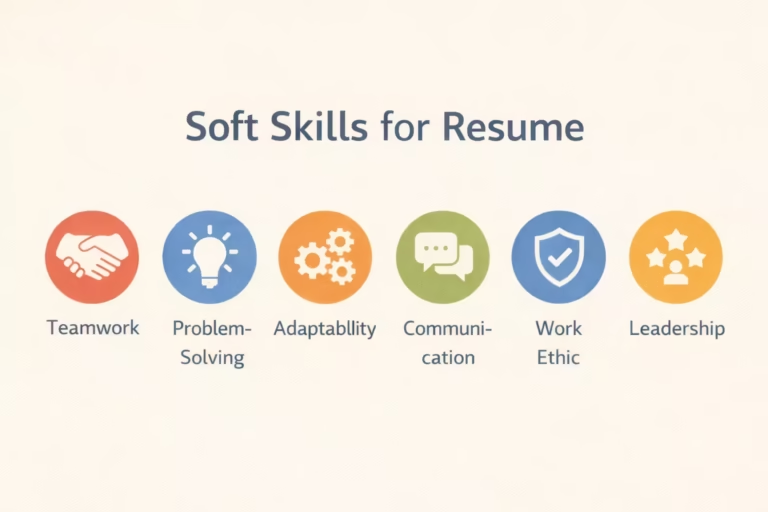
- Communication — writing, speaking, presenting
- Problem-solving — analyzing issues and finding solutions
- Leadership — managing teams and projects
- Organization — planning, time management, attention to detail
- Technology — using software, data analysis, digital tools
- Customer service — understanding people’s needs
Example:
A teacher who wants to move into corporate training already has:
- Public speaking skills
- Curriculum design experience
- The ability to explain complex topics clearly
- Experience managing groups of people
These are all highly valued in the corporate training world.
Step 4: Fill the Skills Gap
After identifying your transferable skills, you will also identify the skills you are missing. This is called your skills gap.
Do not be discouraged. Every career changer has a skills gap. The goal is to fill it — smartly and efficiently.
Ways to fill your skills gap:
- Online courses — Coursera, Udemy, edX, LinkedIn Learning
- Certifications — Google, HubSpot, Microsoft, AWS, and others offer free or low-cost certifications
- Bootcamps — Intensive programs in fields like coding, digital marketing, and data science
- Volunteering — Offer your new skills for free to build real experience
- Personal projects — Build a portfolio, start a blog, create a YouTube channel, design a website
Tip: You do not need to go back to university for four years. Many successful career changers build the skills they need in 6 to 12 months through focused, self-directed learning.
Step 5: Build Your New Professional Network
Here is a truth that many people do not want to hear: your network is more powerful than your resume.
In many industries, jobs are filled through personal connections before they are ever advertised online.
How to build your network in a new field:
- Attend industry events and conferences
- Join LinkedIn groups related to your target career
- Reach out to professionals for informational interviews
- Participate in online communities and forums
- Follow thought leaders in your new field on social media
What is an informational interview?
An informational interview is a casual conversation — in person or online — where you ask someone already working in your target field about their experience. You are not asking for a job. You are asking for advice and insight.
Most people are happy to share their stories. These conversations can open unexpected doors.
Step 6: Update Your Personal Brand
Your resume, LinkedIn profile, and online presence need to reflect your new direction.
For your resume:
- Rewrite your summary to highlight your new career goal
- Lead with transferable skills, not just old job titles
- Include new certifications and courses
- Add any freelance projects, volunteer work, or personal projects related to your new field
For your LinkedIn profile:
- Update your headline to reflect your target role
- Write a compelling About section that tells your career change story
- Connect with people in your new industry
- Share content related to your new field to show you are learning and engaged
Personal branding tip:
Your career change story is not a weakness — it is your unique selling point. Frame it this way: “I bring X years of experience in [old field], plus fresh skills and genuine passion for [new field].” This combination is something that someone who grew up only in the new field does not have.
Step 7: Gain Real Experience Before You Quit
One of the smartest strategies for switching careers is to start before you fully switch.
Ways to gain experience while still employed:
- Take on a side project in your new field
- Freelance on weekends
- Volunteer with an organization in your target industry
- Start a blog, podcast, or portfolio related to your new career
- Apply for internal transfers within your current company
This approach reduces financial risk and helps you test whether you truly enjoy the new field before committing fully.
Step 8: Manage the Financial Transition
Money is one of the biggest concerns for career changers. Here is how to handle it wisely.
Before you quit:
- Save at least 6 months of living expenses as an emergency fund
- Pay off high-interest debt if possible
- Understand how your income will change during the transition period
- Look into whether your employer offers any transition support or severance packages
During the transition:
- Consider part-time or contract work in your new field
- Cut non-essential expenses temporarily
- Explore grants, scholarships, or employer education benefits to fund your retraining
Long-term thinking:
Yes, you may earn less money at the beginning of a new career. But many career changers find that within 2 to 3 years, they are earning as much or more than they were before — and feeling far more satisfied.
Step 9: Apply Strategically and Prepare for Interviews
When you are ready to apply for jobs in your new field, be strategic.
Smart application tips:
- Do not mass-apply to hundreds of jobs. Apply to fewer, better-targeted roles.
- Customize every cover letter to explain your career change story clearly
- Highlight what makes you different — your combined experience
- Use your network to get referrals wherever possible
Interview preparation for career changers:
The most common interview question you will face is: “Why are you switching careers?”
Prepare a clear, positive, and confident answer. Do not apologize for your career change. Instead, explain:
- What motivated the change
- What steps you have taken to prepare
- Why you are excited about this new direction
Example answer:
“After ten years in finance, I realized my true passion is helping people through design. Over the past year, I completed a UX design certification, built a portfolio of five projects, and worked with two small businesses on their websites. I am genuinely excited to bring both my analytical background and my new design skills to a role like this one.”
Step 10: Stay Resilient and Keep Going
Career transitions are rarely quick or easy. You will face rejection. You will have moments of doubt. You may wonder if you made a mistake.
This is completely normal.
How to stay resilient:
- Celebrate small wins — every course completed, every new connection made
- Keep a journal of your progress to remind yourself how far you have come
- Surround yourself with supportive people who believe in your goals
- Find a mentor who has successfully made a similar transition
- Remember your “why” — the reason you started this journey in the first place
Common Mistakes to Avoid When Switching Careers
Avoid these common pitfalls to make your transition smoother and faster.
- Quitting without a plan. Never leave your current job until you have a clear roadmap and some financial cushion.
- Underestimating transferable skills. Many career changers fail to recognize how valuable their existing experience is.
- Waiting until you are 100% ready. There is no perfect time. If you wait for all conditions to be perfect, you will wait forever.
- Ignoring your network. Many people try to make the switch alone. Building relationships in your new field is essential.
- Focusing only on salary. A higher salary in the wrong job will not make you happy. Consider growth potential, culture, and satisfaction too.
- Giving up too early. Most successful career changers faced rejection before landing their first role in the new field. Persistence pays off.
- Not building a portfolio. In many modern careers, showing your work is more powerful than listing old job titles.
Real-Life Applications and Success Stories
Application 1: Career Change at 30 — From Banking to Tech
James, 32, investment banker turned data analyst:
James spent seven years in banking and felt completely burned out. He started learning data analytics on weekends using free online courses. Within 10 months, he earned a Google Data Analytics certification, built a portfolio of three projects using public datasets, and landed his first data analyst role at a fintech startup — with a 20% salary increase.
Key lesson: You do not need to go back to university. Focused, self-directed learning works.
Application 2: Career Change at 45 — From Teaching to Digital Marketing
Sandra, 45, high school teacher turned digital marketing manager:
Sandra felt her communication and organizational skills were being wasted. She took a 3-month digital marketing course, volunteered to run social media for a local nonprofit, and built a small portfolio of campaigns. She now works remotely as a digital marketing manager for an e-commerce company.
Key lesson: Teaching gives you skills that are incredibly valuable in marketing and corporate training.
Application 3: Career Change at 55 — From Engineer to Life Coach
David, 55, civil engineer turned certified life coach:
David had always been the person his colleagues turned to for advice. At 55, he completed an International Coaching Federation certification and began building a coaching practice on the side while still working. Within two years, his coaching income replaced his engineering salary.
Key lesson: Age brings wisdom. Use it as an advantage, not an excuse.
Tips and Best Practices for a Successful Career Switch
Here are the most important practical tips for anyone who wants to switch careers successfully at any age.
Daily habits that help:
- Spend at least 30 minutes every day learning something related to your new career
- Read one industry article or blog post each morning
- Connect with one new professional each week on LinkedIn
- Track your progress weekly in a simple notebook or app
Mindset tips:
- Replace “I am too old” with “I have more experience”
- Replace “I do not know enough” with “I am learning every day”
- Replace “What if I fail?” with “What if I succeed?”
Practical strategies:
- Start with a side project or freelance work before fully committing
- Find a mentor or career coach who specializes in career transitions
- Join online communities of career changers for support and advice
- Set a clear timeline with specific milestones — not just vague goals
Frequently Asked Questions (FAQs)
Q1: Is it too late to switch careers at 40 or 50?
Absolutely not. Many people make their most successful career changes in their 40s and 50s. At this stage, you bring maturity, real-world experience, emotional intelligence, and a strong professional network — all of which are highly valued by employers. Age is an asset, not a limitation.
Q2: How long does a career change usually take?
The timeline varies depending on how different your new career is from your current one. On average, most career changers complete their transition in 6 months to 2 years. The more preparation you do — skills building, networking, portfolio development — the faster the process tends to go.
Q3: Do I need to go back to university to switch careers?
Not necessarily. While some careers do require formal degrees (medicine, law, engineering), many growing fields — including tech, digital marketing, UX design, project management, and coaching — can be entered through certifications, bootcamps, and portfolio-based learning. Research the specific requirements for your target career before investing time and money.
Q4: How do I explain a career change in a job interview?
Frame your career change as a deliberate, positive choice — not a desperate escape. Focus on: what drew you to the new field, what steps you took to prepare, and how your previous experience adds unique value. Practice your answer until it feels natural and confident. Avoid speaking negatively about your previous career or employer.
Q5: What are the best careers to switch into right now?
Some of the fastest-growing fields with strong demand for career changers include:
- Data analytics and data science
- Digital marketing and SEO
- UX/UI design
- Project management
- Cybersecurity
- Healthcare (especially nursing, therapy, and health coaching)
- Software development
- Content creation and copywriting
- E-learning and instructional design
Q6: How do I manage financial stress during a career change?
Build an emergency fund of at least 3 to 6 months of expenses before making the switch. Consider doing freelance or part-time work in your new field while still employed. Look for affordable or free training options. A short period of lower income is often worth the long-term gain in satisfaction and earning potential.
Q7: What if I do not know what career I want to switch to?
Start with self-assessment. Identify your skills, interests, values, and the lifestyle you want. Talk to people in different fields. Try short online courses in areas that interest you. Volunteer or shadow professionals. Career clarity often comes from action — not from waiting and thinking alone.
Conclusion
Learning how to switch careers successfully at any age is one of the most empowering things you can do for yourself. It requires courage, planning, patience, and a willingness to keep learning — but the reward is a working life that actually excites you.
Here is a quick summary of what we covered:
- A career change is a deliberate move to a different type of work — and it is possible at any age
- Self-assessment, research, and skills development are the foundation of every successful transition
- Transferable skills are more valuable than most people realize
- Networking, personal branding, and gaining early experience are critical steps
- Financial planning reduces risk and stress during the transition
- Resilience and a positive mindset are just as important as technical skills
No matter where you are in life right now — whether you are 25 or 55, a beginner or a veteran — you have the ability to build a career that brings you meaning, growth, and satisfaction.
Your next step is simple: Choose one action from this guide and do it today. Update your LinkedIn. Sign up for a free course. Reach out to one person in a field you are curious about.
The best time to take control of your career was yesterday. The second-best time is right now.
Did you find this article helpful? Share it with someone who is thinking about a career change. And if you have questions or your own career change story to share, drop them in the comments below. You might just inspire someone else to take their first step.
Explore more topics here:
- Phrasal Verbs for Work – Meaning & Examples in English
- Grocery Shopping Tips for Students in North America: Save Money, Eat Well, and Shop Smart
- English Collocations for Describing Places and Locations (Examples and Usage Guide)
- English Conversation at a Bus Stop (Daily Use Dialogue)
- Top Career Options for Students Who Love English (Complete 2026 Guide)
- How to Start a Career in Content Writing: The Ultimate Beginner Guide
📚 Continue Learning English
Choose your next lesson and keep improving your English skills with our free English learning resources.