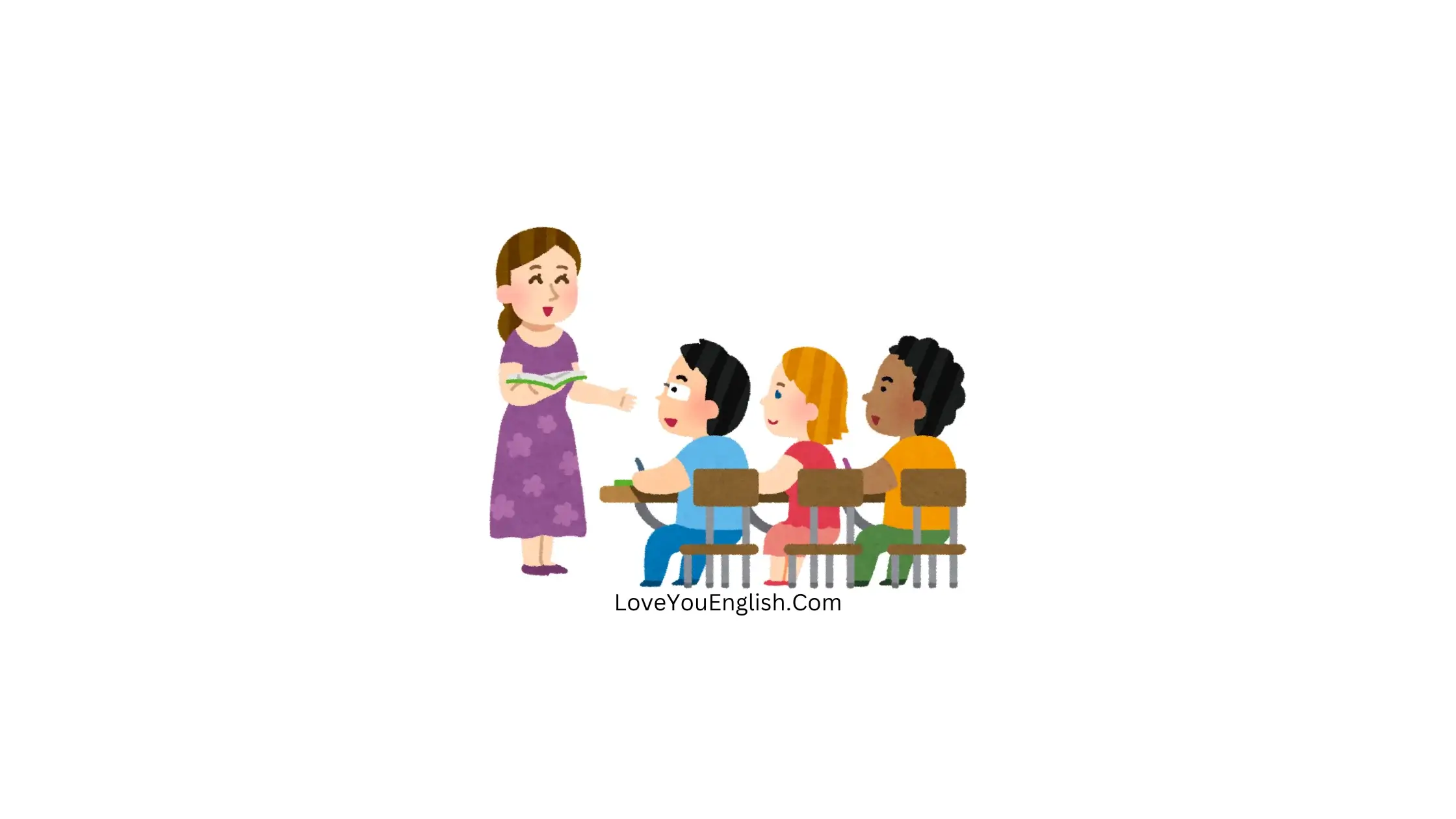
English Dialogues Between Teacher and Student help learners understand and practice common classroom conversations.
Table of Contents
ToggleThese dialogues include asking questions, requesting help, giving instructions, clarifying doubts, and responding politely.
Learning teacher–student conversations makes classroom communication smoother and more confident in English.
These dialogues are ideal for school students, ESL learners, and classroom role-play practice.
They use easy vocabulary, polite expressions, and natural sentence patterns, making them suitable for beginners and intermediate learners.
By practicing teacher–student dialogues, learners can improve their speaking skills, confidence, and classroom communication ability in English.
This topic is part of our English Conversation Practice for English learners.
English Dialogues Between Teacher and Student
Teacher: Good morning! How are you today?
Student: Good morning, I’m doing alright, thanks. Just a bit tired.
Teacher: I see. Well, I hope you can wake up a bit as we dive into today’s lesson. Did you manage to review the material we covered last time?
Student: Yeah, I went over it a couple of times. I think I got most of it.
Teacher: That’s good to hear. Today, we’re going to build on that foundation and delve deeper into the topic. If you have any questions along the way, feel free to ask.
Student: Okay, sounds good. I’ll try to keep up.
Teacher: Great attitude! So, let’s start with a quick recap. Can you tell me what you remember from our last lesson?
Student: Um, we talked about the causes of World War II and the aftermath, like the formation of the United Nations and the division of Germany.
Teacher: Exactly. Now, today we’ll focus more on the impact of the war on different countries and how it shaped global politics. We’ll also discuss some key events and figures during that period.
Student: Okay, got it. I’ll take notes as we go along.
Teacher: Perfect. Let’s begin by examining the economic effects of World War II on Europe…
Conversation between a teacher and a student -2
Teacher: Good afternoon! How are you doing today?
Student: Hi, I’m alright, thank you. Just a bit stressed about the upcoming exams.
Teacher: I understand, exams can be nerve-wracking. But remember, you’ve been preparing diligently, so have confidence in yourself. Is there anything specific you’re feeling unsure about?
Student: Well, I’m struggling with the concept of quadratic equations. I keep getting confused with the different methods of solving them.
Teacher: Ah, quadratic equations can be tricky at first, but once you grasp the methods, it becomes much easier. Let’s go over it again. Do you have any specific problems you’d like to discuss?
Student: Yes, I’ve been having trouble with factoring quadratic expressions. I never seem to get it right.
Teacher: Factoring can indeed be challenging, but with practice, it will become second nature. Let’s work through a few examples together, shall we?
[The teacher proceeds to explain the concept of factoring quadratic expressions, breaking down each step and providing guidance as the student attempts to solve problems.]
Student: I think I’m starting to understand it better now. Thanks for your patience, teacher.
Teacher: You’re welcome! Remember, it’s completely normal to struggle with new concepts. The important thing is to keep practicing and asking questions when you need clarification. I’m here to help you every step of the way.
Student: Thanks, teacher. I’ll make sure to practice more before the exams.
Teacher: That’s the spirit! You’re capable of achieving great things. Keep up the hard work, and don’t hesitate to reach out if you need further assistance.
For quick access to our best content, visit our English learning resources section.
Conversation between a teacher and a student -3
Teacher: Good morning! How are you today?
Student: Good morning, I’m doing well, thank you. I’m excited about the science fair coming up.
Teacher: That’s great to hear! I’m glad you’re enthusiastic about it. Have you decided on a project idea yet?
Student: Yes, I’m thinking of doing something related to renewable energy. Maybe an experiment to demonstrate the effectiveness of different types of solar panels.
Teacher: That sounds like a fantastic idea! Renewable energy is such an important topic, and a project like that would be both educational and impactful. Do you need any help planning or executing your experiment?
Student: Actually, I was wondering if you could help me gather some materials and set up the experiment. I’m not sure where to start.
Teacher: Of course, I’d be happy to help. Let’s sit down and discuss what materials you’ll need, how to set up the experiment, and any safety precautions we should take. We can also brainstorm ways to collect and analyze the data effectively.
[The teacher and student spend the next few minutes discussing the experiment in detail, outlining the materials needed, the procedure to follow, and how to ensure accurate results.]
Student: Thank you so much for your help, teacher. I feel much more confident about my project now.
Teacher: You’re welcome! I’m glad I could assist you. Remember, if you have any questions or run into any challenges along the way, don’t hesitate to ask for help. I’m here to support you every step of the way.
Student: Thanks again, teacher. I’ll make sure to keep you updated on my progress.
Teacher: I look forward to seeing how your project turns out. I have no doubt it will be a success!
Conversation between a teacher and a student -4
Teacher: Good afternoon! How are you today?
Student: Hi, I’m doing okay, thank you. I’m just a bit overwhelmed with all the assignments and projects we have lately.
Teacher: I understand, this time of the semester can be challenging. Is there anything specific you’re struggling with that I can help you with?
Student: Well, I’m having trouble understanding the concept of mitosis in biology. It seems so complex, and I’m afraid I’ll never get it.
Teacher: Mitosis can be a bit tricky to grasp at first, but I’m confident that with some guidance, you’ll understand it better. Let’s start by breaking it down into simpler terms. Do you know the basic stages of mitosis?
Student: Um, I think there’s prophase, metaphase, anaphase, and telophase, right?
Teacher: That’s correct! Those are the four main stages of mitosis. Now, let’s go through each stage step by step and I’ll explain what happens during each one.
[The teacher proceeds to explain the process of mitosis, using diagrams and visual aids to help the student understand. They discuss the significance of each stage and how it contributes to cell division.]
Student: Okay, I think I’m starting to get it now. It’s still a bit confusing, but I’ll keep reviewing and asking questions if I need to.
Teacher: That’s the spirit! Mitosis can be a challenging topic, but with perseverance and practice, you’ll master it in no time. Remember, I’m here to help you whenever you need it.
Student: Thanks, teacher. I really appreciate your patience and support.
Teacher: You’re welcome! Don’t hesitate to reach out if you have any more questions or need further clarification. Together, we’ll tackle this topic and any others you find difficult.
FAQs About English Dialogues Between Teacher and Student
Why are teacher and student dialogues important for English learners?
Teacher–student dialogues help learners practice real-life classroom communication. They improve speaking confidence, listening skills, vocabulary, and the ability to ask and answer questions politely in English.
What can I learn from teacher–student conversations?
These conversations help learners:
- Ask questions confidently
- Request help politely
- Follow classroom instructions
- Express doubts and concerns
- Participate in discussions
- Improve conversational English
Are these dialogues suitable for beginners?
Yes. These dialogues use simple vocabulary, common classroom expressions, and easy sentence structures, making them suitable for beginners, school students, and ESL learners.
What are some common classroom expressions used by students?
Students often use phrases such as:
- “Could you explain that again?”
- “I don’t understand this topic.”
- “May I ask a question?”
- “Can you help me with this problem?”
- “Thank you for your help.”
What are some common expressions used by teachers?
Teachers frequently say:
- “Please pay attention.”
- “Do you have any questions?”
- “Let’s review the lesson.”
- “Good job!”
- “Keep practicing.”
- “Can anyone answer this question?”
How can teacher–student dialogues improve spoken English?
Practicing these dialogues helps learners:
- Develop fluency
- Improve pronunciation
- Learn natural conversation patterns
- Build confidence in classroom situations
- Use polite and professional language
Why is polite language important in classroom conversations?
Polite language shows respect and helps create a positive learning environment. It also improves communication between teachers and students.
How can students ask for help in English?
Some useful phrases include:
- “Could you help me, please?”
- “I’m having trouble understanding this.”
- “Can you explain this topic again?”
- “Could you give me an example?”
What topics are commonly discussed in teacher–student dialogues?
Common topics include:
- Homework
- Exams
- Projects
- Classroom activities
- Subject-related questions
- Study tips
- Academic progress
Can these dialogues help with role-play activities?
Yes. Teacher–student conversations are excellent for classroom role-plays, speaking practice, pair activities, and English communication exercises.
How often should learners practice dialogues?
Regular practice is recommended. Reading dialogues aloud, role-playing with a partner, and repeating common classroom expressions can significantly improve speaking skills.
Are teacher–student dialogues useful for ESL classrooms?
Absolutely. They provide realistic situations that learners may encounter in school, language classes, or academic settings, helping them communicate more naturally and confidently.
What skills can students develop through dialogue practice?
Students can improve:
- Speaking skills
- Listening comprehension
- Pronunciation
- Vocabulary
- Grammar usage
- Communication confidence
How can teachers use these dialogues in class?
Teachers can use them for:
- Role-play exercises
- Speaking activities
- Reading practice
- Pronunciation drills
- Vocabulary building
- Group discussions
These activities make English learning more interactive and practical.
Read and practice more spoken English with these conversations:
📚 Continue Learning English
Choose your next lesson and keep improving your English skills with our free English learning resources.