Walk into any great English Language Arts classroom and you’ll feel it immediately. Students are engaged. Conversations are flowing.
Someone is reading aloud with confidence, another student is debating a character’s choices, and the teacher is moving through the room like a conductor — listening, guiding, redirecting, encouraging. It looks effortless. It isn’t.
The essential skills every ELA teacher should have go far beyond knowing grammar rules or loving books. They involve communication, creativity, classroom management, emotional intelligence, and a deep commitment to helping every student find their voice.
Whether you’re a new teacher stepping into your first classroom or a veteran looking to sharpen your practice, this guide will walk you through the specific skills that make ELA teachers truly effective.
What Are the Essential Skills Every ELA Teacher Should Have?
Before we go deeper, let’s define what we’re talking about. ELA stands for English Language Arts. It covers reading, writing, speaking, listening, and language skills.
An ELA teacher is responsible for all of these areas — often simultaneously, often with thirty students in a room, and often with students at very different skill levels.
That’s a big job. And it requires a specific, layered set of skills that goes well beyond subject knowledge.
Let’s break them down one by one.
1. Strong Reading Comprehension and Literary Knowledge
This one might seem obvious, but it goes deeper than you’d think. An ELA teacher doesn’t just need to love reading — they need to understand how to teach reading as a skill.
There’s a real difference between being a good reader yourself and being able to explain to a struggling 10-year-old why they’re losing track of the story, or helping a teenager understand how an author uses metaphor to build emotion. These are teaching skills, not just reading skills.
Effective ELA teachers know how to:
- Break down complex texts into manageable parts
- Identify where a student is struggling and why
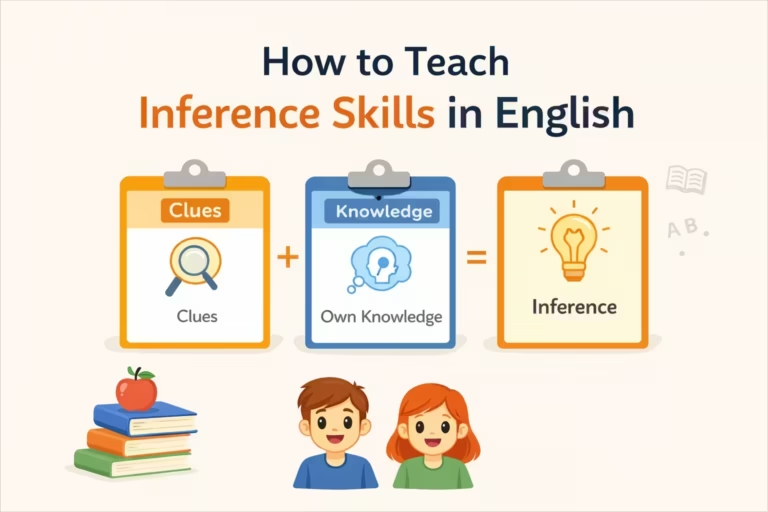
- Teach inference, main idea, and author’s purpose explicitly
- Help students move from literal comprehension to deeper analysis
In my own classroom, I’ve worked with students who could decode words perfectly but had no idea what they’d just read. This is called “word calling,” and it’s more common than many people realize. Recognizing it — and having strategies to address it — is a core ELA teaching skill.
Practical tip: Before assigning a text, pre-teach three to five key vocabulary words and give students a one-sentence summary of the big idea. This simple step dramatically improves comprehension, especially for ESL learners and struggling readers.
2. Writing Instruction Skills
Teaching writing is one of the hardest things an ELA teacher does. Many teachers are comfortable writing themselves but find it difficult to explain the process to students who feel stuck, overwhelmed, or convinced they have nothing to say.
Effective writing instruction involves several layers.
First, teachers need to understand the stages of the writing process: prewriting, drafting, revising, editing, and publishing. Each stage requires different support. Many students — and some teachers — skip the prewriting stage entirely and then wonder why the draft feels scattered.
Second, teachers need to give specific, actionable feedback. “Good job” doesn’t help a writer grow. “Your opening sentence grabs attention, but your second paragraph loses focus — let’s talk about how to connect your ideas more clearly” gives a student something to work with.
Third, teachers need to model writing themselves. When students see their teacher struggle to find the right word, cross something out, and try again, they learn that good writing is messy at first. That’s enormously reassuring.
Classroom example: I used to do what I called “live drafting” — writing a paragraph on the board in real time while thinking aloud. Students watched me second-guess word choices, start sentences over, and edit as I went. The response was always the same: “You make mistakes too?” Yes. Always. That’s how writing works.
3. Spoken English and Oral Communication Skills
This is an area that many ELA teachers underestimate, but it’s essential. Speaking and listening are part of the ELA curriculum for a reason. Students who can express themselves clearly in speech develop stronger writing skills, better reading comprehension, and more confidence overall.
An effective ELA teacher models strong spoken English in the classroom every single day. This means clear pronunciation, varied tone, deliberate pacing, and the ability to explain complex ideas in simple language.
But modeling isn’t enough. You also need to create structured opportunities for students to practice oral communication. This includes:
- Structured academic discussions and Socratic seminars
- Oral presentations and speeches
- Partner and small-group discussions with clear protocols
- Read-aloud activities that build fluency and expression
For ESL learners and ELA teachers working in multilingual classrooms: spoken English practice is especially critical. Students who rarely speak in class fall behind not because they don’t understand, but because they never get the chance to practice producing language. Give them that chance regularly, in low-stakes formats that build confidence before moving to higher-stakes performances.
Pro tip: Start class discussions with a “turn and talk” — thirty seconds where every student tells a partner their answer before sharing with the class. This gives quieter students a safe practice run and dramatically increases participation.
4. Listening Skills — The Underrated Teaching Tool
Here’s something many people don’t expect to see on a list of ELA teacher skills: listening. Not student listening, teacher listening.
Great ELA teachers are exceptional listeners. They hear not just what students say, but what they mean. They notice hesitation, confusion, the half-formed idea that needs a little encouragement to fully emerge. They ask follow-up questions that deepen thinking rather than immediately correcting or redirecting.
In a classroom discussion about a novel, a student might say something that sounds off-topic. A less experienced teacher might move on quickly. An experienced ELA teacher pauses and says, “Tell me more about that.” Nine times out of ten, the student was actually onto something interesting — they just didn’t have the language to express it clearly yet.
This kind of responsive listening is also a model for students. When they see their teacher genuinely engage with imperfect or developing ideas, they learn to do the same with each other.
For online teaching: Listening is even more important in virtual classrooms where body language cues are limited. Pay close attention to tone, hesitation, and what students don’t say. Silence in a breakout room might mean confusion, or it might mean a student needs more processing time. Check in directly and specifically.
5. Differentiated Instruction Skills
Every ELA classroom contains students at different reading levels, from different language backgrounds, with different learning needs and different relationships with literacy. The ability to differentiate — to teach the same content in different ways for different learners — is a non-negotiable ELA teacher skill.
This doesn’t mean creating twenty different lesson plans. It means building flexibility into your instruction.
Some practical examples:
- Offering the same text at different reading levels or in audiobook format
- Allowing students to demonstrate understanding through writing, speaking, or drawing
- Providing sentence frames or graphic organizers for students who need structure
- Giving extension activities for students who finish early and want more challenge
Differentiation is not lowering standards for some students. It’s finding different paths to the same high expectations.
Real classroom moment: I once had a student who was a brilliant thinker but a very reluctant writer. Every essay assignment was a battle. I started allowing him to dictate his ideas into a voice recorder first, then transcribe and refine them. His grades improved significantly, and over time, the gap between his spoken and written expression narrowed. The goal was always strong writing — we just found a different route to get there.
6. Grammar and Language Knowledge — Taught in Context
ELA teachers need solid knowledge of grammar and language mechanics. But more importantly, they need to know how to teach grammar in ways that actually improve student writing — which is not the same as drilling worksheet after worksheet.
Research consistently shows that isolated grammar instruction has little effect on writing quality. What works is teaching grammar in context — pointing out how a professional author uses a dash for emphasis, or how a strong verb choice makes a sentence more powerful, and then asking students to try the same technique in their own writing.
This is called a mentor text approach, and it’s one of the most effective tools in an ELA teacher’s kit.
Example exercise: Take two sentences:
- “The dog ran across the yard.”
- “The dog bolted across the yard, nearly clearing the fence.”
Ask students: What’s different? Which is more interesting? Why? Then ask them to revise one of their own sentences using the same technique. This is grammar instruction that actually sticks.
7. Technology and Digital Literacy Skills
Today’s ELA teacher needs to be comfortable with technology — both for their own instruction and for teaching students how to navigate digital texts, evaluate online sources, and communicate effectively in writing across digital platforms.
This is especially relevant for online teaching, where the entire classroom environment is digital. Effective online ELA teachers know how to use discussion boards, collaborative documents, video response tools, and digital annotation tools to replicate and sometimes enhance what happens in a physical classroom.
But digital literacy also means teaching students to think critically about what they read online. This is a literacy skill, and it belongs in ELA. Teaching students to evaluate a source, identify bias, and distinguish credible information from misinformation is some of the most important work an ELA teacher can do right now.
8. Patience, Empathy, and Relationship-Building
This might feel softer than the other skills on this list, but experienced teachers know it’s foundational. Students do not learn well from teachers they don’t trust.
Building genuine relationships with students — knowing their interests, acknowledging their struggles, celebrating their growth — creates the conditions in which learning happens. An ELA classroom asks students to share their ideas, take creative risks, and be vulnerable. That only happens when students feel safe.
Empathy also means understanding that a student who “refuses to write” might be dealing with anxiety, learning differences, a difficult home situation, or a history of being told their ideas don’t matter. Meeting that student with frustration closes the door. Meeting them with curiosity and patience opens it.
Honest truth: Relationship-building takes time. You won’t reach every student in the first week, or sometimes even the first month. Be consistent, be warm, be clear about your expectations and your belief in their ability to meet them. That consistency, over time, is what builds trust.
Common Mistakes ELA Teachers Make (And How to Avoid Them)
Even experienced teachers fall into these patterns. Being aware of them is the first step to avoiding them.
Assigning reading instead of teaching it. Telling students to “read chapters 1 through 5 for tomorrow” is not reading instruction. Teaching reading means guiding students through the text, building comprehension strategies, and checking understanding along the way.
Over-correcting student writing. When a student’s draft comes back covered in red ink, many students feel defeated rather than motivated to revise. Focus feedback on one or two priorities at a time. Growth is more sustainable than perfection.
Neglecting speaking and listening. These are in the ELA standards for a reason. If your class is mostly silent reading and writing, you’re missing opportunities to develop crucial language skills — especially for ESL learners.
Teaching to the test. Standardized tests are a reality, but teaching only test strategies produces students who can pass a reading test but don’t enjoy or choose to read. Balance skills practice with genuine engagement with literature and ideas.
Not reading yourself. This one stings, but it’s true. ELA teachers who read broadly and enthusiastically model something irreplaceable. Students notice when a teacher genuinely loves books. They also notice when they don’t.
Building Your Own Skills as an ELA Teacher
Developing the essential skills every ELA teacher should have is an ongoing process. No one masters all of these in their first year — or their fifth. Here’s how to keep growing.
Read professional books about teaching literacy. Authors like Kelly Gallagher, Penny Kittle, and Jeff Anderson write practical, accessible books specifically for ELA teachers that are full of classroom-tested strategies.
Observe other teachers. Watch colleagues who are strong in areas where you feel less confident. Ask if you can visit their class. This is one of the most effective forms of professional development available.
Reflect regularly. At the end of each week, ask yourself: What worked? What didn’t? What do I want to try differently? Keep a simple teaching journal if that helps you process.
Connect with other ELA teachers. Online communities, professional organizations, and social media groups offer a wealth of shared resources, ideas, and encouragement. You don’t have to figure this out alone.
FAQs: Essential Skills Every ELA Teacher Should Have
What qualifications do you need to become an ELA teacher?
Most ELA teaching positions require a bachelor’s degree in English, Education, or a related field, plus a state teaching license or certification. Requirements vary by country and region. Many teachers also pursue additional certifications in reading instruction or ESL to strengthen their qualifications.
Is grammar knowledge the most important skill for an ELA teacher?
Grammar knowledge is important, but it’s not the most critical skill. Effective communication, differentiated instruction, and the ability to build student confidence in reading and writing are equally — and often more — important than technical grammar expertise.
How can ELA teachers better support ESL learners in their classrooms?
Focus on building vocabulary explicitly, provide visual supports and graphic organizers, allow students to process ideas in their home language before expressing them in English, and create regular low-stakes speaking opportunities. Relationship-building is especially important for ESL learners who may feel anxious about making mistakes.
What’s the best way to teach writing to students who say they have nothing to write about?
Start with personal experience prompts that feel low-stakes and familiar. Teach students that ordinary moments — a conversation at dinner, a walk to school, a decision they regret — are valid and valuable writing material. Read published personal essays that show students what everyday writing can look like. Writer’s notebooks are an excellent tool for this.
How do online ELA teachers keep students engaged during virtual lessons?
Use varied formats — live discussion, video clips, collaborative documents, quick polls, and partner breakout sessions. Avoid long blocks of lecture. Build in movement or reflection breaks. Create a clear routine so students know what to expect. And prioritize real human connection — check in with students individually, notice when someone seems disengaged, and follow up.
Conclusion
The essential skills every ELA teacher should have are wide-ranging and continuously developing.
From reading instruction to writing feedback, from spoken English modeling to empathetic relationship-building, great ELA teaching is a craft that demands the whole person.
No one gets it perfect. Some days a lesson falls flat. Some students take years to connect with reading and writing.
Progress in ELA is often slow and nonlinear, for students and teachers both. That’s not failure — that’s the nature of language learning and literacy development.
What makes the difference is showing up consistently, staying curious about your students and your practice, and believing — even on the hard days — that words matter, stories matter, and the work you’re doing in that classroom matters deeply.
Keep learning. Keep reading. Keep teaching. The students in front of you are worth every bit of it.
Read more interesting posts here:
- How to Teach Vocabulary Effectively in Middle School
- English Speaking: 150 English Sentences for Common Situations
- Essay: The Impact of Cancel Culture (For Students and Learners)
- Past Simple Tense: Easy Rules, Examples, and Usage Guide
- Business English for Presentations: Useful Phrases & Tips
📚 Continue Learning English
Choose your next lesson and keep improving your English skills with our free English learning resources.