English learning is changing fast, and in 2026, learners have more opportunities than ever to improve their skills. From smart technology to practical speaking methods, the way we learn English today is very different from the past. However, many learners still feel stuck—they understand English but struggle to speak fluently, write confidently, or think in English.
To truly advance your English skills in 2026, you need smart strategies, not just hard work. Practising randomly or memorising rules is no longer enough. What you need are effective methods that focus on real-life communication, confidence, and consistency.
In this article, you’ll discover the top 5 proven ways to advance your English skills in 2026. These tips are practical, easy to follow, and suitable for beginners, intermediate, and advanced learners. If your goal is to speak better English, sound more natural, and use English confidently in daily life or at work, this guide is for you.
1. Create an English Environment Around You
What this means: Surrounding yourself with English in your daily life, even when you’re not formally studying.
One of my students, Mahima from Mumbai, told me she felt stuck at the intermediate level for two years. She attended classes twice a week but spoke Hindi the rest of the time. When she started changing her phone language to English, watching English YouTube videos during breakfast, and listening to English podcasts on her commute, something clicked. Within three months, her comprehension improved dramatically.
How to do this effectively:
For beginners, start small. Change one device to English—your phone is perfect because you use it constantly. You already know where the buttons are, so you won’t get lost. This daily exposure helps you learn practical vocabulary like “settings,” “notifications,” and “battery.”
For intermediate learners, go further. Watch TV shows in English with English subtitles (not your native language). This trains your brain to connect spoken words with written words. I recommend starting with shows you’ve already seen in your language. You know the story, so you can focus on the language itself.
Pro tip from the classroom: One technique I call “narrate your day” works wonders. As you cook dinner, describe what you’re doing in English, even if you’re alone. “I’m chopping onions. Now I’m heating the pan. The oil is getting hot.” It sounds silly, but this transforms passive knowledge into active speaking ability.
2. Focus on Input Before Output
What this means: Listen and read more before worrying too much about speaking perfectly.
Many students make the mistake of trying to speak complex sentences before they’ve heard enough English. Think about babies—they listen for about a year before saying their first words. While you don’t need a full year, the principle holds true.
In my classroom, I had a quiet student named Lin from Singapore. He rarely spoke during the first month, and I worried he wasn’t learning. But he was listening intensely to every conversation. When he finally started speaking, his pronunciation was excellent because he’d absorbed the correct sounds through hundreds of hours of listening.
How to build strong input habits:
For beginners, prioritize listening practice. Use apps like simple English podcasts, children’s audiobooks, or slow-speed news services. The key word here is “comprehensible”—you should understand at least 70% of what you hear. If you understand less than that, the material is too difficult right now.
For advanced learners, challenge yourself with authentic materials. Listen to regular-speed podcasts about topics you’re interested in. If you love cooking, listen to food podcasts. If you enjoy technology, find tech channels. Interest keeps you engaged, and engagement leads to learning.
The reading component: Read something in English every single day, even if it’s just for 10 minutes. Beginners can start with graded readers (books specially written for English learners with controlled vocabulary). Intermediate students should try news articles, blogs, or novels at their level. The magic number is reading for at least 15 minutes daily—this consistency matters more than occasional long reading sessions.
3. Learn Vocabulary in Context, Not Lists
What this means: Learning words as they appear naturally in sentences and stories, rather than memorizing isolated vocabulary lists.
I once had a student who proudly showed me his notebook with 500 words translated into his native language. When I asked him to use “reluctant” in a sentence, he couldn’t do it. He knew the definition but not how the word actually worked.
Why context matters: Words don’t exist alone—they have friends. “Make” goes with “a decision” and “a mistake,” but we “do” homework and “do” the dishes. You can’t learn these patterns from lists. You learn them by seeing words in their natural habitat.
Practical techniques:
When you encounter a new word while reading or listening, write down the whole sentence, not just the word. For example, instead of writing “reluctant = unwilling,” write: “She was reluctant to speak in front of the class.” Now you know the word appears with “to” and describes feelings about actions.
Create a “phrase bank” instead of a vocabulary list. Group useful phrases by situation: “At the restaurant,” “Making small talk,” “Expressing opinions.” When my student Ahmed did this, he stopped translating word-by-word in his head and started thinking in English chunks.
For advanced learners: Start noticing collocations (words that naturally go together). Keep a section in your notebook for these partnerships: “heavy rain” (not “strong rain”), “fast food” (not “quick food”), “make progress” (not “do progress”). Native speakers use these combinations automatically, and learning them makes your English sound more natural.
4. Practice Active Speaking With Purpose
What this means: Speaking with intention and feedback, not just chatting aimlessly.
Speaking is where many learners feel most nervous, but it’s also where you’ll see the fastest improvement if you practice correctly. The key word is “active”—speaking with awareness of what you’re saying and how you’re saying it.
In my conversation classes, I noticed students improved fastest when they recorded themselves speaking for 2-3 minutes about a topic, then listened back. Most had never heard their own English voice before. One student, Lucia, was shocked to realize she was dropping the “s” on plural words. Once she noticed this pattern, she could fix it.
Effective speaking practice:
For beginners, start with structured speaking. Use sentence frames like “I think ___ because ___” or “In my opinion, ___ is important because ___.” This gives you a safety net while you build confidence.
Find a language exchange partner or join online conversation groups. Websites and apps connect learners with native speakers who want to learn your language. This creates a fair trade—30 minutes in English, 30 minutes in your language.
The mirror technique: Stand in front of a mirror and give a 1-minute speech about your day, your weekend plans, or your favorite hobby. Why the mirror? Because you can see your mouth movements, which helps with pronunciation, and it simulates the pressure of having someone’s attention.
For intermediate to advanced learners, practice shadowing. This technique involves listening to a short audio clip (30-60 seconds), then immediately repeating it, trying to match the speaker’s pronunciation, rhythm, and intonation. It’s challenging but incredibly effective for improving your natural flow.
5. Embrace Mistakes as Your Best Teachers
What this means: Changing your mindset about errors from something shameful to something valuable.
This might be the most important point of all. In Korean culture, one of my students explained, making mistakes feels like losing face. She would stay silent rather than risk an error. But here’s the truth I share with every student: mistakes are not failures—they’re data. Each mistake tells you exactly what you need to work on next.
Why this matters psychologically: Research in language learning shows that students who embrace mistakes learn faster than perfectionists who stay in their comfort zone. When you say something incorrectly and someone corrects you, that correction creates a strong memory. You’ll remember that lesson far longer than something you just read in a textbook.
How to use mistakes productively:
Keep an “error journal.” When you make a mistake (in writing, speaking, or even in your thoughts), write it down on the left side of the page. On the right side, write the correction. For example:
- Mistake: “I am living here since 2020.”
- Correction: “I have been living here since 2020.”
- Rule: Use present perfect for actions that started in the past and continue now.
Ask for correction strategically: Tell your language partners: “Please correct me when I make grammar mistakes with past tense verbs.” Specific requests work better than “correct everything,” which can interrupt the conversation flow.
Celebrate your mistakes. I’m serious. When you catch your own error, that’s progress. It means your internal monitor is working. I had a student who started saying “Yes! I caught myself!” every time she noticed a mistake. This positive reinforcement made her braver about speaking.
Bringing It All Together
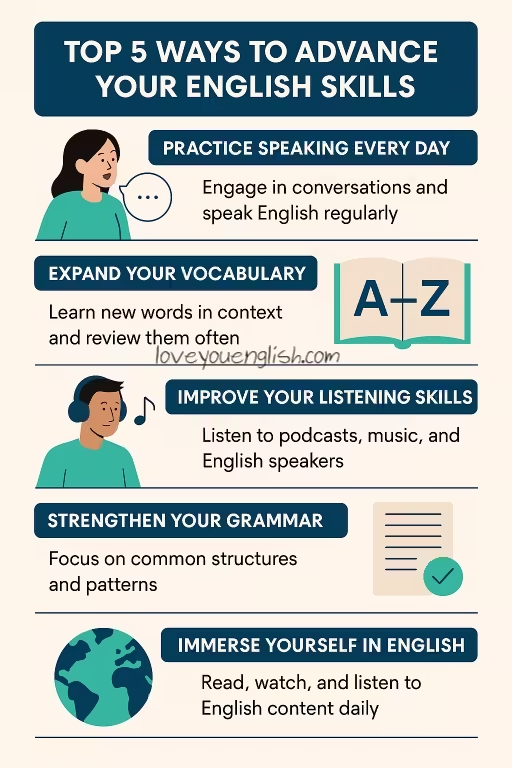
Learning English is not about finding one magic method. It’s about combining consistent habits that work together. Create an English environment, fill your mind with input, learn vocabulary in context, speak with purpose, and treat mistakes as stepping stones.
Remember, advancing your English is a marathon, not a sprint. My most successful students share one quality: consistency. They practice a little bit every day rather than cramming once a week. Even 20 minutes of focused daily practice beats a three-hour session on Sunday.
Start today with just one of these five methods. Next week, add another. Before you know it, these practices will become habits, and those habits will transform your English.
You’ve got this. Every word you learn, every sentence you speak, every mistake you make is moving you forward. Keep going.